Hungary publishes ATM decree with threat of huge fines


Economy Minister Márton Nagy made it clear in a Facebook post on Monday that they would not let banks to decommission ATMs.
ATMs in every settlement! We have decided: all existing ATMs must be operated, no decommissioning!
The government decree published last night also revealed the means by which the government intends to achieve this.
State of danger for five years
The ruling coalition of Viktor Orbán’s Fidesz party and the Christian Democrats (KDNP) have legislative majority in Parliament. Not that they need it. The Orbán cabinet declared the first state of danger five years ago, on 11 March 2020 due to the coronavirus pandemic. Since then, with the exception of a few months, it has maintained a system of "rule by decree", which allows the government to override acts from one day to the next.
After the 2022 elections, Prime Minister Viktor Orbán introduced a new state of danger with the 10th amendment to the Fundamental Law, referring to the Russian-Ukrainian war. The state of danger was extended every six months by the Fidesz majority in parliament. The last extension, citing the war, took place last November, until 18 May 2025.
The Orbán cabinet has not been shy taking advantage of this opportunity to adopt hundreds of emergency decrees, many of which had no connection either to the pandemic or the war in Ukraine and only serve the government’s political purposes. Just two examples: 1) The possibility of dismissing teachers involved in civil disobedience with immediate effect was created on the grounds of a state of war. 2) Also on the pretext of war, in 2022 the government decreed that public spaces could be used free of charge for the 20 August fireworks, which were postponed for a week.
The decree stipulates the following:
From the date of entry into force of this Regulation,
- a credit institution operating an automated teller machine (hereinafter "ATM") may not, in order to provide a service allowing cash payments from a payment account, cease to operate an existing ATM, with the exception of the replacement of an ATM, or
- cease to provide a service allowing cash withdrawals from a payment account of a branch.
In the event of a breach of the above rules, the National Bank of Hungary (MNB) will impose
a fine of between HUF 2 million and HUF 200 million on the operator.
Prime Minister Viktor Orbán's government is gearing up for the 15th amendment of the Fundamental Law (i.e. Constitution). Upon its inception on 1 January 2012, the PM described the Fundamental Law to be "as solid as granite", while it was last amended for the 14th time on 27 December 2024. The use of cash is now to be protected by the Constitution that will state: "everyone has the right to pay with cash."
The other amendment proposals are:
(i) the article on families will say that a person is either male or female. (They even brought religion into the picture, as this is the actual text of the proposal: "The sex of a human being at birth is a biological given which, in the order of creation, can be either male or female.");
(ii) the protection and care necessary for the proper physical, mental and moral development of children takes precedence over all other fundamental rights except the right to life. (This the grounds on which they are planning to ban the Pride march of the LMBTQ+ community.);
(iii) The proposal allows for the suspension of the Hungarian citizenship of several citizens who pose a threat to public order, public security or national security in Hungary. A person whose citizenship is suspended may be expelled from the territory of Hungary;
(iv) The amendment also prohibits the production, use, distribution and promotion of drugs in Hungary.
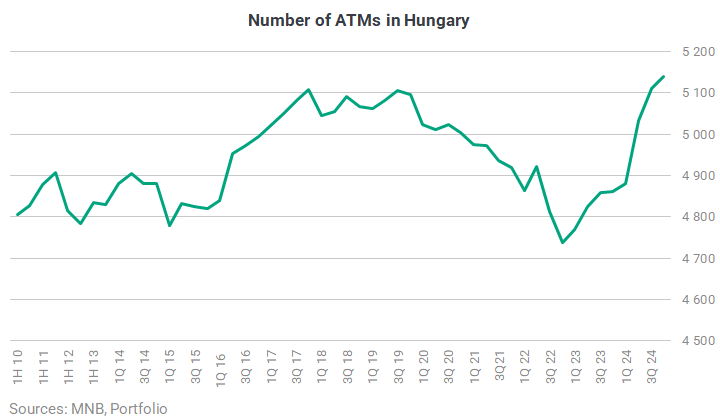
According to MNB statistics, there were 5,140 ATMs in Hungary at the end of 2024, while the number of ATMs operated by banks is currently estimated at around 4,400.
In order to have at least one ATM in every municipality, we estimate that
the banking sector will need to install at least 2,000 new ATMs.
This could cost around HUF 12-16 billion initially if banks buy the simpler, cheaper machines. Then there are the costs of operation, maintenance and cash logistics.
The MNB already had a plan that was working
In February 2023, the MNB's Banknote Regulation was published, which provided for the expansion and reweighting of the bank ATM network. The introduction of the regulation was not without results:
Compared to the end of the first quarter of 2023, there were 371 more ATMs in Hungary at the end of 2024, an increase of almost 8%.
The central bank has been aware of the problem of the shrinking infrastructure for public access to cash for years. While the Covid-19 pandemic led to a strong digitisation boom, it also meant that banks started to increasingly scale back their cash infrastructure.
By the end of 2022, the number of ATMs in operation at banks fell below 4,000 compared to 2019, with more than 400 ATMs decommissioned, and the number of cash desks also decreased significantly, the MNB said in an earlier article published on Portfolio.
This is why, in consultation with the banks, a concept was developed that would not allow the domestic ATM network to wither away. The aim was to facilitate access to cash in rural areas where it may not be commercially viable to operate a branch or ATM.
- On 1 February 2023, an amendment to the MNB's Banknote Regulation came into force, which included new provisions on the central bank's requirements for the minimum number of ATMs operated by banks.
- On 27 February 2024, an amendment to the regulation came into force, obliging banks to close their cash desks only if their turnover is in permanent decline and cash transactions can be transferred to machines.
The former legislation determines the number of ATMs to be operated by banks primarily on the basis of the number of payment cards with cash functionality issued by them.
Debit cards issued have a weight of 1 and credit cards have a weight of 0.5. On the basis of this indicator, the MNB has defined four categories and for each of them it sets an expected average number of ATMs available per three groups of municipalities (metropolitan area, county seat, other municipalities in the county).

In addition, the Banknote Regulation stipulates that credit institutions issuing between 600 000 and 1 200 000 payment cards must operate ATMs in at least 65% of the cities outside the county (214 cities) and credit institutions issuing more than 1 200 000 payment cards must operate ATMs in 80% of the cities outside the county (263 cities).
This is what the domestic ATM network looked like at the end of 2023, according to Portfolio's research. Since then, according to MNB statistics, the network has continued to expand:
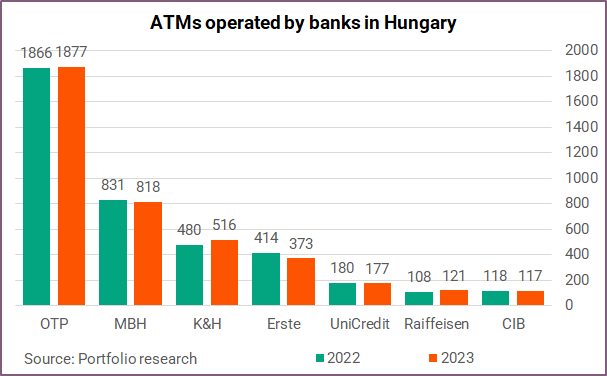
In addition to geographical coverage, it is also expected that the average annual cash withdrawal turnover per ATM and the average annual deposit turnover per ATM with a deposit function should not exceed the benchmarks set by the MNB. The benchmarks are set on the basis of the ATM cash withdrawal and deposit turnover of the previous year(s), which are reviewed by the MNB every three years.
Cash withdrawal in stores yet to take hold
At the end of 2022, it was announced that twice a month, up to a total of HUF 40,000, cash can be withdrawn free of charge from shops when paying by card - provided, of course, that the shops also introduce the service.
Since then, we have made several enquiries with the major retailers to see if they would introduce the service, but so far there are very few retailers who have taken up the offer or are planning to do so. The service was already operating on a market basis at Penny's tills before the regulation, but only with certain OTP cards, and we have heard of one or two small shops in the countryside already trialling cashback.
Cover image: Shutterstock





