Eagerly-awaited data shows how much wages will rise in Hungary this year


January's wage data are crucial. Because as fast as wages grow in the first month of the year, they are expected to grow at a similar rate in the following months.
Surveys of business associations' and companies' wage hike plans predicted a small increase, while economists expected a rise of 8-10%. A new preliminary report from the Central Statistical Office (KSH) has put the issue to bed:
In January, gross earnings rose by 10.4%, while businesses increased earnings by 9.9%, which exceeds even optimistic analyst expectations.

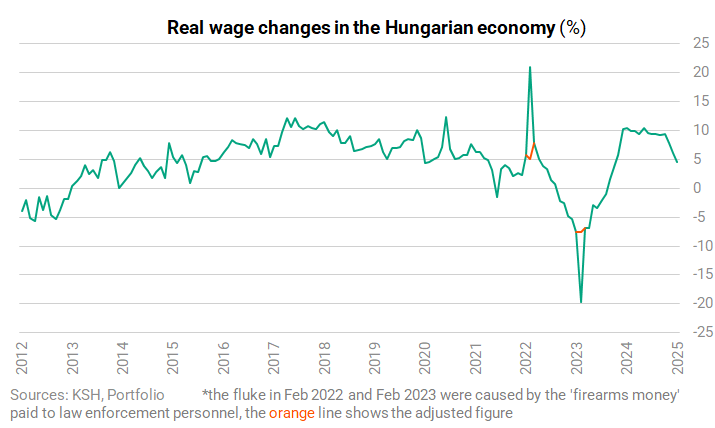
As the chart above shows, wage growth is slowing, but this is not surprising. We have already emerged from a period of inflation above 10%, so earnings growth is not growing as fast.
- The average gross earnings of full-time employees amounted to HUF 668,100, which was 10.4% higher than in the previous year.
- Average net earnings reached HUF 444,300 excluding tax benefits and HUF 459,000 including tax benefits, up 10.4% and 10.2% respectively year-on-year.
- Median gross earnings were HUF 539,500, 9.3% higher than a year earlier.
- Median net earnings, according to Portfolio's calculation, were HUF 359 000.

Almost two thirds of workers earn less than the average wage, while the median is the wage level at which half of the workers earn less and half earn more. This is why the majority of workers feel that they earn less than the average wage. Ultimately, they are right, because the 'average person' is paid the median.
However, with earnings growth slowing slightly compared to last year, while inflation has exceeded expectations (5.5% in January), the rate of growth in the purchasing power of wages is falling.
Real earnings rose by 4.6% on an annual basis, down from 6.1% in December last year.
It is particularly interesting that, for the umpteenth time, business surveys are anticipating a much more modest rate of wage growth than is being achieved. This year, in addition to general factors, they may have been influenced by specific issues related to the economic environment.
- In almost every pay survey, companies 'promise' a slightly smaller pay rise than they actually deliver. Whether they do this to manage expectations, or whether they actually plan to do less than they are forced to do, we do not know. But the experience of recent years shows that companies have consistently raised wages more than they announced in advance.
- Companies certainly have a different view of the labour market situation than economists. While the majority of macroeconomists stress the tight labour market, the still significant shortage of labour and low unemployment, it is also apparent that more and more companies have been forced to cut staff due to the weak economic situation and talk of the end of the period of "labour hoarding". All in all, unemployment of 4.4-4.5%, 70,000 job vacancies and a very high employment rate do not suggest a very slack labour market, although we are certainly a long way from 3% unemployment and 100,000 job vacancies. But let us not forget:
The labour market situation in 2016-17 was virtually the same as it is now - and we talked then about the upward impact of labour shortages on wages.
- Businesses would certainly have preferred to increase the wages of most employees by less than the increase in the minimum wage and the guaranteed wage minimum (9% and 7% respectively). However, the central increase in the lowest wages also pushes up median and average wages. To avoid wage congestion, therefore, it is not only the lowest-paid workers who need a substantial wage increase, i.e. central wage setting up to the median wage will become a matter of course. Moreover, this year it seems very likely that the wages of even high earners will have had to be increased substantially.
In addition, this year most minimum wage earners only received the mandatory increase from their employers, while those in the 4th and 5th income quintiles received increases of over 10%.

It will be interesting to see how the wage data per income quintile develop later in the year, as the first month of the year may well have been boosted by executive pay adjustments and public sector pay rises (e.g. in education), while sectors that typically pay at the minimum wage or skilled worker minimum wage are suffering from weak economic performance.
Overall, the January earnings data were not only higher than the results of the company surveys, but also exceeded analysts' expectations. This shows that the position of workers remains strong. Meanwhile, the purchasing power of earnings is being eroded by the renewed rise in inflation. This is because the consumer price index is likely to be higher than previously expected, not just for January but for the year as a whole. So last year's real wage growth of over 9% could be around half that this year.
Cover image (for illustration purposes only): Getty Images