Hungary sits on a mountain of debt that will be difficult to overcome, warns EC


The Ministry of National Economy (NGM) has reacted to the Commission's opinion in a statement. They say that Hungarian public debt will continue to fall this year and in the coming years.
The European Union, which is about to increase its defence spending, could face a lot of difficulties for member states' budgets if they embark on a massive spending spree, according to the European Commission's Debt Sustainability Monitor for 2024. The analysis predicts only a modest economic recovery in the European Union, with real GDP growing by just 0.9% in 2025, accelerating to 1.5% in 2025 and then expanding to 1.8% in 2026. On the positive side, growth last year was driven by stronger consumption and a rebound in investment in the EU, which could be complemented this year by the expected military boom.
According to the EU report, the disinflationary trend since the end of 2022 will continue: while EU inflation was 6.4% in 2023, it slowed to 2.6% in 2024 and could fall to 2.0% in 2026, in line with the European Central Bank's target, signalling a return to price stability.
The EU's aggregate budget deficit, which reached 6.7% of GDP in 2020 due to the pandemic, has been gradually declining in recent years. Last year it was only 3.1%, while it could have fallen to 2.9% by 2026, according to the DSM report, if member states had not started to increase defence spending. The decline so far has been driven by discretionary fiscal austerity and revenue surpluses, despite weak economic activity and rising interest expenditure.
Partly in response, the European Commission is proposing that defence spending should not be included in member states' deficits up to 4.5% of GDP.
The EU's aggregate debt-to-GDP ratio in 2023 was 82.1%, well below the peak of over 90% reached during the pandemic, the report highlights. However, by 2026, the EU average could rise to 83.4%, driven by deteriorating interest rate differential growth and persistent primary deficits. Debt ratios in most member states will be lower than in 2020, but six countries - Belgium, France, Greece, Italy, Portugal, Greece and Spain - could still have debt levels above 90%.
Hungary faces serious risks
Hungary faces a particularly challenging budgetary situation, according to the Commission's analysis. Although the country's debt ratio may be lower compared to 2020, it remains one of the eleven Member States identified as being at high risk of unsustainable fiscal positions in the medium term.
The Hungarian debt dynamics are defined by a declining but still high budget deficit and still high public debt. Interest rate differentials support debt reduction, but to a lesser extent than before, the report says. Government gross financing needs remained high in 2024, although the lengthening of the average maturity mitigates short-term risks.
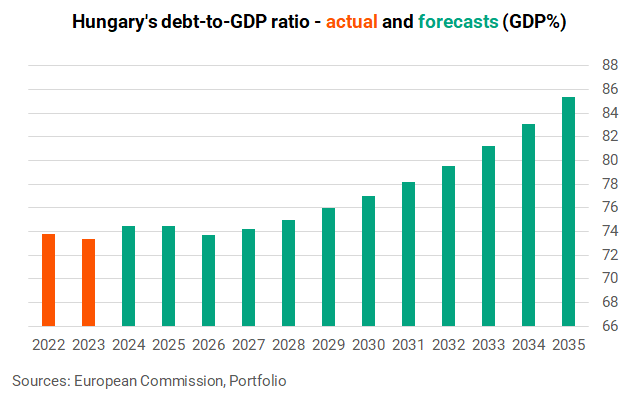
In its Debt Sustainability Report, the European Commission projects medium-term fiscal sustainability risks for the period 2022-2035, with
the gross public debt ratio increasing gradually from 73.8% in 2022 to 85.4% in 2035.
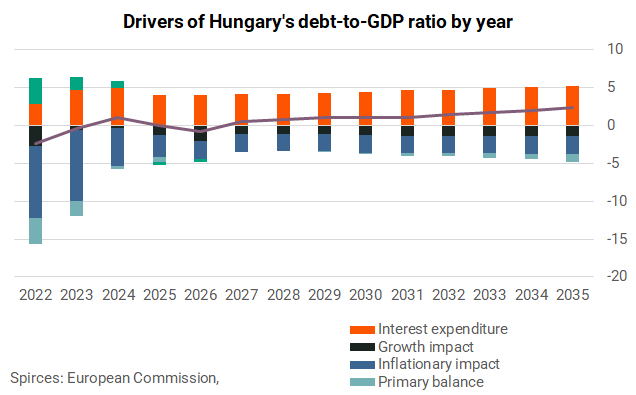
The evolution of the debt ratio is influenced by several factors: the primary balance, the snowball effect and other debt modifiers.
The snowball effect means that public debt can automatically increase even if the government does not borrow new money because interest costs rise faster than economic growth. This is particularly dangerous if the interest rate is higher than the rate of GDP growth.
The primary balance, which reflects the deficit excluding interest expenditure, improves from minus 3.4% to -1.0% between 2022 and 2035.
This improvement is largely underpinned by the evolution of the structural primary balance (SPB), which takes into account the costs of ageing (such as rising pension and health care expenditure) and other structural factors, according to the Commission.
The “snowball effect” is a positive impact on the debt ratio of minus 9.3% in 2022 (mainly due to inflation), but by 2035 it turns into a negative impact of plus 1.3%. This change is mainly due to a reduction in the impact of inflation and a stabilisation of interest expenditure. Other debt adjustment items, such as exchange rate effects and accounting items, also decrease, from 3.5% in 2022 to 0% in 2035, indicating a reduction in the associated impact.
The structural balance, which shows the state of public finances after removing cyclical factors, improves from -7.3% to -6.1% by the end of the period, but this still points to a persistent, deep structural deficit. Meanwhile, the gross financing requirement, which represents the resources to finance the budget deficit and debt renewal, rises from 14.7% to 18.1% by 2035, pointing to an increase in financing challenges.
The risk assessment should take into account several factors that increase the Hungarian public debt. These include the relatively high share of foreign currency debt, close to 30%, which poses an exchange rate risk, according to the European Commission. The higher the foreign currency debt ratio, the higher the increase in government debt if the forint falls.
In recent times, the European Commission has increasingly seen the inward indebtedness of a country to its own banking system as a risk factor. Their logic, in simple terms, is that too much interdependence could lead to liquidity problems for both the state and the banking system in the event of a financial shock.
Unsurprisingly, they now see a risk factor in domestic banks' exposure to strong government bonds, which they see as a financial stability risk. Likewise, the need for refinancing due to large amounts of maturing retail government bonds is seen as a potential source of problems; as well as the significant contingent liabilities arising from government guarantees, which could put a strain on the budget.
At the same time, the diversification of Hungary's public debt financing, relying on international bond markets, retail government bonds and the domestic financial sector, is seen as a positive factor.
The European Commission's deterministic stress tests show further vulnerabilities for Hungary. To test this, a model was constructed based on various hypothetical external shocks - a deteriorating inflation environment, external financing problems - and their expected effects were assessed on the basis of the current structural situation. Thus, the report shows that in the case of an adverse interest rate differential increase - if it deteriorates by 1 percentage point compared to the baseline scenario with the European Central Bank's expected level of below 2% - the debt ratio could exceed the baseline path by about 7 percentage points by 2035. In other stress scenarios, such as lower structural primary balances or temporary financial stress, the debt ratio could be about 1 percentage point higher in 2035.

The stochastic projections, which take into account uncertainty factors such as extreme changes in economic growth, inflation or interest rates, indicate a medium risk, as the probability of debt growth over the next five years is medium.
The Commission's simulations suggest that in the short term, there is no certainty that public debt will increase: there is a 54% chance that debt-to-GDP ratios will be higher in 2029 than in 2024.
Geopolitical risks, such as Russia's war in Ukraine and tensions in the Middle East, create further uncertainty in the short term. They point out that protectionist measures by the US could curb world trade, which would negatively affect the EU's open economy, including Hungary.
Weak productivity and delays in the implementation of the Recovery and Resilience Facility (RRF) will further increase the challenges, both domestically and across the EU, according to the Commission.
Cover photo (for illustration purposes only): Getty Images





