Is Hungary's budget in trouble already?


The first three months of this year have passed and the negative risks to the Hungarian economy that we have already identified are beginning to materialise, so it seems time to assess the state of this year's budget. At first glance, there are not many positive developments:
- In March, the deficit was HUF 831 bn, the second highest deficit for the month in 24 years.
- In the first quarter, the central sub-system of general government (excluding local governments) accumulated a deficit of HUF 2,554.1 bn, the highest ever recorded.
- The three-month deficit is 62% of the annual cash deficit plan.
What nuances the picture is that there are factors that the government could have anticipated:
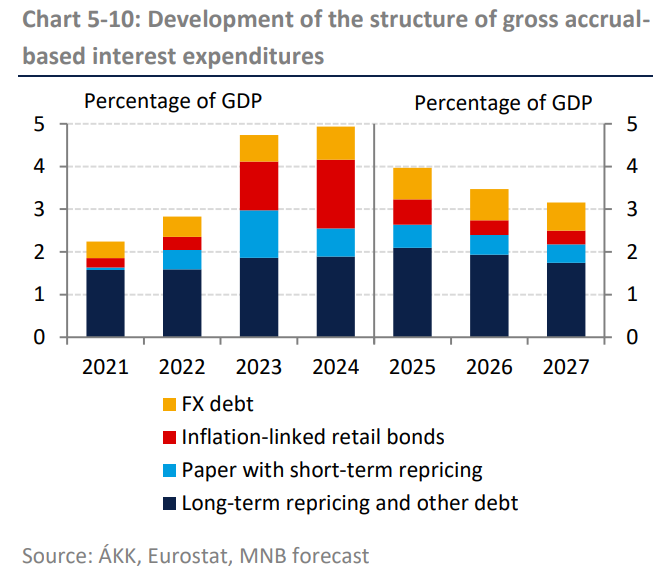
- In March alone, interest expenditure amounted to HUF 515 billion, 33.5% higher than in March 2024, and in the first quarter it has already reached HUF 1,553 billion, 25% higher than in the first quarter of last year. The fact that 40% of the annual interest expenditure target was reached in the first three months of the year, the same as a year ago, is a warning sign. The front-load interest expenditure reinforces this type of course for the whole budget.
- Within interest expenditure, interest on PMÁP retail government bonds also increased in March this year, with around HUF 284 billion spent on this item in the third month of this year, compared to HUF 250 billion last year.
And there are some factors that will have a positive impact on fiscal developments this year:
- According to Portfolio's calculations, net VAT revenue in March was HUF 666 billion, 7.8% higher than in March last year. In the first quarter, HUF 1,913 billion of net VAT enriched state coffers, an increase of 16.1%.
- Another very important positive development for VAT receipts is that in the first three months of the year, 23.1% of the annual VAT revenue target was met, compared to 19.2% in 2024.
What to be expected in 2025?
On the basis of these factors, the 2025 budget is not necessarily reassuring at first glance, at least as regards the sustainability of the original 3.7% deficit target, but
it is not to say that the budget is in tatters and close to collapse after only three months of this year.
It should be recalled that in recent months the government has left the 2025 deficit target unchanged, but at the end of February raised the 2026 deficit target as a share of GDP to 3.6% from 2.9%. While it is too early to make a final judgement on whether this year's deficit target will be met or missed, it is worth summarising what is happening in the budget.
In its quarterly Inflation Report published at the end of March, the central bank said "the fiscal deficit may decrease further in 2025, supported mainly by declining interest expenditures and rising tax revenues as economic growth picks up." The MNB expects the accrual (ESA) balance of the general government sector to be in the range of 3.5–4.3% of GDP this year, while in December it forecast a 3.4-4.2% range, i.e. it now expects a marginally worse outcome. It said that
with adequate expenditure control the deficit target of the government is achievable.
If we take the median of the updated estimate, the budget deficit could be 3.9% this year, slightly higher than the official target of 3.7% (the MNB forecasts this assuming inflation of 4.5-5.1% and GDP growth of 1.9-2.9%).It is worth noting here that the central bank stresses the need for "adequate expenditure control" to achieve the target.
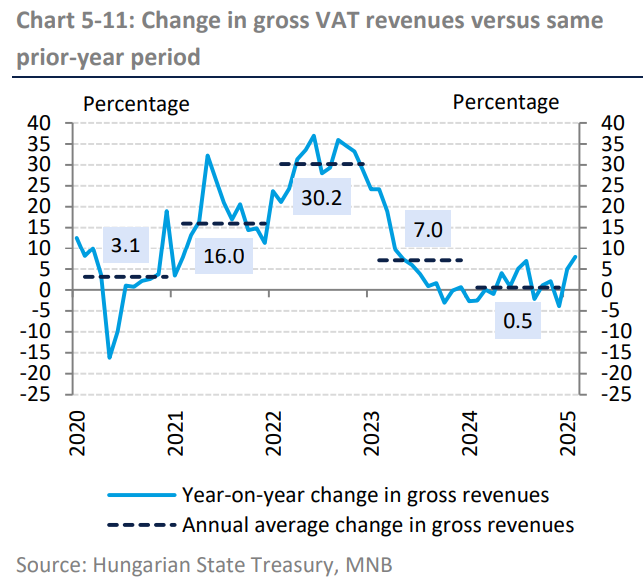
The MNB staff believes that cash-based tax and contribution revenues may be close to the 2025 Budget Act appropriations. This is supported by the fact that VAT revenues, which are the main pillar of the Hungarian tax system, exhibited a significant increase at the beginning of this year.
"Gross VAT revenues rose by 5% in January and by nearly 8% in February in year-on-year terms. In addition to the favourable macroeconomic outlook, the measures adopted in 2024 (e.g. inflation-indexed increases of certain taxes, extending the scope of windfall taxes) will also contribute to the growth in tax revenues this year. As energy prices stabilise at a lower level, a decline is expected in expenditures related to the utility cost reduction measures. As our current inflation projection exceeds the 3.2% rate of the macroeconomic assumption forming the basis for the 2025 Budget Act, pensions and the material expenditures of institutions are expected to increase."
Analysts at OTP Bank projected in a research note last week
A 4.8% deficiti for this year under a no-policy-change scenario, while three months ago they still expected a 4.5% gap.
They stressed that there is a negative risk of further easing before the parliamentary elections. As the effect of currently announced tax measures kicks in, a further deterioration is projected in 2026 (to a deficit of 5.2% of GDP) in a no-policy change scenario without further measures. This could mean that the deficit will be among the highest ones in the region (only the extraordinarily high deficit in Romania will be above it).
We should note at this point that Hungary's ESA-based fiscal deficit was 4.9% of GDP in 2024. Playing with the idea that there could be a scenario in which external circumstances turn out to be such that the government is satisfied with just a minimal reduction in the budget deficit this year compared to last year, the government still has 1.1 percentage points of "room to manoeuvre" compared to the original target of 3.7%, which is over HUF 900 billion in nominal terms.
Risks and side-effects
The above shows that there are significant question marks over the achievement of this year's target and that there are other risks that could lead to a deviation from the budgetary path:
- Higher inflation means that the state will have to pay a pension supplement in the autumn. The Economy Ministry expects an extra expenditure of HUF 91 billion, but an extra expenditure of more than HUF 160 billion is not excluded.
- Higher inflation will undermine the government's strong commitment to spending restraint this year.
- This year's budget adopted by Parliament does not include the personal income tax exemption for mothers with three children, which will come into effect in October, the VAT refund for pensioners (on purchases of vegetables, fruits and selected dairy products) expected in the second half of the year, and the PIT exemption to be introduced for the infant care allowance (CSED) and childcare fee (GYED) from July 2025. According to MNB calculations, this will add 0.13% of GDP to this year's budget deficit.
- The weakening of the forint is not favourable for interest expenditure.
- Lower real GDP weakens the fiscal fundamentals, but it should be quickly added here that higher-than-planned inflation could also lead to higher nominal GDP, which in turn helps the indicators as a percentage of GDP due to the higher denominator.
- The loss of growth caused by the tariff war and its risks for the Hungarian economy, even in the short term, is a new issue. For the time being, there is a lot of uncertainty, everyone is guessing how much worse the GDP growth trajectory will be in the world, in Europe and in the Hungarian economy, but analysts agree that this is a negative development and could be another blow to the Hungarian economy.
Even some recent years are more of a reminder than anything else. Indeed, when we have seen similar deficit trajectories (most recently in 2022 and 2023), the government has had to make significant fiscal adjustments during the year (a series of deficit target revisions, adjustment packages, investment postponements, tax increases, special taxes).
This year, however, the year before the 2026 general election, the analyst community does not think it realistic for the government to tighten the fiscal reins (but neither do the rating agencies and investors) - quite the contrary.
Conclusions
All in all, earlier fears that no significant reserves had been built into this year's budget, so that the negative risks that are now emerging and the balance-worsening effects of the newly planned economic policy measures "cannot be absorbed", have been confirmed.
As things stand, the most likely scenario is that there will be a small slippage in the 2025 budget, but the larger slippage will be limited by the fact that, on the revenue side, VAT receipts are set to recover massively as economic growth and consumption pick up. (The impact of the return of higher inflation will also be felt here, as VAT is levied on more expensive goods, leading to rising VAT receipts as demand increases.)
The biggest risk is precisely the ability to meet this year's deficit target, which is difficult to predict in advance: how much the government will be in a spending mood this autumn, and to what extent it will start making major election promises in 2025 (which could explicitly worsen this year's budget) beyond the "family tax haven" measures already described.
It will therefore be worth keeping a close eye on the preliminary monthly public finance data at the beginning of each month, because if they still paint a better picture than currently expected (or at least do not show a further deterioration in the deficit trajectory compared to previous years), the government will have an increasing to loosen the purse strings.
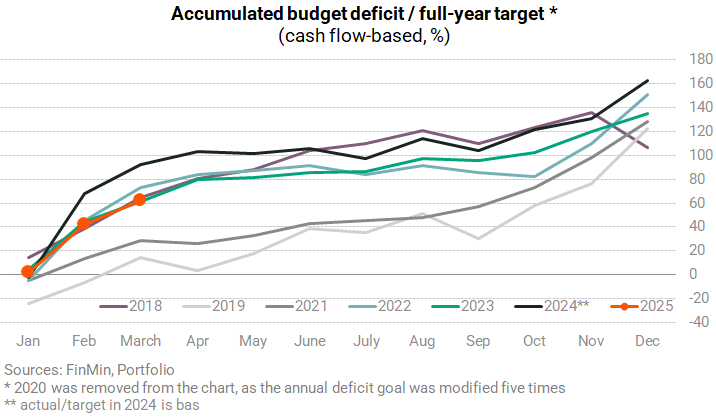
Looking back over the longer term, after years of deficits above or around 7%, the time may come for a budget deficit of around 5%. This would allow the government to comply with the EU budget rules (which are in flux anyway due to increased military spending) and to reassure investors and rating agencies (by claiming that the deficit will not be out of line with other countries).
It's another question what the consequences of a deficit stuck so high will be for debt and interest payments.

Cover image (for illustration purposes only): Getty Images





