Credit rating agency review of Hungary due after dire warnings


On Friday, the Hungarian economy will receive yet another assessment when Standard & Poor's (S&P) publishes its latest decision on the country's sovereign debt rating.
Although the rating agency did not change its 'BBB-' rating, just above junk, and maintained a stable outlook in its review last October, downgrade risks included fiscal and macroeconomic difficulties and pre-election spending ahead of what S&P said were fiscal risks.
And the February interim report could be seen as an explicit warning - especially on fiscal sustainability and debt developments.
Stable outlook with serious warnings
At the end of October, S&P affirmed Hungary's 'BBB-' investment grade rating and stable outlook. They argue that the economic recovery, disinflation and falling interest costs provide the government with an opportunity for fiscal consolidation. At the same time, they made clear that there are a number of downside risks to the fundamentals.
The main negative factor identified was the upcoming general election in 2026, which could lead the government to postpone the necessary fiscal tightening. Other risks cited include:
- the budget deficit expected to be well above the government's target in 2024-27;
- the high debt-to-GDP ratio (expected to be 74.6% in 2024 - which eventually came in lower at 73.5%);
- significant interest expenditure;
- costly and potentially inflationary stimulus measures; and
- continued uncertainty about EU funding.
While a favourable path for inflation was outlined, they also warned that the exchange rate, wages and energy prices remained sensitive variables. The exposure of the export-dependent economy to the German business cycle and geopolitical tensions was also highlighted.
February report: sharper tone, louder fiscal warnings
In February 2025, S&P issued another detailed and stern warning on Hungary.
It was more explicit: the government's pre-election spending promises pose significant economic risks.
The personal income tax exemption for mothers was highlighted as potentially costing hundreds of billions of forints in lost revenue by 2026 and beyond - potentially worsening the deficit ratio by 0.4-0.5 percentage points of GDP in 2025 and 2026.
According to the February forecast,
- public debt could peak at 77% in 2026 (against the government's target of around 71%),
- the budget deficit could be much higher than officially planned, and
- failure to achieve fiscal consolidation could jeopardise the stability of the forint and hence interest expenditure.
Detailed calculations of the budgetary impact of tax exemptions have been published, showing that more than HUF 800 billion could be lost from public revenues by 2029. The further extension of family tax benefits, the VAT refund promised to pensioners and the new CSED/GYED tax benefits will further worsen the balance.
Mothers with three children will be exempt from personal income tax for lifetime from October 2025; the exemption for mothers with two children will be phased in from 2026 gradually based on age of the persons, while mothers under 30 with one child will be exempted from personal income tax from 2026. In addition, a personal income tax exemption will be introduced for the infant care allowance (CSED) and childcare fee (GYED) from July 2025.
External risks: loss of EU funds and German weakness
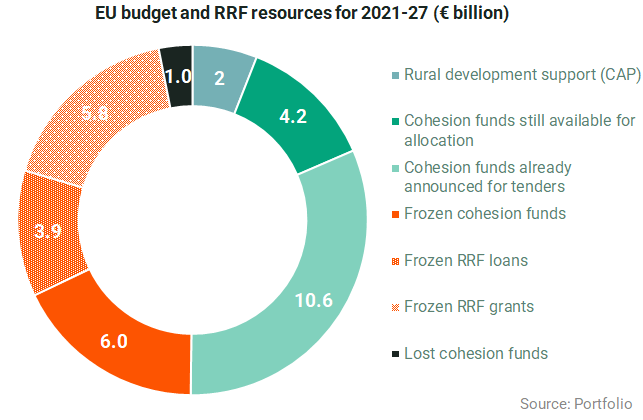
The rating agency is also increasingly focusing on access to EU funds. In February, it highlighted that Hungary has already lost more than €1 billion by the end of 2024 due to the N+2 rule and the daily fine imposed by the European Court of Justice last June. The country loses €1 million a day for breaching asylum rules, which the European Commission deducts from cohesion payments.
S&P said in February and last October that the loss of EU transfers could put increasing strain on the budget, while capital inflows could also slow.
There are signs of this: there is a barely 7% margin left for the government to bid for EU funds that have not been blocked.
The other major external risk at the beginning of the year was seen as the weakness of the German economy. Germany's previous GDP growth forecast of 1.2% in 2025 was cut to 0.5%, which directly hurts Hungarian export prospects, which are highly integrated with German industry.
Moreover, these developments took place before the tariff war: although Donald Trump has suspended reciprocal tariffs in the US for 90 days, which would impose an additional 20% burden on EU imports, the 25-25% special taxes on automotive and metal products remain in force.
According to analysts, this could hurt the country's growth prospects, both directly through the Hungarian economy and indirectly through the German economy.
How is Hungary doing now?
The latest data show that while Hungary is technically out of recession, the recovery remains fragile. GDP grew by just 0.5% in the fourth quarter of 2024 compared with the previous quarter and by just 0.1 % on an annual basis. Only the services sector kept growth alive, while industry and construction remained in recession.
The manufacturing sector contracted for the fifth consecutive quarter and in February was already down 8% on an annual basis.
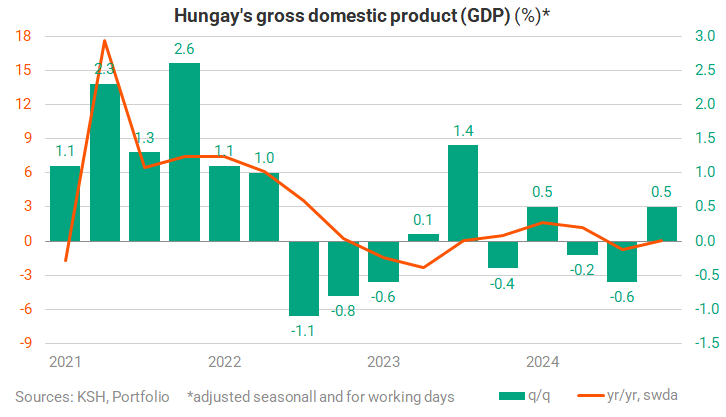
Investment contracted by 12% in 2024, and while some large new factory capacities coming on stream at the end of the year (BMW, BYD, CATL) could boost GDP, their impact could only partly offset the overall weakness. The export outlook is further undermined by the possibility of an escalation in the EU/US tariff war, which is leading many sectors to adopt a wait-and-see approach.
At the same time, the Hungarian economy remains on a recovery path, although the expected momentum has been steadily declining in the past and in forward-looking expectations.
inflation retreated to 4.7% year-on-year in march, but core inflation remains high at 5.7%.
The MNB is therefore not expected to change its interest rate policy and will continue to stress the importance of exchange rate stability.
In addition, the forint has also started to weaken in the uncertain market environment caused by Trump: although it has strengthened by roughly 1.3% compared to the beginning of 2025, it has already eased by more than 3% compared to the beginning of January in the tariff war environment.

State budget: the biggest landmine in the field
The biggest question mark in the eyes of the rating agency remains the fiscal path (at least according to its previous communication). As we reported, March saw a record deficit of HUF 831bn and the first quarter deficit has already reached 62% of the annual target.
The three-month cash deficit stands at HUF 2 554 billion, an unprecedented level.

Interest expenditure is also higher on a pro-rata basis: 40% of the annual interest target was reached by the end of March. It should be added, however, that (as can be seen from the graph above) the front-loaded trajectory of the budget deficit during the year is far from unique and is in fact typical, so it is not yet worth talking about a dramatic overshoot of the deficit target - but it is worth talking about palpable tensions.
The economy ministry has so far not changed its 3.7% of gdp deficit goal for 2025, but it did raise the 2026 target to 3.5% from 2.9% previously.
With regard to S&P's rating, it is important to note that the central bank and several analysts (e.g. OTP) believe that an actual deficit of around 4.5%-4.8% is more likely. On the revenue side, the March public finance data show an improvement - VAT revenues rose by 16% - but on the expenditure side, as S&P warns, the promised and partly already implemented social and electoral measures will have a strong offsetting effect.
In its quarterly Inflation Report at the end of March, the central bank said that "adequate expenditure control" was needed to meet the fiscal targets - something unlikely in the pre-election political cycle.
We wrote more about the fiscal situation in these articles:
What should we expect from S&P?
The rating agency is likely to take into account the favourable inflation and exchange rate developments and the first signs of recovery from recession, but the extent to which this picture is affected by risks related to the fiscal path, EU funding and increased political spending.
S&P made it clear already last October what could trigger a a downgrade. It said it could lower the ratings
- should Hungary's fiscal performance prove much weaker than S&P's forecasts, or
- if external pressures re-emerge, for example from an energy supply shock, affecting the forint exchange rate and inflation.
In neither case do we see dramatic changes, the fiscal picture may have deteriorated minimally and the likelihood of external shocks from the more violent side of the tariff war may have increased slightly. But it is likely to be highlighted - and any deterioration in the outlook could be justified - that the feasibility of meeting the 2025 deficit target is highly questionable, the debt trajectory has shifted upwards and the political cycle is increasingly pushing government decisions towards fiscal loosening.
On a positive note, S&P was broadly optimistic that the new German government is already planning a fiscal stimulus package of EUR 100-150 billion for this year and that the rules on the fiscal debt brake have already been rewritten. In addition, the European Union wants to increase defence spending on the continent, which could have a positive impact on Hungarian growth.
We would not hazard a guess as to the outcome of the rating review, but two scenarios seem likely:
- S&P does not change the rating or the outlook, as the Hungarian macroeconomic picture is improving despite the challenges mentioned above. The tariff war and the actions taken so far by the new Trump presidency create a highly uncertain external environment, so there do not seem to be sufficient arguments to move an EU member to non-investment grade from a distance. Moreover, the experience of recent years suggests that the rating agencies have not been rigorous - not only with Hungary, but with emerging markets in general.
- The second option is to maintain the rating at BBB-, but to cut the outlook. This could be driven by deteriorating EU relations, loss of resources, increased volatility due to external factors and a complete transformation of the global trading system.
The unchanged rating and outlook alone could be seen as positive by the markets. However, a downgrade in the outlook could have a very negative impact in this situation.
S&P Global Ratings is expected to release its new rating report after 22:00 on Friday.
Cover photo: EU





