S&P revises outlook on Hungary's rating to negative


Here's the first rating decision of the year
On April 11, 2025, S&P Global Ratings revised its outlook on Hungary to negative from stable. At the same time, it affirmed its 'BBB-/A-3' long- and short-term foreign and local currency sovereign credit ratings on Hungary.
The key reasons behind the revised outlook are:
- Volatile external economic conditions, uncertainty on EU inflows, and returning inflation complicate Hungarian policymaking, raising the risk of stagflation.
- The period in the run-up to 2026 general elections could also see renewed fiscal loosening, despite already-elevated debt to GDP.
Outlook
"The negative outlook reflects our consideration of increasing risks to Hungary's fiscal and external stability over the next two years from
- rising trade protectionism,
- weakening global demand,
- narrowing capital inflows, and
- elevated interest spending amid pre-election budgetary loosening,"
S&P said.
Economy Ministry responds
"The international credit rating agency Standard and Poor's has reaffirmed Hungary's sovereign debt rating and, like other rating agencies, continues to rate Hungary as an investment grade country," the Economy Ministry said in a statement issued late Friday in response to the rating agency's decision.
"At the same time, the rating agency, which has been consistently gloomy about the performance of European countries recently, revised its outlook on Hungary's sovereign debt from stable to negative.
The government believes that this assessment is temporary and that a positive turnaround is expected in the second half of the year.
"The Hungarian economy is on a sound footing, as reflected in the rating agency's assessment, and the outlook could return to the stable category in the coming period," the ministry added.
The statement also sent important reassuring messages to credit rating agencies and investors, who are otherwise concerned about fiscal policy.
"The Ministry of National Economy states that the country's financing situation remains stable and secure, and the government remains committed to maintaining strong fiscal control, which will contribute to reducing the budget deficit and public debt.
"In line with fiscal austerity, the government plans a budget with a primary balance of zero, i.e. a balanced budget position for next year excluding interest on public debt. This means that the budget will remain neutral for economic growth, i.e. neither stimulative nor regressive," the ministry wrote, detailing the measures recently implemented to combat inflation.
"The government's position is that Hungary is entitled to EU funds and we are working to make them available as soon as possible. According to the latest figures from the European Commission, Hungary has already claimed €1.97 billion of the €21.7 billion available for the 2021-2027 programming period, and this amount could increase in the near future.
"A further €12 billion is already available to be injected into the economy and can soon be put to use with the help of Hungarian businesses. The Hungarian economy is on a strong footing and remains an attractive destination for international investors," it concluded.
When could Hungary's rating change
Downside scenario
S&P said it could lower the ratings "should Hungary's fiscal performance prove weaker than our forecasts or external pressures compound, for example via spillover effects from trade war escalations, cancellation of major EU funding allocations, or misaligned monetary policy settings, affecting the forint's exchange rate and inflation."
Upside scenario
According to the rating agency, it could revise the outlook to stable "should fiscal consolidation occur more rapidly than we project, shifting debt to GDP onto a clear downward path. We could also consider an outlook revision to stable if Hungary achieved tangible progress in accessing more of its EU funding allocations, including its Recovery and Resilience Facility (RRF) grants, over the coming two years, benefiting government finances and investments."
In our preliminary article, we predicted that Hungary country could receive a minor warning from S&P:
Rationale
S&P said it has revised the outlook on the 'BBB-' long-term ratings on Hungary to negative to reflect risks to the country's public finances from the uncertain growth outlook, high interest expenditure, narrowing EU fund inflows, and spending pressures ahead of a tightly contested election.
Our analysis of the current state of this year's budget can be found here, and it is also important to note that the government has once again opted for an early budget drafting for 2026. In other words, the huge uncertainties created by the tariff war have not deterred the government from setting next year's headline figures in stone this summer. This practice has already led to several budget revisions over the last few years.
"High debt to GDP and persistent inflationary pressures imply limited policy flexibility for Hungarian authorities. Against the backdrop of global trade disruptions, vulnerabilities are rising due to the Hungarian economy's openness, with exports equivalent to 75% of GDP, a significant share of which are vehicles or auto components. The outlook for domestic demand is also subdued, given elevated interest rates, and weak business and household confidence. Compared with our most recent publication on the country from Oct. 25, 2024, we have lowered our forecast for Hungary's 2025 GDP growth to 1.5% from 3%, well below the government's medium-term target of 3%-6%."
S&P's economists noted that despite the consolidation of government finances in 2024, Hungary's debt to GDP is the highest in the region, at 73.5%. "This is combined with an interest bill that we forecast at over 4% of GDP for 2025, among the highest in the EU. We forecast the general government balance at 4.5% of GDP for 2025 (the government's target is 3.7%) and 4.0% in 2026 (the new target is 3.6%), compared with the government's targets of 3.7% and 3.5%, respectively.
Discretionary spending hikes ahead of the 2026 elections present a risk to our fiscal projections.
S&P noted that additional pressures could come from inflation and the exchange rate. "Resurging domestic inflation amid softening growth will also complicate the Hungarian National Bank's (MNB's) policy execution. After touching 5.6% in February, Hungarian inflation was 4.7% in March, down in part from the government's anti-inflationary measures, but still up from 2024's average of 3.7%."
We think the impact from the government's measures to tame inflation will be only temporary
and now see inflation averaging 4.5% for 2025, up from our 3.6% forecast in October 2024."
They believe "the MNB will have to walk a tight policy rope in 2025" and in their baseline scenario, they expect the bank "to maintain a conservative and conventional approach to policy formulation and keep easing on pause throughout 2025 as inflation remains stuck above target. With a policy rate of 6.5% since September 2024, Hungary has yet to recover material policy space compared with its end-2021 2.4% policy rate."
We consider it unlikely that Hungary will be able to draw any RRF funds before the designated funds' expiry in December 2026,
S&P's analysts said. EU fund absorption disappointed in 2024, they added.
"In the year, Hungary's budget received about Hungarian forint (HUF) 1.3 trillion (€3.2 billion) of European Cohesion funds, about half of the planned amount and prompting delays to the government's investment program.
We also see little progress in unlocking further EU funding, most notably Hungary's RRF allocations.
These funds total €9.5 billion in grants and loans (about 4% of GDP) and its access remains contingent on the completion of reforms, the 27 super milestones, of which completion of five of them is missing.
We expect neither Hungary nor the EU are likely to compromise on their political positions, which, in our view, makes any breakthrough in disbursement unlikely, in particular before the 2026 elections.
S&P has lowered its capital account balance forecast over 2025-2028, to 0.9% of GDP on average, compared with its previous expectation of 1.5%, reflecting its assessment that RRF inflows will be absent.
S&P reminded that Hungary recorded modest real economic growth of 0.5% in 2024, with weak investment a key drag on activity. Notably, investments fell 11.1% in 2024 as public investment was subdued due to active fiscal consolidation while lower-than-expected inflow of EU funds ate into overall investment plans.
S&P forecasts the Hungarian economy will grow by 1.5% in 2025, underpinned by a pickup in private consumption, although risks to Hungary's trade-dependent economy remain. "We forecast investments and net exports will weigh on activity. We expect investment will decline again in 2025, albeit slowly, as EU funds inflow remains slow and returning inflation and the MNB's hawkish monetary stance delay further interest-rate normalization."
"Hungary's growth outlook remains uncertain considering that the country's open and trade-intensive economy is susceptible to external developments. These include growth in Germany, Hungary's key trading partner; the scope, extent, and longevity to which global trade tariffs are introduced; and the effect of geopolitical tensions on energy or other key import prices.
"U.S. tariffs pose risks to global economic growth, although Hungarian growth should be less subject to direct effects. This is because only about 4% of goods exports are sold to the U.S., which reduces the vulnerability of Hungary's exports.
But the country could suffer ripple effects from lower economic growth in the eurozone, its main trading partner.
"The inflow of foreign direct investment (FDI) fell to 2.0% of GDP in 2024, compared with 8.4% in 2022. The high levels of inward FDI recorded in 2021-2022 reflected sizable investments in Hungary's electric vehicle (EV) sector and associated battery production facilities, notably from Chinese companies.
We think prospects for further investments in these sectors is vulnerable to lower demand for EVs across Europe and evolving global trade tensions.
"At the same time, the EU's decision to impose tariffs on Chinese EV imports could accelerate direct investment into European auto manufacturing hubs, including Hungary.
As the 2026 election approaches, S&P's economists see risks of difficult policy trade-offs. "The 2022 general elections gave way to a constitutional super majority for Prime Minister Viktor Orbán's Fidesz party, albeit at a cost to fiscal prudence.
With policymakers now entering election mode, weaker fiscal outcomes would likely complicate the central bank's capacity to meet its inflation targets, worsening the coordination between fiscal and monetary policy,
S&P warned.
"In addition, the government's frequent use of state-of-emergency measures--which have been extended on different grounds since 2020--reinforces our view that checks and balances between public institutions remain limited.
"Although risks relating to energy supply remain contained amid currently high domestic storage levels, Hungary has one of the most energy-intensive economies in Europe. However, while the country's dependence on Russian energy imports continues to be high, some diversification efforts are proceeding. In March 2025, Hungary signed an agreement with Croatia for transit of 2.1 million tons of non-Russian oil via the Adria pipeline. The agreement continues through the end of 2025 and replaced one-third of Russian oil supplies. Even so, we think Hungary's fiscal and external accounts would be vulnerable to adverse external developments, such as a renewed energy shock and global trade tariffs."
An era of imbalances?
We expect additional fiscal pledges ahead of the 2026 elections could de-stabilize the government's consolidation agenda,
S&P said, while acknowledging the consolidation of government finances in 2024.
"Hungary's general government deficit improved to 4.9% in 2024 from 6.7% in 2023, supported by government consolidation measures and strengthening tax receipts. The government's efforts shifted the general government's primary balance to a surplus of 0.1% of GDP, compared with a deficit of 2% of GDP in 2023. The government's active consolidation measures in 2024 totaled about 1.3% of GDP and included cuts to capital expenditure and the amendment of sector-specific taxes in energy and banking. Despite these efforts, the general government deficit in 2024 was higher than the government's revised full-year forecast of 4.5% of GDP, from higher interest expenditure, public wages, and social contributions," S&P said about Hungary's past performance.
The elections in 2026 could lead to further tax and spending pledges,
S&P warned.
"The government has already rolled out measures that expand family housing subsidies, award personal income tax breaks to mothers, and contributions to start affordable housing projects; we account for these in our fiscal forecast. We forecast Hungary's fiscal deficit at 4.5% of GDP in 2025, compared with the government's budgeted deficit of 3.7% of GDP, including the measures introduced and our economic growth forecast. The country's public finances, even outside of election periods, have recently been characterized by spending overruns.
S&P estimates Hungary's general government interest expense to remain substantial in 2025, although it should decline to 4.1% of GDP from 5.0% in 2024. The outsized interest payments in 2024 equalled a high 11.9% of government revenue in 2024, significantly reducing budgetary headroom. "We estimate that the repricing of the government's inflation-linked bonds in late 2024 and early 2025 should reduce the interest bill by about 1% of GDP over 2025, giving budgetary execution some space."
S&P also assumes that "Hungary's near-term fiscal performance will also be affected by the use of state-owned enterprises for offloading fiscal outlays."
e think these quasi fiscal channels (Eximbank and Development Bank, for instance) will remain incorporated in the government's fiscal deficit management and funding strategy.
"The implementation of the government's Economic Policy Action Plan could, in our view, be partly undertaken via state-owned enterprises, which have previously been involved in the execution of government policy programs. This program aims to mobilize about HUF4 trillion (€9.8 billion, or about 5% of estimated GDP in 2024) in 2025, including more than HUF2.6 trillion (3.2% of GDP) on households and HUF1.4 trillion (1.7% of GDP) on businesses."
S&P assesses "weaker fiscal outcomes would likely complicate the Hungarian central bank's capacity to meet its inflation targets, which would affect fiscal and monetary policies alike. The yields of Hungarian government bonds and the forint's foreign exchange rate have been sensitive to Hungary's economic policy developments. This suggests the market's reaction to government overreach could complicate consolidation efforts further."
They forecast Hungary's net general government debt at 69.4% of GDP in 2025, largely stable from 2024 levels. Despite elevated debt, they see no immediate government funding risks. "The government has access to a broad array of tested domestic and foreign financing," they acknowledge, adding that Hungary's foreign currency-denominated debt now stands at 29.4% of the total as of December 2024.
Inflation very much alive
Risk from inflation continues,
S&P said. "After peaking at 25.7% in January 2023, inflation decreased consistently over 2024, reaching a 3.7% average for the year. The trend has shifted since November 2024, with inflation coming in at 4.7% in March 2025 from repricing of food and services. Government measures, including restrictions on profit margins for food products and caps to fees charged by banks, have been introduced and helped contain inflation from the 5.6% of February.
That said, we think the impact from the caps will likely be only temporary.
They assess the MNB will have little room to continue its easing ambitions over 2025, and
do not rule out rate hikes.
"With volatile inflation, high foreign exchange rate volatility, and the forint now trading above 400 to the euro, we forecast the policy rate to remain at close to the current 6.5% through 2025. In addition, the MNB lending program's expiration will squeeze market liquidity in the first half of 2025 and provide welcome automatic tightening of current monetary conditions. We do not think the MNB will replenish this liquidity, at least not until broader inflation settles. That said, we do not rule out that the recently appointed MNB leadership could prove more growth-supportive than the previous regime, but do not foresee the bank being excessively dovish over 2025-2026."
"In 2024, Hungarian banks achieved recorded a solid systemwide return on equity of 17.9%, owing to strong net interest income and robust asset quality. Despite the economic cooling in 2024, we did not observe a material worsening in credit quality as household creditworthiness remains resilient and asset quality stabilization was supported by the reclassification of transactions previously under the payment moratorium. Moreover, liquidity reserves are ample, supported by the rise in household savings and rising central bank reserves," S&P concluded.
What to watch out for from now?
Overall, investors are closely following the decisions of three major international rating agencies. This time, two rating agencies have a negative outlook on Hungary's debt rating, following the latest decision by S&P and Moody's last November. S&P's decisions over the next two years (usually the time it takes to decide whether to change the outlook on a sovereign's rating to stable and re-rate the issuer) will be more closely watched as the agency's rating on Hungary's debt is on the verge of junk. A further downgrade would put Hungary into non-investment grade.
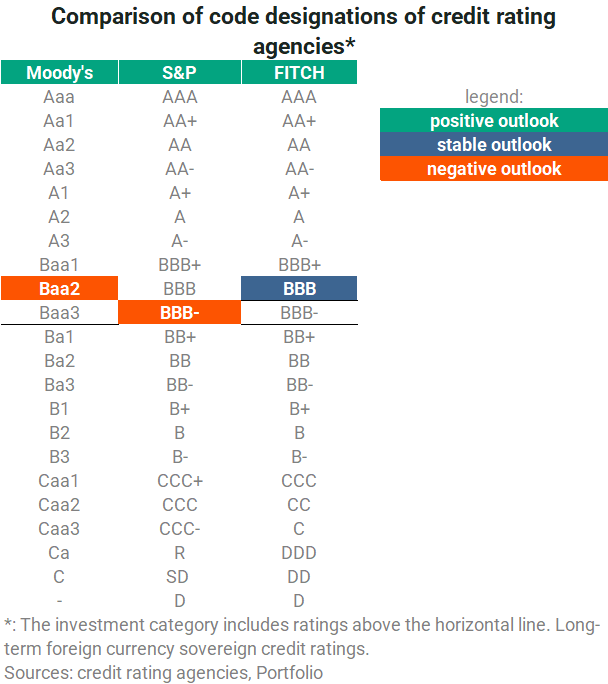
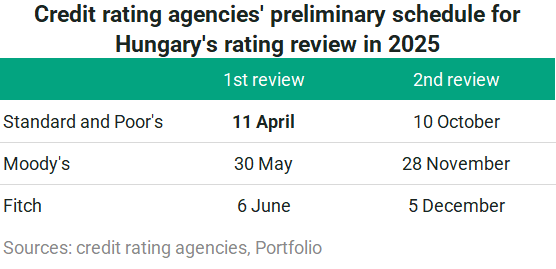
As in the past, there will be six rating agency reviews this year, with Standard and Poor's leading the queue, Moody's next on 30 May, followed by Fitch on 6 June, and then the year-end will be busy again.
Cover image (for illustration purposes only): Getty Images





