Historical records broken in Hungarian demographic trends


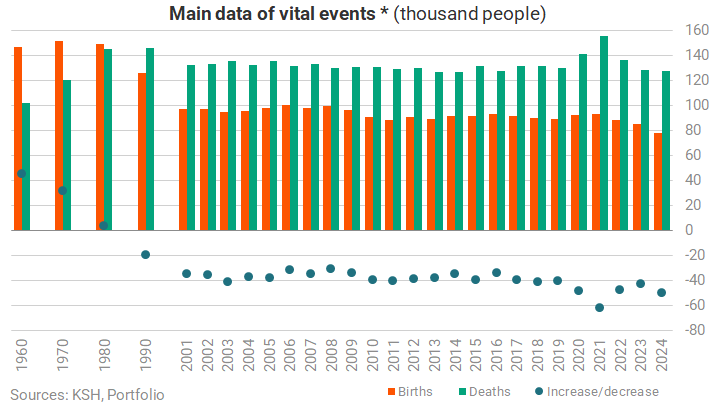
At the beginning of every year, there is a lot of news about how Hungary's population has changed. This is based on the balance between births and deaths: when the Central Statistical Office (KSH) presents its December and yearly population movement reports, we learn about the natural decrease. Last year, for example, preliminary data showed that there were 127,500 deaths and 77,500 births, resulting in a natural decrease of 50,000.
The only time we have seen a greater natural population loss than this in the country's last 100 years was during the worst period of the coronavirus pandemic in 2021.
Much less attention is paid to how migration changes the domestic population. This is because these figures come later and there is no official major KSH report on them.
However, it is a very important factor in demographic processes: the experience of the last 30 years shows that it plays a significant moderating role in population decline, as the country has a positive migration balance. For this reason alone, it is worth taking a look at the migration data provided by the statistical office.
Migration of Hungarians
In 2024, both immigration and emigration of Hungarians reached new historical highs. The number of emigrants exceeded 41,000 and the number of immigrants exceeded 39,000. As a result, there were 2,000 fewer Hungarians in the country. The difference is not significant, but it is worth noting that while there was a slight increase between 2016 and 2022, the balance was negative in the last two years.
The picture is further nuanced by the fact that about a quarter of immigrant Hungarians are 'foreign-born immigrants'. Most of them are Hungarian citizens with dual citizenship from neighbouring countries. In other words, the migration balance for Hungarian citizens living in Hungary shows a stronger net emigration.

Migration of foreigners
Last year the balance of immigration and emigration of foreigners was lower than usual. Only during the years of the Covid pandemic lockdowns (2021-2022) was net immigration lower. According to preliminary data, 6,300 more people moved to Hungary than left in 2024.

The interpretation of these figures is complicated by the fact that the annual change in the number of foreigners living in Hungary (total stock) is only loosely related to the balance of emigration and immigration. We suspect that this is mainly due to statistical inaccuracies. In any case, the number of foreigners living in Hungary has for the first time exceeded a quarter of a million, i.e. 2.6% of the population.
Overall migration balance
As we have seen above, population growth due to migration of Hungarian and foreign citizens is historically low (in the case of the former it is markedly negative), so it is not surprising that the combined change in the two categories is small.
So much so that the population increase due to the combined migration difference of Hungarian and foreign citizens is only 4 thousand, which is within the statistical margin of error. In 2019 and 2022, for example, the population increase due to migration was more than 35,000.

In other words, last year net migration did not offset the significant natural population decline (due to the balance of deaths and births).
Population and migration
In the light of what has been said so far, it is understandable that there were significantly fewer Hungarians in the country last year. As a result of a natural decrease of 50,000 and a net migration balance of 4,000, Hungary's population shrank by 46,000 and is now well below 9.6 million.

Emigration reaches all-time high
A total of 41,300 Hungarians emigrated in 2024, a new all-time high after a record of over 35,700 in 2023. The emigration of 41,300 people is as if the entire population of Dunaújváros or Hódmezővásárhely had disappeared.
In the 15 years, since Viktor Orbán has been Prime Minister, 367,515 Hungarians moved abroad.
It's as if Hungary's second and third most populous cities, Debrecen and Szeged, had been emptied out over the course of a decade and a half.

As regards the key destinations, Austria has been the top choice since 2019, with 22,850 Hungarians choosing the neighbour in 2024, almost three times as many as those who emigrated to Germany (7,900) last year.
According to the latest Eurostat report, the number of Hungarians officially living in Austria exceeded 100,000 in 2024. Compare this with the fact that only 78,000 children were born in Hungary in 2024.

Over 55% of Hungarians that emigrated last year went to Austria, while just 19.1% chose Germany. These two countries were neck-and-neck until 2019, when Austria first became more popular than Germany. The share of the United Kingdom as a destination for Hungarians shrank to 1.9% in 2024 from almost 41% in 2010. While the Brexit (1 February 2020) is an obvious factor, the popularity of the UK started to wane well before that.

Almost 29,000 Hungarians returned home from emigration in 2024, which is also a new record.

Austria was in the lead last year, with 15,700 Hungarians leaving it behind for their homeland, followed by Germany with 6,000 Hungarians abandoning it.

More than half (54.3%) of Hungarians returning home came from Austria, followed by Germany (21%).

Between 2010 and 2024, more than 124,000 Hungarians emigrated to Austria, more than 104,000 to Germany, and almost 53,000 to the UK.

According to KSH statistics, the country lost almost 117,500 Hungarians to emigration (the net of emigrations and returns) in the 15 years between 2010 and 2024, with the most lost to Germany (41,279), Austria (36,120) and unspecified countries (19,121).
In fact, many more people are leaving the country than indicated above; for example, in 2022, foreign countries registered almost twice as many Hungarian arrivals as the number of departures known to domestic authorities.
According to KSH's Demographic Portrait 2024, 546,000 Hungarians are still officially registered as living abroad. Moreover, these figures only include data from EU countries, the UK, Switzerland and Norway. Meanwhile, the United States, Canada, South America, Israel and the Arab world also have significant Hungarian communities.
KSH researcher Ágnes Hárs recently pointed out to Válasz Online that with birth rate falling for decades, and the number of young people is shrinking, it is particularly important how many of them leave.
The 15-64 age group would have been 6.9 million in 2010 without emigration, falling to 6.6 million by 2023. Emigration reduced this by 120,000 in 2010, but
by 2023 the total number of people in this age group living abroad was 420,000.
So the total loss (due to fewer births and emigration) is 152,000+420,000=572,000 people. This is not only felt by Hungarian families, as their children and grandchildren move abroad, but also by the Hungarian economy - there is a shortage of working heads and hands.
In 2010, 1.8% of the working age population emigrated, and by 2023 this ratio was already 6.8%.
Cover photo (for illustration purposes only): Getty Images





