What will the Hungarian central bank do with interest rates? - The market is divided


A lot has happened in the world and in Hungary since the MNB's last rate-setting meeting at the end of March. The US tariff war has escalated, the economic outlook has darkened and global uncertainty has peaked.
This also has implications for the Hungary's growth and inflation outlook, while inflation (finally) came in better than expected in March, the government is taking strong measures to further artificially lower it.
However, the forint has started to weaken again, signs of fiscal loosening have increased and Standard & Poor's has pushed Hungary's sovereign debt to the edge of junk status.
Weaker growth overall, perhaps a slightly more favourable inflation outlook, but a huge increase in uncertainty and a weakening forint - this is the backdrop against which the National Bank of Hungary's Monetary Council will have to decide tomorrow whether to change its interest rate policy. This change may not be reflected in an immediate rate decision,
at least the economists polled by Portfolio remain in complete agreement that the 6.5% benchmark rate will remain unchanged.
Mihály Varga, Governor of the Hungarian National Bank (MNB), stuck to his main message of caution in his first interest rate decision in March, ruling out the possibility of monetary easing in the near future.

Our previous GDP growth forecast of 2% for this year has been revised down to 1.5-1.7%, says Mariann Trippon, senior analyst at CIB Bank, outlining the impact of the changing environment on the Hungarian economy. This forecast is below the government's revised growth expectation of 2.4% and also below the lower end of the MNB's March forecast range of 1.9-2.9%.
In parallel, the inflation picture has also changed:
- The government has reached an agreement with the banking sector and telecoms companies, so services are not expected to see a stronger monthly repricing in April, either.
- Recessionary fears over the global tariff war have also led to a sharp correction in oil prices, which is positive for domestic fuel prices,
- while weakening demand due to the tariff war could have a disinflationary effect,
- while potential EU responses could raise inflation.
- However, if some exports from the US market are diverted to Europe, the increased supply could also put downward pressure on prices.
- Meanwhile, a weak/weakening forint exchange rate is an upside risk, and
- lower world energy prices due to the global slowdown are a downside risk,
Trippon listed the new factors. She has lowered here forecast for annual average inflation to 4.5-4.7% from 5.0% previously. Nevertheless, the inflation target for 2026 is still in doubt, which justifies a cautious monetary policy, she said.
Zsolt Becsey has come to a similar conclusion. According to the analyst at UniCredit, although the balance on the inflation front has shifted in a more positive direction, this is not enough for the central bank to cut in such a turbulent geopolitical environment. The forint is seen as a riskier financial asset by international investors, so there is still a need to maintain an interest rate shield to avoid periods of sharp forint depreciation.
Although annual price dynamics are expected to moderate in the coming months, disinflation is starting from a much higher level than previously expected due to the inflation surprise at the beginning of the year, which has pushed the inflation target further away," said Márta Balog-Béki, economist at MBH Bank.
Therefore, the MNB will not rush to cut interest rates, which could support the forint. Monetary easing will come when it is clear (and the market believes) that inflation could return to the central bank's target range on a sustained basis over time. It is too early to say at this stage. Balog-Béki believes that the MNB will not be able to lower interest rates before the end of the year - and only if the US Federal Reserve is able to implement a substantial easing.
Perhaps the above already shows that analysts are spectacularly divided on the timing of rate cuts. A significant number of our respondents do not expect any rate cuts this year, but the same number expect two rate reductions (a total of 50 basis points). Interestingly, the median one-cut scenario remained in the minority, but still became the consensus median.

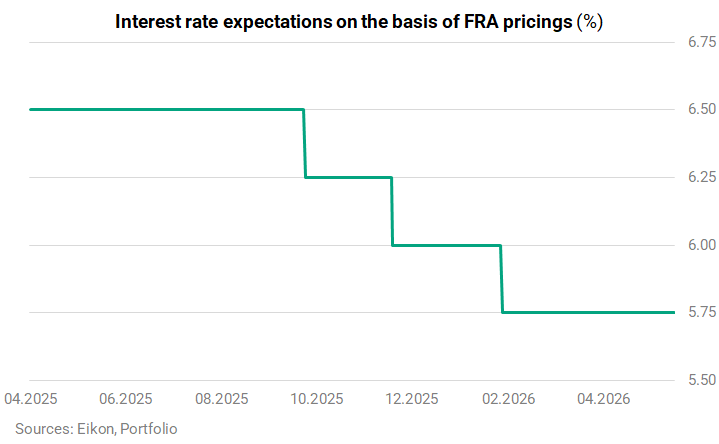
Market pricings, by the way, reflect the dovish stance. In recent weeks, market participants' rate expectations have shifted to the downside, with one or two 25bp cuts expected this year, said Zoltán Varga, an analyst at Equilor. Indeed, based on Friday's forward rate agreements (FRAs), Portfolio calculates that the market is pricing in three rate cuts over the next 12 months, one of which would come in early 2026.
According to Gábor Regős, analyst at Gránit Fund Management, the sky isn't falling just yet. In his view, four non-independent conditions are needed to trigger a rate cut:
- Inflation returning to the target range - even without a margin cap.
- A much stronger forint exchange rate than now.
- Favourable risk perception.
- Monetary easing in the region - especially Poland.
Of course, all of this will depend to a large extent on the outcome of the tariff war. According to Péter Koncz, an economist at Századvég Economic Research, the tariff war will be the most important issue in the coming months, along with the development of domestic inflation, which will also influence monetary policy.
On the one hand, there is the question of how far-reaching the tariff measures will be and, on the other, how the world's leading central banks will react to the changed economic situation.
The National Bank of Hungary will publish its interest rate decision tomorrow at 14:00, explaining its rationale in writing and at a press conference at 15:00.
Cover photo: Portfolio





