Hungary retail sales shrink in the month of the margin cap launch


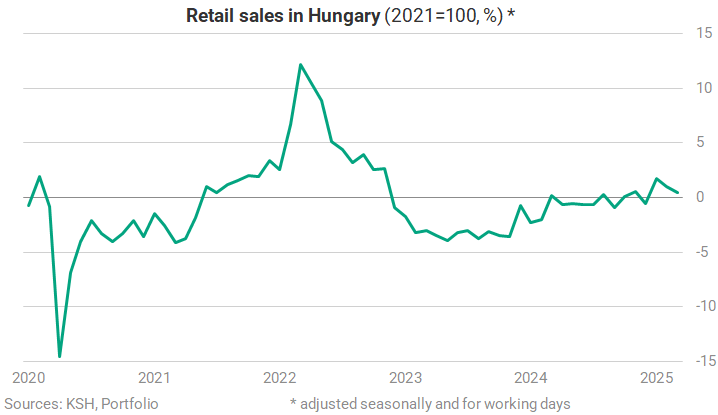
According to seasonally and calendar adjusted data, retail sales fell by 0.5% in March compared with the previous month. Although the margin cap only took effect in the second half of the month, it is interesting to note that the fall in basic food prices did not boost overall shop sales.
Sales in the grocery stores most affected by the margin cap also rose only 0.2% month-on-month, which is weak compared to previous months.
This means that the volume of retail sales fell for the second month in a row, with February down 0.6% on January.
This is also reflected in the fixed base figures: compared to 2021, sales in March were only 0.5% higher. Although the decline in the last two months has not broken the slow upward trend in retail sales, it is clear that the trend is very uncertain. Household consumption is rising according to GDP statistics, but it is clear that this is not primarily reflected in sales in physical stores.
although the figures are indeed surprising, it would be too early to say the margin cap is ineffective.
We will know more about how successful the measure has been in stimulating consumption when we have the April figures. The government is also extending the measure to drugstores.
Annual changes
On a year-on-year basis, adjusted for calendar effects (and Easter), sales volumes were 0.4% higher than in the same period of 2024.
- The volume of sales grew by 1.2% in both specialised and non-specialised food retail. The volume of sales increased by 2.7% in non-specialised food and beverage stores, which account for 77% of food retailing, and decreased by 3.1% in specialised food, beverage and tobacco stores.
- Total non-food retail sales increased by 5.9% in volume terms.
- The volume of mail order and internet retailing, which accounts for 8.5% of total retail sales and covers a wide range of goods, grew by 5.0%.
- Fuel sales at petrol stations edged up 0.1%.

Ministry blames it on Easter
According to the Economy Ministry, the slowdown in retail sales in March is only a temporary, technical phenomenon, which is due to the Easter effect, i.e. that in 2024 Easter fell at the end of March, while this year it fell in the second half of April, so the effect of the Easter shopping season was fully felt in April this year. Based on online cash register data, the ministry said April could see an increase of up to 5-6% on an annual basis.
Cover image (for illustration purposes only): Portfolio