Hungary's inflation retreats over margin cap impact


The deceleration in inflation has to main reasons:
- The margin cap was fully reflected in the price index in April. Food price controls started on 17 March, but as the price indexation period of the Central Statistical Office (KSH) lasts until the 20th of each month, it was only enough to prevent average monthly food prices from rising in the month of their introduction. However, it was already known in advance that prices for the product group concerned had fallen by around 18% on average compared with the period before the margin cap, and this should be reflected in the April price statistics. And it is. As you can see, the KSH recorded a 1.3% fall in food prices on a monthly basis. This is slightly less than expected, as the question was whether annual food inflation would tame from 7% to below 5%, but the KSH reported a 5.4% rise.
- The plummeting oil price amid the global economic turmoil is keeping a lid on fuel inflation. Fuel prices fell 1.4% in April from the previous month and are already down 7% on the year.

There is another, less visible factor behind the moderation in inflation. The sharp rise in services prices at the beginning of last year is starting to fall out of the annual inflation index, to be replaced by lower price increases this year.
In this case, this meant that the rate of increase for services fell from 7.5% in March to 7%. However, a 0.8% rise in services prices on a monthly basis is still not a small increase and is the best indication that
underlying price pressures remain strong in Hungary.
Although core inflation, which captures more persistent price movements, has also fallen, it remains at 5%, i.e. still far from price stability.
According to Portfolio's rough calculation, inflation could have been up to 1 percentage point higher in April, i.e. above 5%, if the government had not introduced a margin cap.
This also suggests that although the government is treating the superficial wounds, which makes the 'patient' look better, i.e. the official indicator is falling, there is actually internal bleeding, i.e. inflation in Hungary is not OK at all.
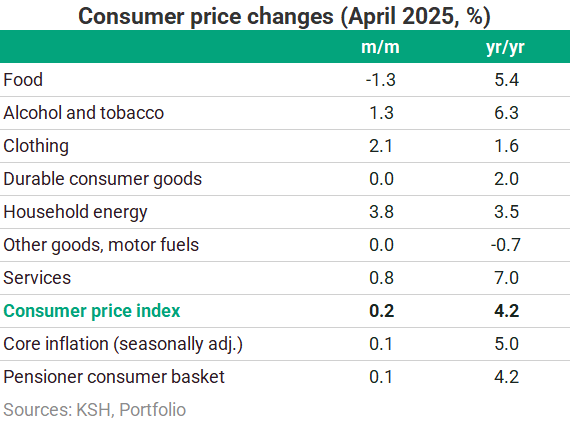
The impact of the margin squeeze can best be observed by looking at the prices of individual products. Food prices fell by 1.3 %, but within this, margarine fell by 23.6 %, dairy products by 13.4 %, flour by 12.5 %, butter and spreads by 8.7 %, milk by 8.6 %, edible oil by 6.1 %, pork and sausages by 5.9 %, cheese by 5.4 %, poultry meat by 5.0 %, sugar by 4.3 % and pork by 4.1 %. However, we continue to see significant price increases on products outside the margin cap. The price of chocolate and cocoa increased by 3.3%, snack bars by 1.9%, soft drinks and rice by 1.4% to 1.4%, dry pasta by 1.3%, baked goods by 0.9% and bread by 0.7%.
The extent of the price increases seems to support Portfolio's calculations for the time being: based on the data in the price monitoring system's database, there is no evidence of intensive cross-pricing, which means that the retail sector has not yet started to recover its losses by raising prices of other products.
However, this process may begin as retailers begin to realise that the price cap is in fact a permanent tool that will become the new norm. Indeed, most market analysts polled by Portfolio earlier this week had already predicted that the price cap would remain in place until the election.
All in all, the favourable developments in commodity prices, the direct price interventions and the repricing restraint imposed on service providers already point to a very different inflation path from the one that seemed to be emerging after the unexpectedly sharp wave of price adjustments in January-February.
In the coming months, inflation is not expected to fall at the same pace as in April. The large base effects have run their course, so only small cooling effects are likely. These include a further decline in fuel prices, the drugstore margin cap (which will appear in the statistics from June) and the fact that, based on today's detailed data, the repricing effect of the weak forint may already have faded.
The latest data are unlikely to rewrite central bank's (MNB) monetary policy plans. The temporary effects of the margin cap are worth reviewing for interest rate policy, as the hectic global environment continues to pose risks to financial stability, and the central bank may stick to its previous communication in May that the 6.5% base rate will remain in place on a permanent basis.
Cover image (for illustration purposes only): Getty Images