Hungary's industrial performance is ugly, but there's a glimmer of hope


You'll find the answers to the following questions in this article:
- What is the trend in the Hungarian industry?
- How are domestic and export sales of industry doing?
- What segments are showing the largest contraction?
- Where can we see signs of recovery?
- What do the orders data suggest?
- What are the prospects for domestic industry?
Industrial production rose slightly in March compared with February, but the year-on-year decline remains large. Industrial production is now 7% below its level in 2021, and the downward trend of the past year and a half is still unbroken.

The bad news is that both domestic and foreign orders are weakening. The stock of domestic orders has reached a new low on a 2021 basis, down more than 15%.
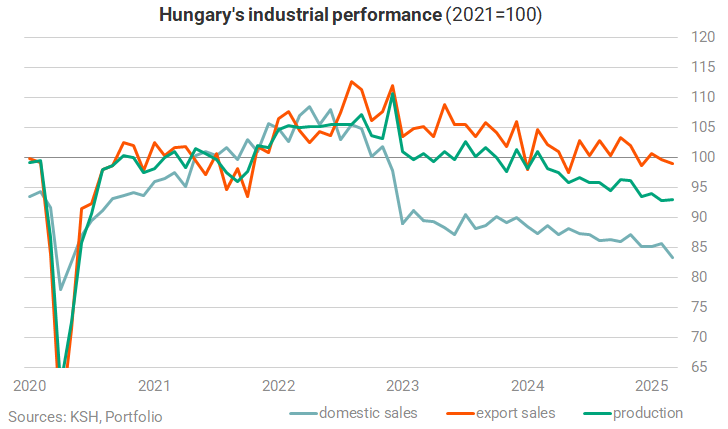
In a positive sign for export sales, manufacturing exports of motor vehicles and computer, electronic and optical products rose by 3.5% and 14% respectively on an annual basis.
We see a decline in output in most sectors. Electrical equipment which has long been the main driver (battery production is in this sector), is almost exactly where it was in 2021 in March. But since then there have been periods when production has been 60-80% higher. Not surprisingly, battery production has been as volatile as vehicle manufacturing. The risk for the industry is precisely when the weight of these cyclical industries becomes too great - as is happening here in Hungary.

The Central Statistical Office (KSH) pointed out that, on an annual basis,
the production of electrical equipment in the two main sub-sectors, batteries and accumulators, fell by 41% and electric motors, generators, distributors and regulators by 14.8%.
However, the graph above also suggests that while battery production is suffering, vehicle production may have already bottomed out and slow growth has begun. This is supported by the fact that vehicle production has already made a positive contribution to export sales. However, this should be treated with caution for the time being, as uncertainty about global economic growth and developments in the tariff war could lead to further surprises in the period ahead.
On a seasonally adjusted basis, the electronics sector was largely flat in March, while the food sector showed a slow decline. The bad news is that the other, smaller sectors are also trending lower.
In light of the above it is no surprise that industry was a drag on q1 gdp.
Between January and March, industrial production fell by 4.4%, which is not the same as value added (in terms of GDP) but shows that industry is weakening. Output fell in nine of the thirteen manufacturing sub-sectors, with the largest fall of 25% in electrical equipment.
As far as the outlook is concerned, order books are not very robust either.
- The volume of new orders for all the manufacturing sectors surveyed fell by 1% compared to March 2024.
- New domestic orders decreased by 8.0%, while
- new export orders increased by 0.2%.
- Total new orders at the end of March were 10.2% down yr/yr.
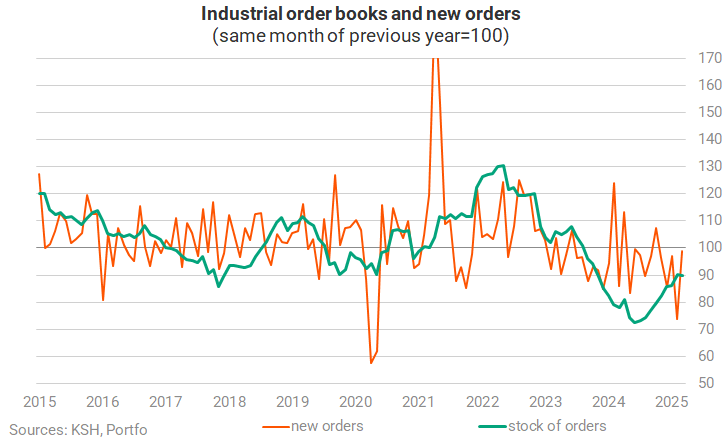
Overall, order books are not as weak as they were 3-6 months ago, but we continue to see subdued order books in the industry. This suggests that
the coming months are unlikely to bring a major boost to the industry.
However, recovery is urgently needed, as industry is one of the sectors in Hungary where employment is on the decline.

Cover image (for illustration purposes only): Getty Images





