You'd never guess why workers don't get sacked in Hungary


This article will answer the following questions:
- The Hungarian economy has been performing poorly for years.
- Companies continue to retain staff.
- Why wouldn't businesses cut staff?
- When could the trend reverse and unemployment rise?
- Which sectors are already in trouble?
- Where is the number of employed going up?
- When will the demographic trajectory become a reason for concern?
The Hungarian economy has oscillated between technical recession and modest growth over the past two years. Even the modest GDP growth expected for the first quarter of this year failed to materialise and the economy contracted again. This has once again raised the question of what lies ahead for Hungarian workers. Will there be a wave of redundancies if the economy fails to grow?
Let's take a look at what has happened so far! Over the past two years, despite the difficult economic situation, the unemployment rate has risen only slightly, employment levels have remained very high and there is still talk of labour shortages in some sectors.

This phenomenon - where companies do not lay off workers despite a fall in demand - is known as labour hoarding. But how long can this strategy last?
Labour hoarding occurs when companies retain employees despite a weak economic environment, in the hope of an imminent return to economic activity.
This often means hidden overcapacity: workers' productivity is temporarily reduced because they have less work to do, but the company does not lay them off so as not to have to recruit and train them again when the economy picks up.
It is somewhat similar to what was known before the change of regime as "unemployment within the gate", which in theory is very far from the competitive market environment. In reality, however, this phenomenon seems to exist in a market economy.
In recent years, Hungary's tight labour market, demographic trends and emigration have also encouraged companies to hold on to their existing workforce. And companies have a number of arguments to maintain "unemployment within the gate" in the coming months.
Labour shortage and demographic pressure
The labour market has experienced persistent labour shortages for almost a decade. There are still many job vacancies because there are not enough suitably qualified workers. Companies are therefore reluctant to make people redundant because they know that once they have lost their workforce, especially skilled and semi-skilled workers, it will be difficult to replace them, even if the economy rebounds in the meantime.
The main trend is that the working-age population is declining due to the low birth rate of recent decades, while the emigration of Hungarian workers is increasing.

More than 40,000 Hungarians left the country last year, while fewer than 30,000 returned. This is the third year in a row that more of our fellow citizens have moved abroad than have returned to Hungary.

As the graph below shows, the only thing that has temporarily halted the decline in the working-age population over the past two decades has been an increase in the retirement age. We expect the working age population to start shrinking again in the coming years as the increase in the retirement age has come to an end.

As shown in the graph above, the number of people of working age who are not in education or raising children will soon 'converge' with the number of people of working age.
This means that even with increased activity, there will not really be more workers to employ.
Companies know, feel and experience all this and are more attached to their employees than ever before.
High recruitment and training costs
In addition to the above concerns, recruitment is not only an administrative burden but also a direct cost: job advertising, selection, interviews. This is followed by the training process, which can take many months.
During this time, employee productivity is low, which is a cost to the company.
There is also the possibility that the selection process goes wrong and we actually hire the wrong people. In this case, the employee is fired and the process starts again. These costs are a much greater burden in the long run than paying temporary wages for unused/underutilised labour.
The last time many people realised this was during the Covid crisis. During the pandemic, many companies around the world - including in Hungary - reacted to the initial shock with immediate, massive cutbacks as demand collapsed.
However, experience has shown that while rapid redundancies may appear to be financially justified in the short term, they can result in higher costs and competitive disadvantages in the long term than simply retaining employees even when the going gets tough.
Of course, hindsight is 20/20, and at the time of the lockdowns there was no way of knowing how long the economic chaos would last, so the main lesson for governments is that the only way to stop the economy is to throw companies a lifeline.
Faith in recovery is key
The psychological driving force behind labour hoarding is optimism. Over the past two years or more, many people thought that demand would gradually and nicely pick up. And then they were disappointed. Last year, many companies were hoping for a "rebound", but the recovery never came.
The same dilemma applies this spring, especially after the poor GDP data. At the beginning of the year, 3% GDP growth was not out of the question, but with the outbreak of the tariff war and deteriorating global trends, expectations have started to gravitate towards 2%, and after reports of weak performance in the first quarter, it may well be closet to 1%.
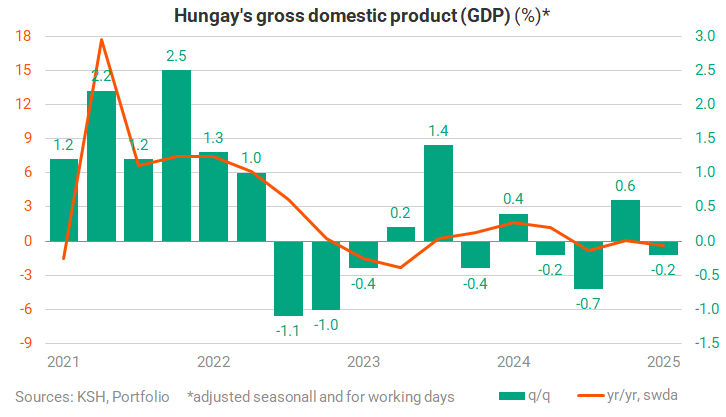
Trump's tariff war, weak external demand, low domestic consumer confidence, relatively high savings rates and a lack of willingness to invest are casting a growing shadow.

If these factors were to turn around in the short term, the workforce that is now retained would be immediately "ready to go", while firms that have downsized could start scrambling to recruit.
Persistent demand shortages and structural problems
However, there is now a growing argument for companies to opt for redundancies. Although many companies expect a cyclical downturn, the reality is that there are structural problems in many sectors. Moreover, the cyclical downturn is unevenly spread across sectors.
The construction industry has lost significant public contracts due to fiscal restraint on investment, while housing starts are at a low. The crisis in the automotive industry is deepening, so it comes as no surprise that battery production is also falling, while more and more industries are now struggling. And industrial production is already well below 2021 levels.

This is reflected in the fact that the number of people employed in industrial production has fallen, albeit slightly, in recent years.

Unsurprisingly, the hectic performance of the construction sector has also led to a decline in the number of people employed in the sector.

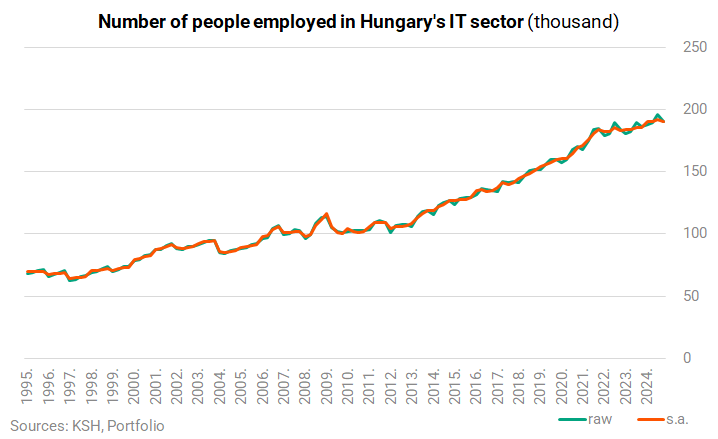
So why is employment not falling at the national level? It is because there are sectors that are growing even in difficult economic conditions.
The best example is the IT sector. Here we did not see a downturn even during the Covid crisis, but IT has increased employment even amid modest GDP performance over the past two years. In Hungary, IT's resilience to shocks seems to be well above the international trend, and digitalisation and automation are creating a steady demand for these professionals.
Tough months ahead
Small firms' prospects are also hampered by a lack of investment resources and sometimes by difficulties in export markets, but domestic consumer demand is the most important factor and this may encourage businesses (especially in the services sector) to persevere.
Therefore, the main reason for a significant slump in SME hiring intentions is when the only growth engine, household consumption, also slows down. In such cases, overcapacity may be temporary and labour hoarding may be justified for a longer period, although the weak capital and liquidity position of SMEs may be a constraint.
Large companies worry about limited export opportunities. For executives, the picture is mixed, with cautious optimism about a recovery in the European economy and gloom about the tariff war and challenges in the automotive sector.
In this situation,
- productivity can fall the more people are "unemployed inside the gate", undermining competitiveness.
- Meanwhile, under-utilised staff can become demoralised - with less work their motivation dwindles. Moreover, in such cases, some companies decide to reduce wages (through fewer hours, overtime, shifts).
- The company's cost structure is distorted by the need to maintain staffing levels, making it more difficult to compete on price with other market players,
- while this distortion in the cost structure is reinforced by an incomes policy that encourages rapid wage increases.
Especially for small and medium-sized enterprises, hiring staff is simply not financially sustainable in the long term. In times of declining orders, one might think that over time downsizing is not an option but a necessity. But it seems that even the smallest firms are trying to hold on to their staff as long as possible.
Most of the redundancies we are now seeing are in cases where they are unavoidable: when a company is in a difficult financial situation, production stops or a factory goes bankrupt (e.g. Dunaferr). Behind the high level of employment, the tensions are already visible (redundancies in industry and construction) and the longer the economic stagnation lasts, the more difficult the period will be for companies and workers alike. But downsizing remains a last resort. Demographic trends suggest that Hungary will soon run out of workers.
Cover image (for illustration purposes only): Getty Images





