Rating reviews for Hungary are just around the corner – has the time for punishment come?


Moody’s and Fitch Ratings coming right up
So far this year, there has been one rating review for Hungary, with Standard & Poor's (S&P) downgrading the outlook on the country's debt rating to negative from stable in April. Based on the preliminary calendars published in December, Moody's and Fitch will now publish the results of their reviews a week apart.
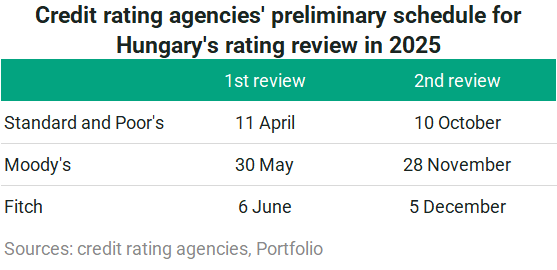
As usual, it is worth noting that a change to either the rating or the outlook is not guaranteed by the review schedule. Rating agencies always have three options:
- They can change the country's debt rating or outlook.
- They can leave everything as it is and issue an updated analysis of their views.
- Alternatively, they can choose not to publish a new analysis, instead briefly indicating that they have left the rating and outlook at the same level as before.
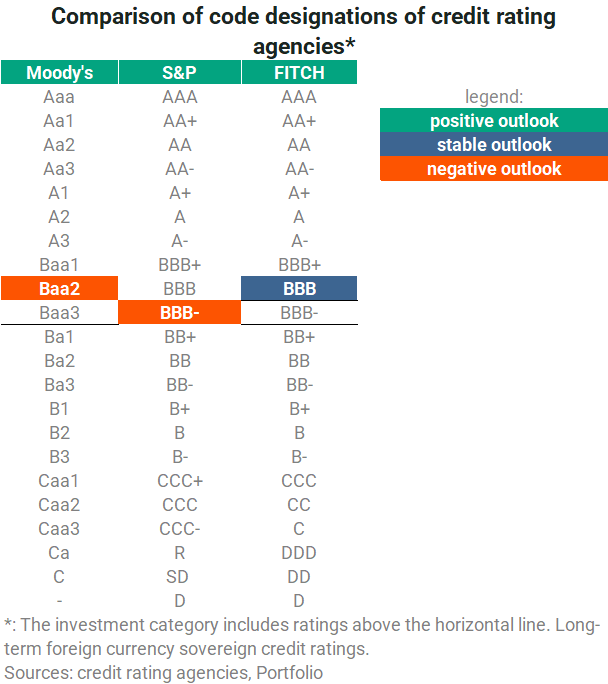
Currently, Moody's has Hungary's rating at Baa2 with a negative outlook. It was last downgraded from stable last November. Fitch's rating is the same, at BBB, but the outlook was upgraded from negative to stable in early December. Recent months' global and domestic economic developments, coupled with the outlook downgrade by Moody's, suggest that
a negative move may be warranted, which would imply a downgrade by Moody's and a negative outlook by Fitch.
Weaker growth, uncertain EU funding
There have not been many positives to report about the Hungarian economy in the past six months, but there have been some negatives.
- At the beginning of the year, there was a surprise pick-up in inflation, which the government is trying to tackle with margin caps.
- The first-quarter GDP data was an unpleasant surprise, with the economy contracting by 0.2% compared to the previous quarter instead of the expected growth of 0.3%. This could fundamentally change the outlook for the year as a whole.
- The budget deficit is also not developing as anticipated: the government has raised its deficit target to 4.1% of GDP for 2025, while the 2026 draft budget currently under consideration by parliament projects a deficit of 3.7%.
Last November, Moody's stated that losing a substantial amount of the envisaged EU funds could result in weaker-than-expected growth and fiscal performance. They also identified risks stemming from lower-than-expected economic performance in key export markets, particularly Germany, as well as potential government spending ahead of the 2026 parliamentary elections.
This is why, in their analysis, they wrote that weaker-than-expected growth and fiscal positions, as well as persistent uncertainty regarding EU funding and potential supply disruptions resulting from Russian energy dependence, could lead to a negative outcome.
"Hungary's institutions not being able or unwilling to fully implement the remaining reforms would have a negative impact on the quality of the country's institutional framework, which would be credit negative. More generally, signs of a reversal of fiscal consolidation and a material weaker than expected trend growth rate would be credit negative," Moody's said.
"Hungary's Baa2 ratings would come under pressure were susceptibility to event risk to rise significantly, possibly in the context of an escalation of the Russia-Ukraine war with NATO involvement", the statement concludes," it added.
There has been little progress on EU funds in the last six months, and the likelihood of an agreement being reached by August on the absorption of the RRF funds is decreasing. If no agreement is reached, Hungary could lose the funds permanently.
The government has already acknowledged in the budget that the previous deficit target will be slightly exceeded. However, analysts say that even the new target of 4.1% is ambitious. In its latest forecast, the European Commission projected a deficit of 4.6% in 2025 and 4.7% next year. In other words,
the budget is facing serious challenges, partly due to lower-than-expected growth and the denial of EU funding.
The topic of economic growth has been discussed several times in this article. The government is still officially expecting GDP to grow by 2.5% this year, although this figure is expected to be revised in June. However, the majority of analysts now forecast growth of around 1%, with an increasing number revising their official forecasts below this figure. In its aforementioned macroeconomic forecast, the European Commission projected growth of just 0.8% in 2025.
By contrast, Moody's forecast economic growth of 1.9% in 2025 last November, while in December, Fitch predicted an even stronger growth rate of 2.5%. While the latter rating agency's deficit forecast of 4.2% may be correct in terms of magnitude,
it would not be surprising if the two firms had reacted to the fact that Hungary's growth prospects have halved over the last six months.
Of course, this could still be attributed to temporary setbacks, but the Hungarian economy has struggled to gain momentum in recent years despite government efforts. Disputes over EU funds have played a role in this, with no agreement being reached in the last six months and the permanent loss of RRF funds looming.
Trouble could really find Hungary in the autumn
Fortunately for Hungary, the two rating agencies that are about to announce the results of their rating review still have room to downgrade without jeopardising the country's investment grade. Ratings at both Moody's and Fitch are currently two notches above the key threshold, meaning that
even a downgrade would not cause Hungary serious problems.
The situation is much more threatening in the case of Standard & Poor's. Its BBB rating is already one notch lower that at the other two rating agencies and, since April, it has been accompanied by a negative outlook.
There is therefore a real threat of a downgrade to non-investment grade.
S&P experts will next review developments in Hungary on 10 October. This means that, on the one hand, we have another six months to wait, but, on the other hand, the fate of the RRF funds could be decided by then, as the current most likely scenario is negative. By October, second-quarter growth data will be available, as well as some data for the third quarter. The current state of the budget could also be an important factor for analysts.
What is certain is that a possible downgrade in the autumn could be painful. The move to junk grade would mean that some institutional investors would have to sell their Hungarian assets, which could put pressure on the forint and the Hungarian government bond market. Some investment strategies recommend that conservative investors sell if the country receives a non-investment grade rating from two of the three major credit rating agencies. However, it is possible that the first junk grade rating could already trigger a repositioning in the market.
Recently, the best the Hungarian government could hope for was to avoid a downgrade by Moody's in order to buy more time. Ratings from the three major agencies tend to move in tandem, so it is unusual for there to be a two-notch difference between them. If Moody's leaves the rating at Baa2, a possible downgrade by S&P in October would create exactly that kind of difference. However, it is worth noting that
There is no rule that prevents one ratings agency from giving a rating that is two notches lower than that of a competitor.
All three rating agencies emphasise that they use different models and consider different weightings of economic factors. Therefore, they are not affected by the ratings given by a competitor.
There are plenty of examples of greater disparities in Europe. For example, Slovenia has an AA- rating with S&P, which is three notches better than Moody's A3 rating. There are also cases of a two-notch difference in Serbia and Slovakia.
Cover photo: András Müller / Portfolio





