Banks could inject twice as much credit into the Hungarian economy - MNB


Bálint Dancsik, Head of Department of the MNB, presented the key findings messages of the Financial Stability Report released today:
- The Hungarian banking system continues to be characterised by high profitability, abundant liquidity, good loan portfolio quality, and a strong capital position, and consequently, the sector’s shock resilience remains outstanding.
- The banking sector remained highly profitable in 2024, with one-off items still playing a significant role. However, profitability declined once these were removed.
- Banks' capital position has continued to strengthen, with a high level of free capital buffers that would be sufficient to more than double the stock of loans.
- Banks’ lending capacity is abundant, and no general credit supply constraints can be identified.
- The duality of the credit market remains unchanged. Household lending is set to pick up significantly in 2024 and early 2025. However, corporate lending has not yet turned around.
- Although housing prices rose dynamically in late 2024 and early 2025, this did not lead to an increase in stability or credit risk; rather, it increased the risk of overvaluation, while ousing market developments at the beginning of this year point to a further rise in overvaluation.
- The central bank's stress test indicates that, even in the event of a severe shock, the sector would still meet the regulatory requirements for liquidity and capital adequacy.
The MNB is satisfied with almost all banking and credit market indicators. The only area of concern is the dynamics of corporate lending.
Deepening geopolitical and trade tensions are also posing a challenge to the banking system, and the outlook for global economic growth in 2025 has deteriorated substantially since the previous report. Nevertheless, both the European and Hungarian banking systems have the capacity to absorb shocks.
Capital accumulation is supported by the fact that Hungarian banks recorded an after-tax profit of HUF 1,595 billion in 2024, which was even higher than the previous year, and about half of this may be reinvested based on preliminary dividend payment plans. The annual return on equity (RoE) of the banking system amounted to 22.6% at year-end.
After the elimination of the volatile and special items (dividend income, bank levy (special tax on financial organisations and windfall tax); and in 2024, an accounting effect related to revaluation revenue, stemming from a merger of foreign subsidiaries),
the profit was HUF 214 billion lower than in 2023, amounting to HUF 1,242 billion, down in annual terms but still high historically. adjusted roe came in at 17.6%.
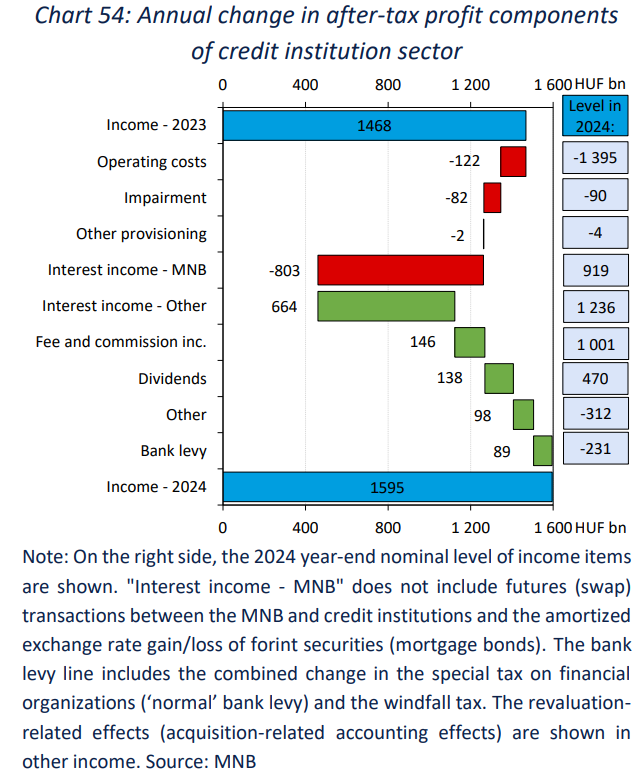
Compared to 2023, the net interest income from the MNB decreased significantly, by HUF 803 billion.
In comparison, the net interest income from sectors other than the MNB increased by HUF 664 billion, in which the increase in the net interest income of the private sector played a major role.
According to Bálint Dancsik, repricing interest-subsidised loans (e.g. baby loans) at higher yields during the start-up period also played a role. Additionally, the banking sector was characterised by higher impairment charges (HUF 90 bn, up HUF 82 bn on 2023), albeit still historically low, compared to previous years.
In the household sector, the proportion of non-performing loans has continued to decline. In contrast, in the corporate sector, this proportion has remained unchanged for a year and a half. The report also identifies four additional vulnerable segments:
- At the beginning of 2025, foot-and-mouth disease appeared in Hungary again after nearly 50 years. The share of loans in the affected sectors accounts for 1.4% (HUF 177 billion) of the total corporate sector portfolio, and including the supply chains, 2.2% of the portfolio may become vulnerable (nearly HUF 300 billion).
- Impact of the slowdown in Germany's automotive industry: The effect of the 20-30% sales revenue shock calculated as above leads to a slight increase in the probability of default: the PD of the related companies would increase from an average of 2.9% to 3.2% (unweighted averages), while the non-performing stock of retail loans would increase by HUF 22-26 billion.
- Failure to meet the childbearing conditions for family subsidies: the MNB estimates that there were almost 32,000 prenatal baby support loan contracts (23% of the contracts affected by the deadline that are still active at the end of 2024) where a child was not yet born at the end of 2024. The higher instalments and the repayment of the interest subsidy may cause problems for only 4,000 contracts (HUF 34 bn). the CSOK subsidies (home purchase subsidy scheme for families) in case not all children were born by June 2024 for roughly 20,000 contracts where the childbearing deadline will expire in mid-2026; these contracts are linked to a subsidised interest loan portfolio of nearly HUF 60 billion.
- Phasing out of the mortgage loan interest rate cap: the cap will be phased out on 1 July 2025, according to the current legislation. This measure currently applies to 286,000 contracts (HUF 1,200 billion). Within this, the MNB estimates that the number of vulnerable debtors is 16,000, with a loan portfolio of HUF 137 billion under the cap (2% of the total mortgage portfolio); taking into account these debtors’ other loans, the repayment of 24,000 contracts (HUF 185 billion) may become problematic.
Banking system liquidity remains ample, but with a varied structure. The average level of operational liquidity reserves (OLR) in April 2025 was HUF 20,847 billion, which is 67% of private sector deposits. Factors affecting liquidity in 2025: 1) The transfer of municipal deposits to the Hungarian State Treasury to the tune of about HUF 350 billion. 2) Maturity of central bank long-term collateralised loans, partly due to the expiring of loans taken out during the Covid crisis. Sectoral liquidity surplus would provide sufficient coverage even with severe stress.
There is also ample free capital. High profitability has created favourable conditions for capital accumulation, and the uncertain environment has justified building up additional capital buffers, as required by the MNB.
According to the central bank's estimate,
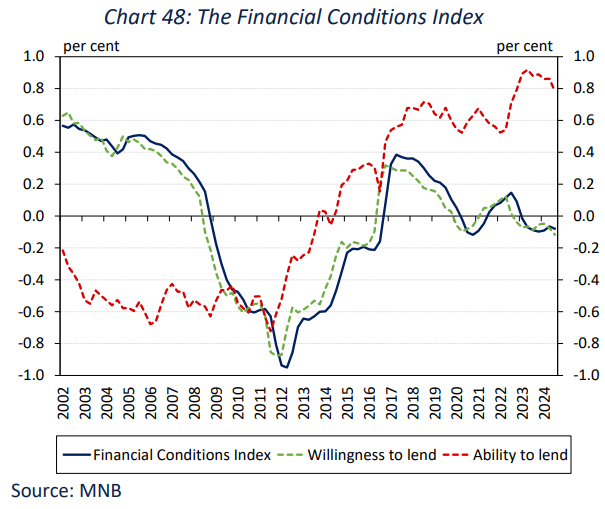
the free capital of HUF 2,256 billion would make it possible to disburse approximately HUF 30,000 billion, with which the private sector’s lending portfolio would more than double.
This is confirmed by the Financial Conditions Index, which shows that the lending capacity of the sector is historically high and its willingness to lend is at around the equilibrium level.
The banking system is resilient enough to withstand multiple macroeconomic shocks. The central bank's stress test assesses the banking system's ability to cope with adverse developments in German industry and a customs war. Currently, the banking system's own funds total around HUF 7,000 billion, and the main stress scenario would result in a capital shortfall of only around 1% of this amount.
The lending market continues to be characterised by duality: while household lending is picking up, the corporate credit market remains in wait-and-see mode.
The MNB expects household lending to grow by 11.5% (up from 9.7% last year) and corporate lending to grow by 4.5% (up from 1.6% last year) across the financial system as a whole.
Demand for investment loans has not turned around, and the stock of liquid corporate assets remains high. According to MNB experts, banks do not expect a turnaround in demand for investment loans, but banks' lending capacity is ample and no general supply constraints in lending can be identified.
As Mihály Varga indicated at the Portfolio Lending conference, the MNB has started consulting with banks on ways they can use their high lending capacity to support corporate lending and real economic performance.
In corporate lending, the share of subsidised loans is declining, while the stock of guarantees remains high. At the end of 2024, about 50% of the corporate loan portfolio was already denominated in foreign currency, which compares with 58% in December 2013 and 37% in June 2021. This is a return to the previous trend rather than an excessive, newly found rise in foreign currency lending. The majority of companies with foreign currency loans — 83% — have foreign currency borrowings and therefore have natural hedging.
The risk indicators for both housing and personal loans do not suggest an accumulation of systemic risk, given that household credit issuance is already well below disposable income levels. The debt-to-income (DTI) ratio for housing and personal loans remains unchanged; however, the loan-to-value (LTV) ratio increased in Q2 and the share of borrowers declined.
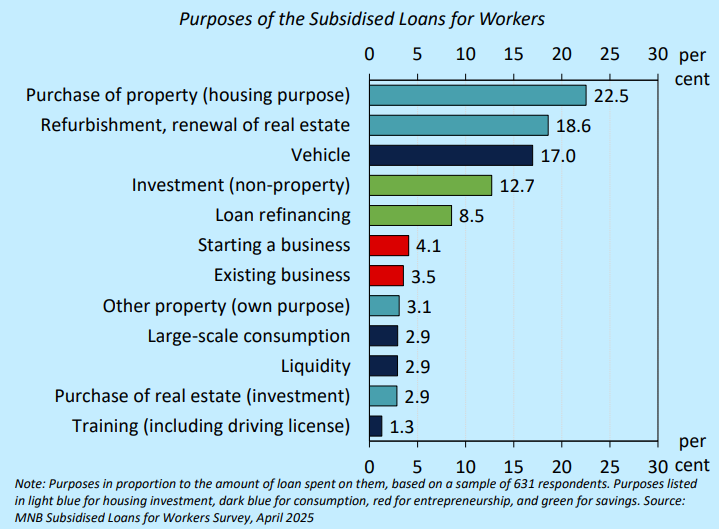
The MNB has conducted a survey into the Subsidised Loan for Workers, a new, state-subsidised unsecured product offered by banks, which has been available since January 2025. In the first four months of the year, a total of 20,000 contracts were concluded, worth HUF 77 billion. Almost half (47%) of the disbursements are used for housing purposes (purchase, construction, renovation, equipment), 17% for vehicle purchase, and less than 10% for loan refinancing.
Based on the MNB's estimate, contracts worth around HUF 300 billion (i.e. around 77,000 contracts) may be concluded in 2025 as a whole.
Market lending for housing continues to be driven by low interest rate spreads. The MNB pointed out that,
In the longer run, interest revenue failing to cover the credit risk and operating expenses may pose a stability risk to the financial intermediary system.
At the request of the Economy Ministry, banks may introduce another voluntary interest rate cap of 5% for market-based housing loans in the period between 1 April and 31 October 2025, but according to the central bank's estimates this will not have a significant impact on domestic housing and loan market processes.
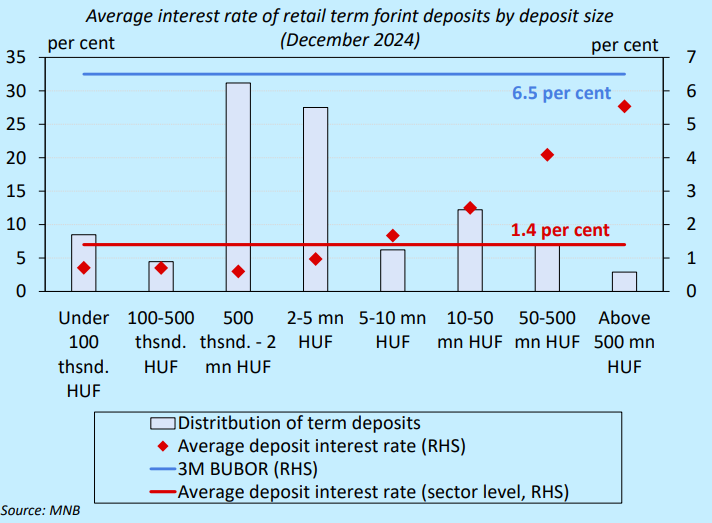
The deposit market shows heterogeneous interest rate transmission, the extent of which depends substantially on the size of deposits. The average interest rate on retail deposits below HUF 5 million is only 0.8%.
In the housing market, contrasting trends in supply and demand have led to an acceleration in house price increases. This was driven by a reduction in the number of newly built homes and a substantial increase in demand. The year-end increase in sales was mainly due to an increase in demand for early repayment and investment. Risks to housing lending from stretched incomes remained moderate at the national level. Housing price dynamics at the beginning of the year suggest an increase in overvaluation. The MNB uses the House Price-at-Risk (HaR) model to measure downside and upside risks to house price movements.
Cover photo: Shutterstock





