Moody's completes periodic review of Hungary's ratings


Among the key rating considerations, Moody's notes that Hungary's ratings, including its Baa2 long-term issuer ratings, are "supported by a diversified economy with moderate trend GDP growth, and the authorities' commitment to gradual fiscal consolidation."
It added, however, that
Credit challenges arise from institutional and governance weaknesses, which mean that Hungary may lose out on a substantial amount of the envisaged European Union funds.
Consequently, Moody's added, this could weaken the credit rating agency's
assessment of institutional strength, lower trend GDP growth, and weaken fiscal and debt metrics.
The rating agency thinks that "Hungary's susceptibility to geopolitical event risk is moderate, driven by risks due to Russia's war in Ukraine and the disengagement of the United States from its historic role as a guarantor of European security."
Their baseline scenario does not assume a military confrontation between NATO and Russia.
Moody's noted that Hungary's real GDP growth for the winter half of 2024-25, as well as the rating agency's own near-term forecasts, are lower than expected at the time of the last rating action in November 2024.
We have lowered our GDP growth forecasts for 2025 to 1% from the previous estimate of 1.9%, and for 2026 to 2.8% from 3.2%. Consequently, this slightly lowered our estimate of trend growth to 2.2%.
Fiscal developments
Regarding fiscal developments, Moody's continues to expect the debt-to-GDP ratio to remain broadly unchanged over 2025-26 compared to 73.5% in 2024. As expected at the time of the last rating action, they forecast parts of the material weakening of debt affordability metrics in 2023-24 to be temporary. Interest payments to revenue increased significantly to 11.8% in 2024 from 6.6% in 2022 due to the lagged impact of inflation-linked debt, Moody's added.
With the slowdown of consumer price inflation and its effect on inflation-linked debt, Moody's forecasts interest payments will decrease to 9.9% of revenue in 2025 and remain on a gradual downward path from 2026 onwards.
Significant risks to our fiscal forecasts relate to a potential sharp increase in government spending ahead of the 2026 parliamentary election.
So, after Moody's last gave Hungary a negative outlook six months ago, the rating agency has not modified its current rating or the outlook assigned to it. In other words, despite worsening trends such as lower growth, high levels of government debt, a lack of EU funding, a deteriorating international economic environment, uncertainties surrounding customs policy and geopolitical tensions, as well as significant fiscal risks such as overshooting the deficit target and the possibility of election-related spending, the rating agency has chosen to adopt a patient approach and wait and see what happens in Hungary. It is not common practice for major rating agencies to heavily penalise a country at the first opportunity after issuing a negative outlook. It will be interesting to see which of the risks identified by the rating agency materialise in the next six months or so (whether negative or positive), and in this respect, the situation could become more challenging for the rating agencies' assessment of Hungary this autumn, as the 2026 parliamentary elections draw closer.
The Hungarian economy and its growth
Moody's notes that "Hungary's credit profile is supported by the country's "a3" economic strength, which balances the significant size of the Hungarian economy, high national income levels, and moderate trend growth that is supported by FDI projects, against longer-term challenges such as population aging and potential difficulties in further moving up the value chain."
It adds that the country's "baa3" institutions and governance strength reflects "a moderately strong overall institutional framework that has some features that could erode policy credibility. In this context, weaknesses at the institutional level have been at the origin of a contentious relationship with the EU, causing uncertainty about the disbursement of significant EU funds."
"The "ba1" fiscal strength score considers the high government debt burden and the significant weakening in debt affordability metrics mainly driven by inflation-linked retail government securities in 2023-24. This weakening is expected to partly reverse, stabilizing from 2027 at a level consistent with the "ba1" score for fiscal strength."
Moody's fiscal strength assessment also includes a negative adjustment because "general government foreign currency debt is greater than 20% of GDP. Hungary's "baa" susceptibility to event risk score is driven by political risk and banking sector risk."
That negative outlook...
Moody's said that the negative outlook on Hungary reflects downside risks related to the quality of Hungary's institutions and governance, which means that
the country may ultimately lose out on a substantial amount of the envisaged EU funds because it does not meet the conditions for the release of these funds. In turn, this could lower trend GDP growth and weaken fiscal and debt metrics.
This situation happens in the context of weak growth in Germany, one of Hungary's key trading partners, which could amplify negative pressure on the economy, while
a potential sharp increase in government spending ahead of the 2026 parliamentary election could exacerbate negative fiscal trends.
Moody's adds that
the negative outlook signals that the rating is unlikely to be upgraded in the near term.
The outlook will likely be returned to stable:
- If there is a significant and durable improvement in the relationship with the EU and further progress with respect to the super milestones. Full compliance with the conditionality would unlock sizeable EU funds which would be credit positive due to its beneficial impact on Hungary's economic, fiscal, and institutional strengths.
- Additionally, achieving a more substantial fiscal consolidation, resulting in significantly better than expected fiscal and debt metrics, would be credit positive.
- Furthermore, a materially stronger than expected trend growth resulting in faster than expected income convergence with the EU average would be credit positive.
Moody's also lists conditions that would be credit negative:
- A further, significant delay in reaching an agreement between Hungary and the EU on the fulfillment of required reforms would put a substantial part of EU funds at risk which would weigh on the rating.
- Hungary's institutions not being able or unwilling to fully implement the remaining reforms would have a negative impact on the quality of the country's institutional framework, which would be credit negative.
- More generally, signs of a reversal of fiscal consolidation and a material weaker than expected trend growth rate would be credit negative.
- In addition, given the still high reliance of Hungary on energy imports from Russia, a prolonged energy supply disruption would also be credit negative.
- Moreover, Hungary's Baa2 ratings would come under pressure were susceptibility to event risk to rise significantly, possibly in the context of a military confrontation between NATO and Russia, which we view as a very low-risk, very high-impact shock.
"National Bank of Hungary's (NBH) long-term issuer rating remains unchanged at Baa2. NBH's negative outlook remains unchanged as well. NBH's credit profile is closely intertwined with that of the government and influenced by the same credit fundamentals. Its ratings and outlook are therefore in line with those of the government," Moody's added.
Economy Ministry responds
Shortly after the statement was released by Moody's late on Friday evening, the Economy Ministry issued a response, in which it stressed that, like the other rating agencies, Moody's continues to recommend Hungary for investment.
The ministry argues that the Hungarian economy is on a sound footing. In addition to aiming for the highest possible growth, the ministry has set a target to have the credit rating outlook upgraded from negative to stable. However, the ministry does not mention any concrete measures to achieve this.
The ministry then turned to government measures designed to support household consumption and encourage investment by SMEs. According to the ministry, these measures would boost GDP growth.
As has been the case on previous occasions, the ministry did not address the warning signs and potential downside risks in Moody's rating. More interestingly, this time the ministry's statement does not even touch upon the rating agency's comments on the budget, although in this type of communication it is customary to reassure creditors and rating agencies that the government is keeping the deficit process under control.
It is no coincidence that, each time it has commented on the three most recent rating decisions (Moody's in November last year, Fitch in December and S&P in April this year), the ministry has made a point of emphasising that "the government is committed to tight fiscal management, reducing the budget deficit and public debt".
However, there was no such message in the ministry's response to Moody's latest periodic review.
Previous assessment by Moody's published six months ago
Moody's carried out is previous periodic rating review on Hungary last November when it downgraded the country's rating (Baa2) outlook to negative from stable.
The decision came against the backdrop of stagnating EU funding and the rating agency's expectation that Hungary could lose some of the funding it is due by the end of this year. They also warned that the Hungarian economy's perception was not helped by Germany's woes and the expected increase in government spending due to the 2026 parliamentary elections. They said all these factors combined to weaken the country's fiscal strength.
What next?
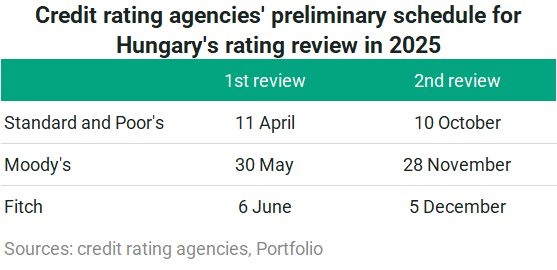
Fitch Ratings, one of the three major international credit rating agencies whose decisions are most closely followed by market participants, will be next on Friday, bringing the first half of the review cycle to a close.
Standard and Poor's was the first in line this year, downgrading the outlook in April.
Here is how the second half of the rating review calendar for Hungary looks (we wrote about this in more detail here):
Cover photo: Jeenah Moon/Bloomberg via Getty Images





