Debate on Hungary's controversial transparency bill postponed


Foreign influence in next year's election
Citing its own report on foreign attempts to interfere in the Polish presidential elections by supporting the government's candidate, the daily newspaper Magyar Hírlap asked Gulyás whether the same thing might happen in Hungary next year. Gulyás said that it was unacceptable and intolerable for the European Commission to fund campaigns. According to Gulyás, Brussels poses the biggest threat because it favours one side or the other based on its own sympathies.
Debate on transparency bill postponed
Gergely Gulyás reiterated what Máté Kocsis announced a few hours ago: the debates on the transparency law cannot be concluded satisfactorily, which is why the parliamentary group postponed the vote. The proposal came from the faction, and Viktor Orbán took note of it, he said.
When later asked if the threat of EU sanctions played a role in the postponement of the debate on the transparency bill, Gulyás replied said that the parliamentary group could answer this question, but he does not think so.
"We will remove the transparency law from Thursday's legislative committee agenda, and no decision will be made on the issue before the summer. The National Assembly will not vote on it", Máté Kocsis, leader of the Fidesz parliamentary group, told Index on Wednesday.
The proposal, which the government argues is aimed at protecting Hungary's sovereignty, but which critics argue is aimed at stifling any civil society organisation or media outlet that dares to criticise the government, will only be discussed in the autumn session. According to Kocsis, the group is united in its belief that legal instruments are needed to protect sovereignty. However, they are still debating which instruments are needed.
In a Facebook video, Kocsis said that there are many proposals for the draft law that need to be discussed. Therefore, he is not sure that it will be adopted in the spring session. He later clarified that the discussion of the law would be postponed until autumn, in order to allow time for the proposals of professional organisations to be considered.
Gov't wants guarantees from the capital
Gergely Gulyás explained that they are ready to support the Municipality of Budapest, but only if the cabinet receives guarantees during the negotiations that the support will be used to implement meaningful measures to improve the city's budget.
When asked by ATV how much money would be paid to the capital, the minister said that they are still in negotiations, so it is not yet possible to answer this question.
Passengers can turn to court over Budapest transport disruption
Answering a question, Csaba Latorcai said that anyone who suffers damages due to the planned ten-minute public transport shutdown on Friday can go to court.
Asked whether Karácsony's statement that another 18 billion forints will be taken away from the capital is true, Gergely Gulyás said that it is not true that the money be kept by the casinos, because they will not keep a penny. The amendment applies to Szerencsejáték Zrt, but it does not only affect the capital. According to him, this could mean a total amount of around HUF 10 billion, which could affect the capital in proportion to lottery players.
Where could they build the new cargo airport?
'We have identified four possible locations for the new cargo airport. The government will support whichever location is favoured by the local government,' said Gergely Gulyás in connection with Tuesday's announcement.
What will happen to Budapest?
There is a procedure for municipalities in bankruptcy. The first question is whether Budapest has already reached this situation. All municipalities must respect the laws, from the richest to the poorest, says Deputy Minister Csaba Latorcai. He says that the legal situation should be examined to establish whether it is necessary to appoint a budget supervisor, and if so, one should be appointed.
Raising Hungary's defence expenditure
In line with NATO's expectations, we will also likely increase military spending by the target date. There is still debate about whether the target should be 3 or 5%, but Hungary supports the idea that member states should increase their spending on this as a proportion of GDP, said Gulyás.
“Significant Russian and Ukrainian funds have been moved in order to support various propaganda efforts,” Gulyás repeated. According to the minister, there is still a provision in the Criminal Code that makes war propaganda punishable, and "the authorities must take action against it."
Journalists in Hungary are paid to produce war propaganda for both countries,
he said earlier.
Of NATO’s 32 members, 24 now meet the alliance target of spending at least 2% of GDP on defense, and US President Donald Trump is pushing for that to rise to 5% — a figure that only Poland comes close to meeting at the moment (3.83% in 2023), with Lithuania having pledged to hit it in the future.
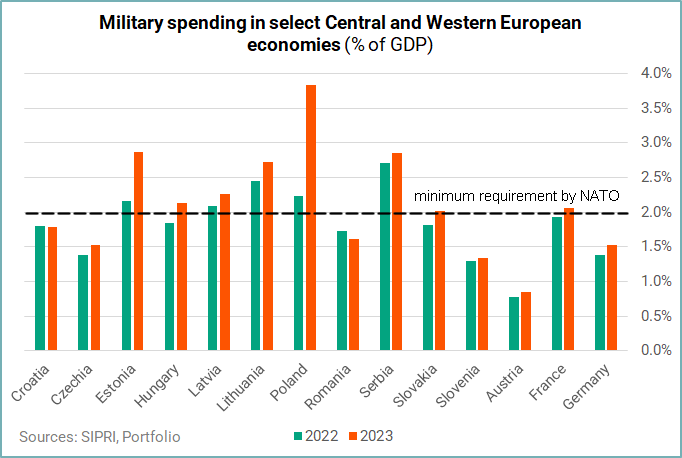
According to the Stockholm International Peace Research Institute (SIPRI), Hungary's miliary expenditure amounted to 2.13% of its gross domestic product in 2023, which was not the highest in the region, but at least exceeded the 2.0% NATO requirement and showed an annual growth of 0.29 percentage points. Poland stood out with 3.83%, a huge jump from 2.23% of GDP defense spending in 2022 (+1.6ppts).
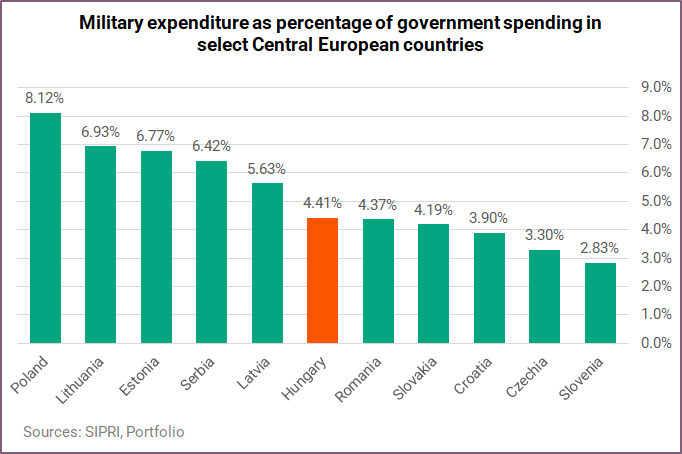
When it comes to military expenditure as a share of government spending, Poland stands out with 8.12%, while Hungary is ranked in the middle of the region with 4.41% in 2023.
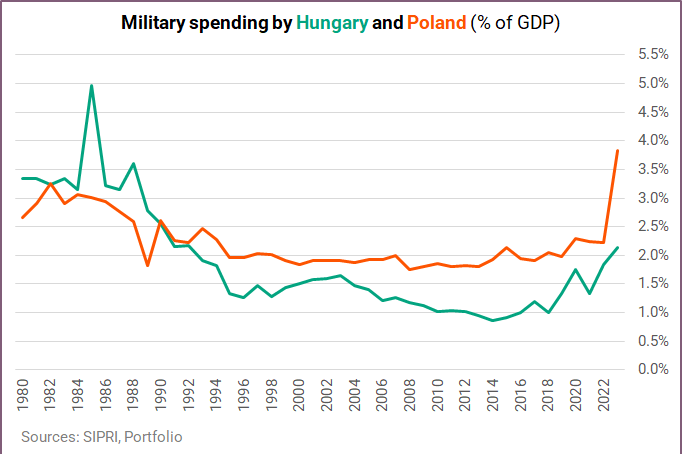
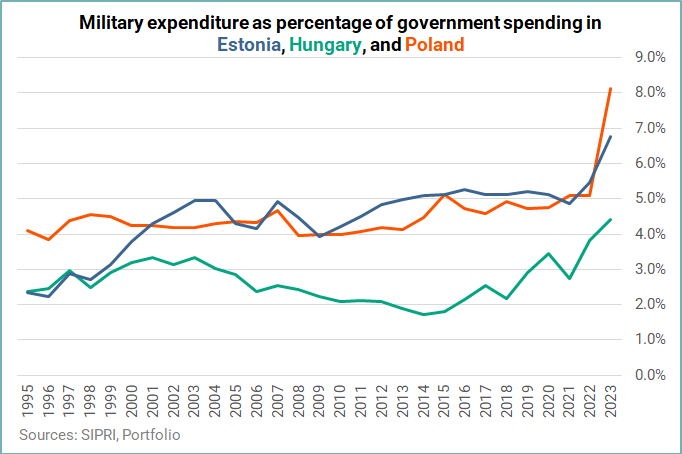
Poland's spending grew the most in the region (+3.02ppts), followed by Estonia (+1.32ppts) and Hungary (+0.61ppts).
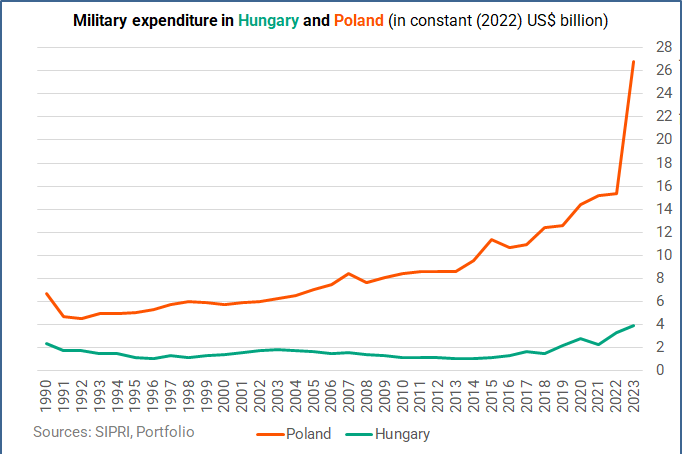
Hungary is ranked 4th in the region in terms of defense spending in constant (2022) USD, with about USD 3.88 billion in 2023. Poland is way ahead of its peers in this category with a whopping USD 26.78 billion expenditure.
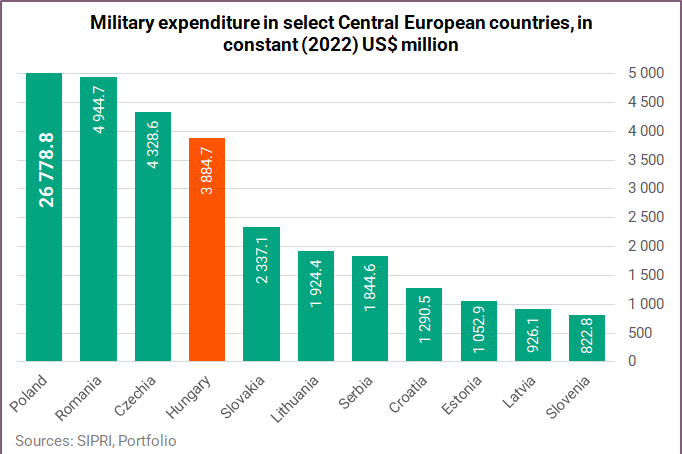
Poland's miliary spending in constant (2022) USD leaped 75% year on year in 2023, while Estonia recorded the second-sharpest growth of 29, followed by Hungary (+19%).
Latorcai chimes in
Csaba Latorcai, a guest at the press conference, has listed how many billions of forints the government has contributed to the operation of the capital in recent years.
According to Latorcai, Budapest needs to draw up a new budget, and the municipality must be scrutinised to determine how the money has been spent. In 2019, István Tarlós handed over control of Budapest with more than 200 billion forints in the city's coffers, he claims.
Regarding the solidarity tax, Latorcai said later that Budapest should pay it for commuters. When asked why the payment rate has increased ninefold compared to 2019 (Tarlós' time), Latorcai did not answer, but said:
Financially, there is no danger that the capital's municipality will become a net contributor.
Budapest bankrupted
The government has also addressed the situation of the capital city's municipality, and we want its activities to reflect the city's greatness. By contrast, the capital's current position is clearly the result of management errors. Six years ago, Budapest was won by a substantial margin, and bankruptcy was not a topic of discussion in last year's campaign, said Gulyás.
The responsibility lies solely with the capital's leadership, but we are ready to help,
said Gulyás. He added that this will require thorough screening to reveal the scale of the problem.
The government has appointed Deputy Minister Csaba Latorcai and Gergely Gulyás to negotiate with the capital.
At the end of last week, Mayor Gergely Karácsony claimed that the State Treasury had illegally pulled HUF 10.2 billion out of the capital's account. He also said that 'dramatic scenarios' were being prepared for the city's public service companies. Speaking at a press conference on Wednesday, he claimed that the government intended to take additional funds from the capital via a legislative amendment.
Following the press conference, there was an exchange of messages between Economy Minister Márton Nagy, and the Mayor of Budapest. Prime Minister Viktor Orbán''s Fidesz party claims that Gergely Karácsony had driven the city to the brink of bankruptcy. Meanwhile, Péter Magyar, the head of the Tisza Party and Orbán's greatest challenger in next year's election, wrote to Márton Nagy accusing the government of trying to bankrupt Budapest and other municipalities for years.
Demján Sándor Programme
In the Demján Sándor Programme, the government will increase funding for SMEs from HUF 50 billion to HUF 130 billion. Around 1,800 companies will be able to benefit from this resource, which can be used for investment, development and capacity expansion, said Gergely Gulyás, describing the government's recent decision.





