Bank profits in Hungary plummet - What has happened?


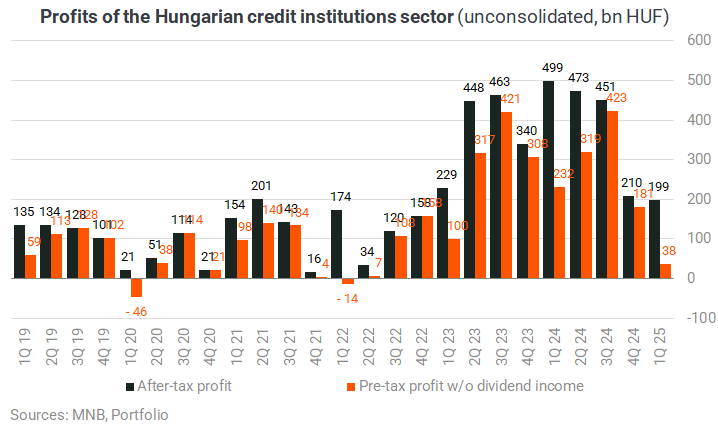
The National Bank of Hungary (MNB) has published its prudential data for the first quarter for the Hungarian banking sector. These show that the sector made an after-tax profit of HUF 199 billion in the first three months of the year on a non-consolidated basis (i.e. excluding OTP's foreign subsidiaries, for example).
Excluding dividend income from partly foreign and non-bank subsidiaries, profit stood at just HUF 38 billion. The former figure represents a 60% drop over the past year, while the latter represents an 84% drop. While the profit of HUF 199 billion
represents a 'raw' annualised return on equity of 9.3%, it is too soon to draw any far-reaching conclusions.
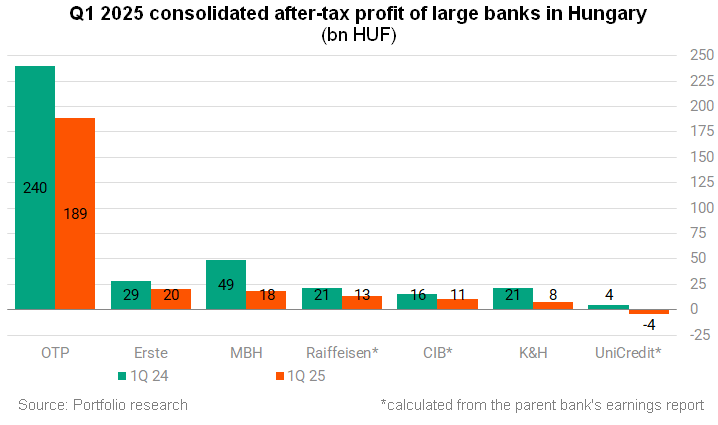
Based on published preliminary earnings reports, press releases and press conferences, the after-tax profit of all seven major banks fell to HUF 256 billion in Q1 this year from HUF 380 billion a year earlier on a consolidated basis. The reasons for this decline vary from bank to bank: some are mainly due to an considerably increase in windfall profit tax (e.g. OTP), while others are due to a decrease in interest income (e.g. MBH). Several banks have also been affected by an increase in risk costs.
For the banking sector as a whole,
the deterioration in non-consolidated profitability should not be attributed to core earnings.
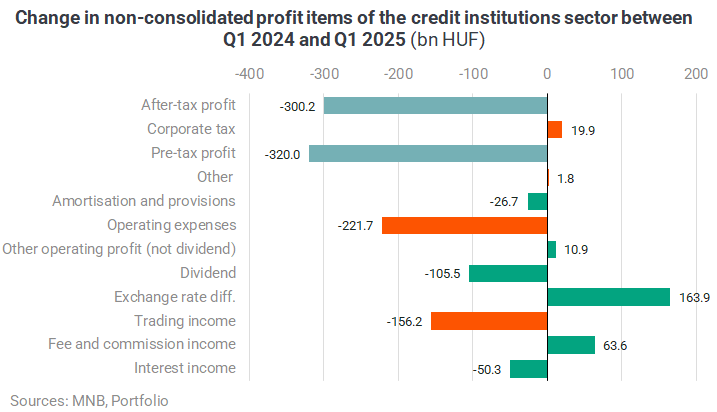
Although interest income fell by 8.6% year on year (due to the delayed impact of the decline in the interest rate environment), this was offset by a 26.1% increase in fee and commission income (partly due to the raise to the financial transaction tax, reflected in costs). Meanwhile, results from financial operations remained stable.
The decline in dividend income of HUF 106 billion, which is also included in revenue, is a significant figure. However, based on previous years' experience, it is possible that this year's dividend income will be higher in the second quarter than last year's.

Operating expenses have increased significantly by 37% in one year, which is clearly due to the rise in special taxes accounted for here. If this item only comprised personnel expenses, for example, we would see an increase of just 13%. By contrast,
the extra profit tax and special tax liability increased by 66%, rising from HUF 196 billion to HUF 326 billion,
which has significantly worsened banks' cost levels.

According to the government's communications, the banking sector could pay around HUF 180 billion in windfall profit tax this year, following last year's HUF 128 billion, if it succeeds in absorbing the tax burden set by law in exchange for the conditional increase in government securities holdings.
By contrast, the sector recorded an extra profit tax of HUF 210 billion in the first quarter (banks typically pay their entire annual extra tax burden in this quarter), which seems an overestimation, particularly given that the nominal increase in government security holdings required to halve this year's tax burden has already been achieved by the banking system. It is likely that the banks will revise this high level of extra profit tax downwards during the year, thereby improving the results in later quarters.
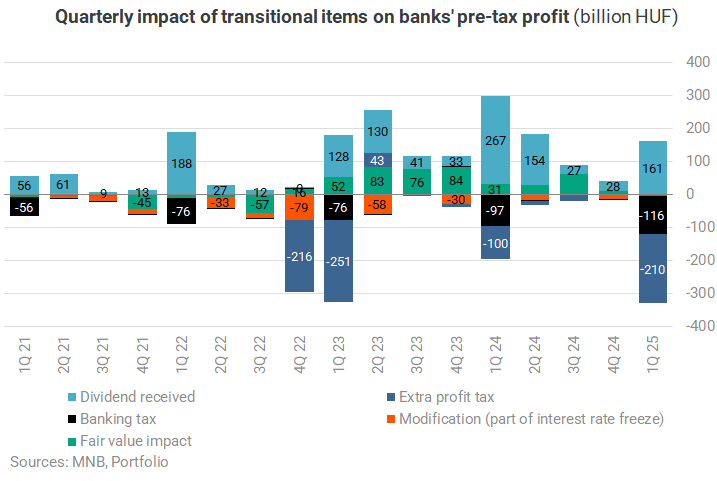
In addition to special taxes, adjustments should be made for the fair value effect related to the revaluation of subsidised loans, the 'adjustment loss' due to the interest rate freeze and the dividend income mentioned above when examining the income generation of the banking sector's activities more closely. Excluding these items from the pre-tax profit reveals a deterioration of 'only' HUF 48 billion compared to the previous year, whereas
without this adjustment, the sector's profit would have been almost double the actual figure.
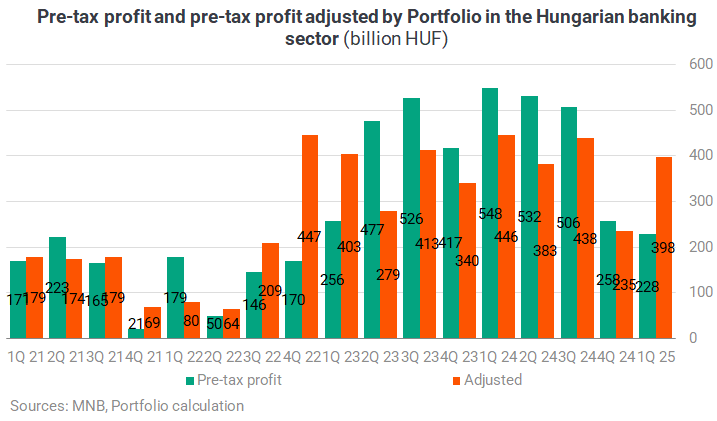
In the chart below, we examine which items improved and which worsened banks' results. We have not yet mentioned the impairment and provisioning line, which deteriorated by HUF 27 billion. This appears to be driven by prudent considerations, presumably due to expected portfolio deterioration resulting from the recessionary economic environment.
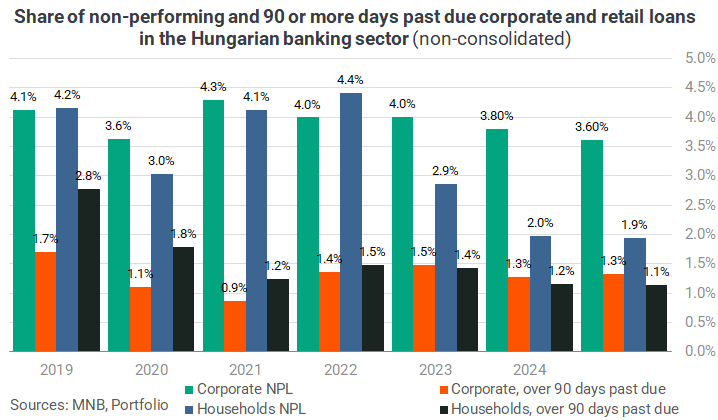
For the time being, the quality of the customer portfolio has not deteriorated. Compared to the end of 2024, the proportion of non-performing loans to corporates has fallen to 3.6% from 3.8%, and to households to 1.9% from 2.0%. Similarly, there has been no deterioration in the proportion of loans that are more than 90 days past due.
From a profitability perspective, banks' performance in the first quarter was mainly affected by an increase in special taxes and a decline in dividend income. The situation is also mixed in terms of business portfolios.
While corporate loans and deposits declined sharply in the first quarter, retail loans and deposits increased at a welcome rate.


Cover image (for illustration purposes only): Getty Images





