Borrowing in Hungary at a dizzying high, but how long will this retail fever last?


The Hungarian central bank has published its lending and deposit statistics for the banking sector in April. Compared to March, the number of new retail lending contracts decreased slightly for housing loans (HUF 134.1 billion), personal loans (HUF 90.5 billion), Baby Loans (HUF 17.0 billion) and the Workers' Credit (HUF 17.7 billion). However, this can largely be attributed to the Easter holidays.
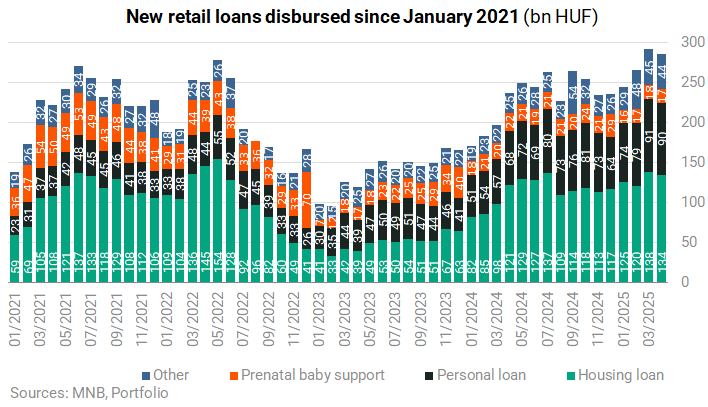
Nevertheless, banks disbursed 34% more home loans, 46% more personal loans, and 38% more total household loans in the first four months of the year than in the same period the previous year. The decline in Baby Loans was offset by an increase in the Workers' Credit.

At Portfolio's Lending 2025 conference on 22 May, the majority of the professional audience (45%) believed that the new volume of home lending could peak this year. Meanwhile, 36% thought that we were somewhere in the middle of the recovery process, and only 6% thought we were at the beginning of the process that started last year. Furthermore, 9% of the audience expected a decline this year.
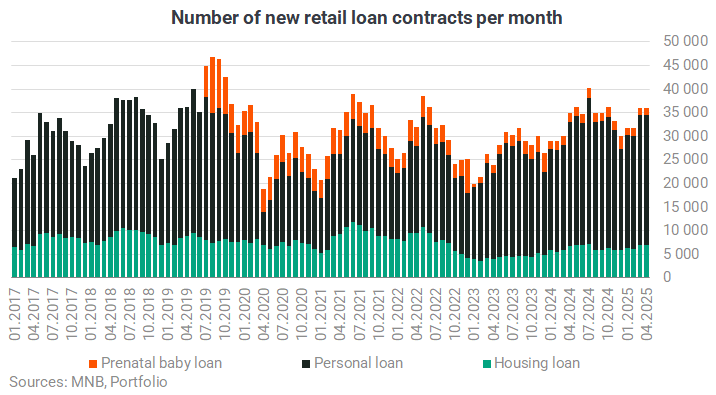
The annual increase in the number of contracts is much smaller: the number of new housing loans increased by 9% this year alone, while the number of personal loans went up by 13%, meaning that the growth in lending in 2025 is mainly due to the increase in the average loan amount, not to more borrowers.
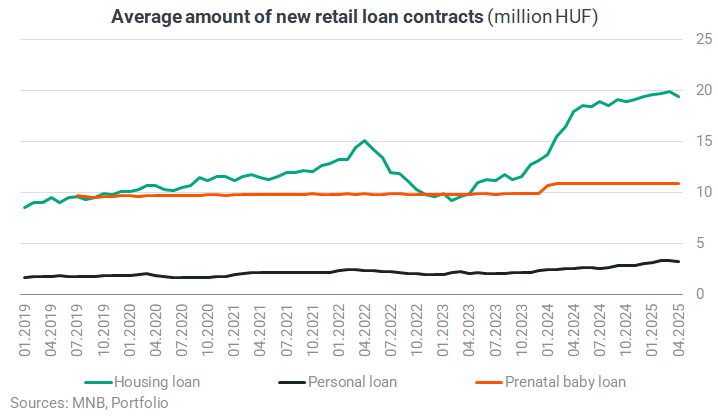
In April, the average housing loan was HUF 19.5 million, while the average personal loan was HUF 3.3 million. The average housing loan is now 8% larger than a year ago, while the average personal loan is 26% larger. However, the average amount of housing loans has increased significantly in annual terms in the previous months, not in April.
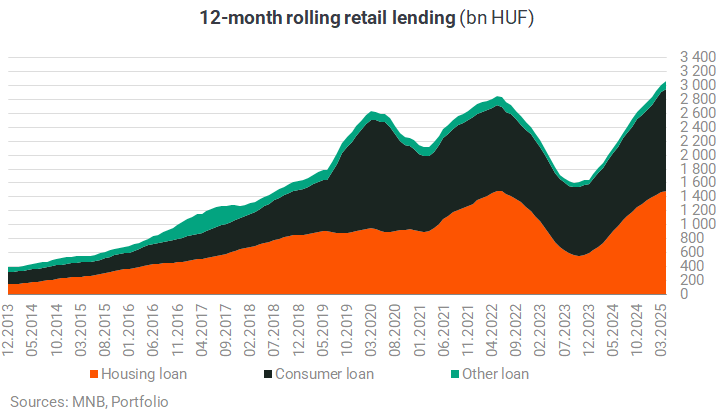
The chart below shows that, despite the minimal slowdown in April, household lending is still at a record high. Over the past 12 months, households have taken out loans worth HUF 3,059 billion, of which HUF 1,482 billion were housing loans and HUF 1,466 billion were consumer loans. The volume of new housing loans could reach HUF 1,600 billion this year, up from HUF 1,350 billion last year.
Clearly, lending in the housing market is being driven by the sale of second-hand homes and market-rate loans, with new volumes of the latter up 47% this year, while subsidised loans are down 2%. CSOK Plus's momentum at the beginning of last year seems to be fading this year. While the market for open-ended mortgages remains weak, monthly data from the MNB indicates a level of new lending of 9.9 billion, which has not been seen since June 2023.

As with CSOK Plus, the demographic downturn could account for the 17% decrease in baby loans this year.
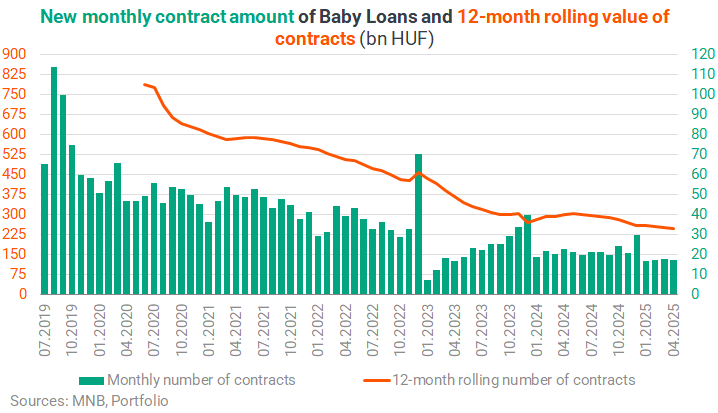
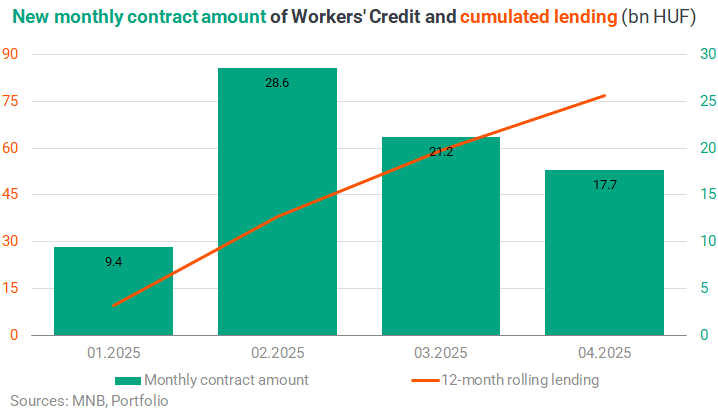
From a banking perspective, the HUF 14 billion drop in lending in the first four months of the baby loan is amply compensated by a new product: HUF 77 billion of interest-free loans to workers. At the same time, the initial surge appears to be subsiding: the number of new contracts has been declining since February.
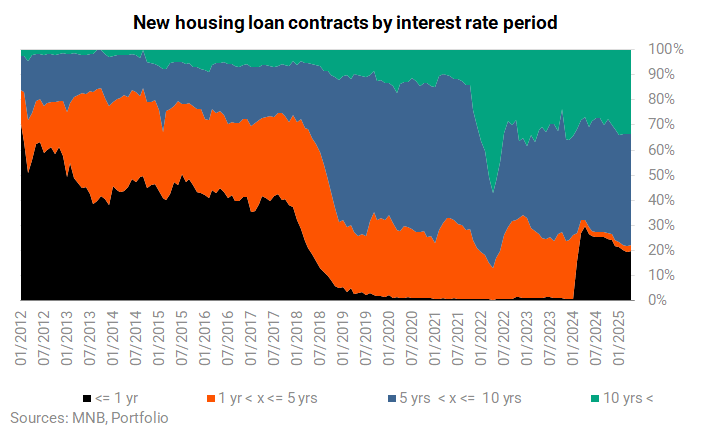
The weakness of CSOK Plus is also evident from the decreasing share of variable-rate loans in housing lending, as CSOK Plus is classified as such in the statistics due to the way interest rate subsidies work. In normal housing lending, there are no variable loans per year, where loans with a 10-year interest period and fixed repayments are clearly dominant.
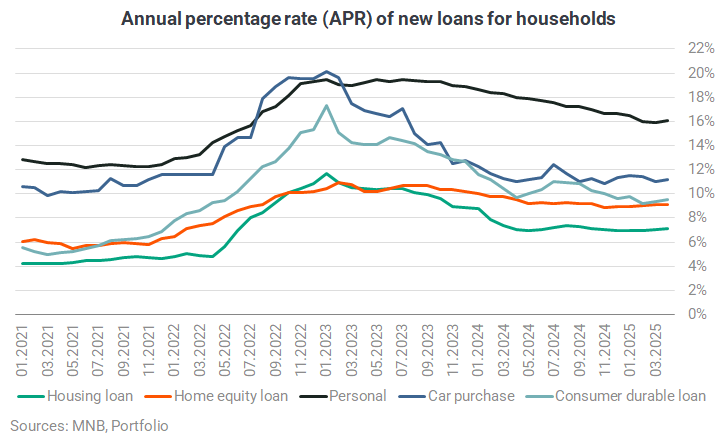
The average interest rate on market-rate mortgages has remained at around 6.5% for over a year now, which is no coincidence. The yields on the government security market have also remained fairly stable during this time.
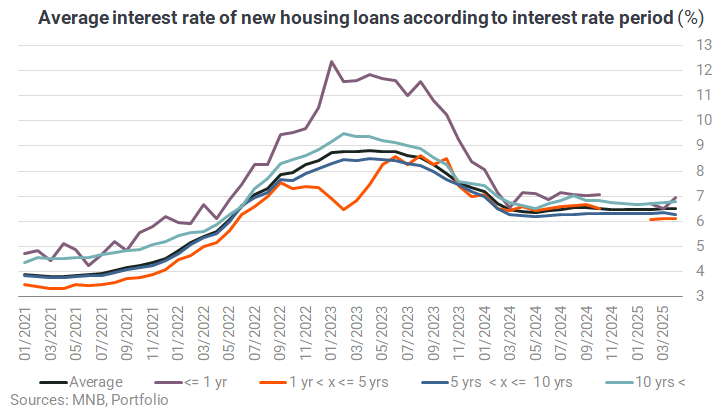
The average APR for new home loans is 7.1%, whereas for personal loans it is 16.1%. This is up slightly from the previous month, presumably due to composition effects, but still 1.8 percentage points lower than a year earlier.
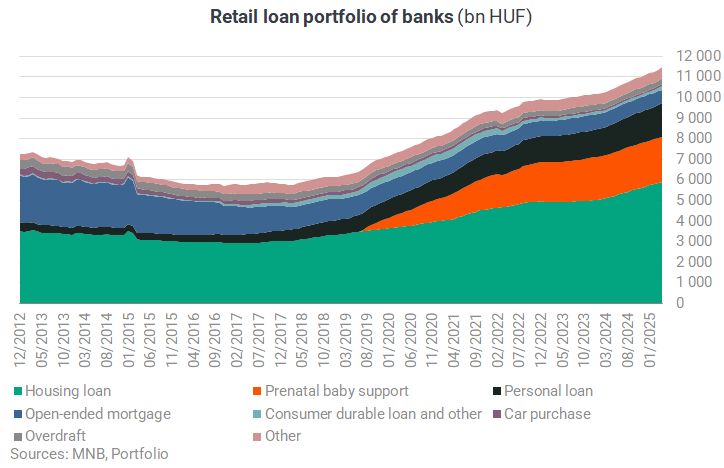
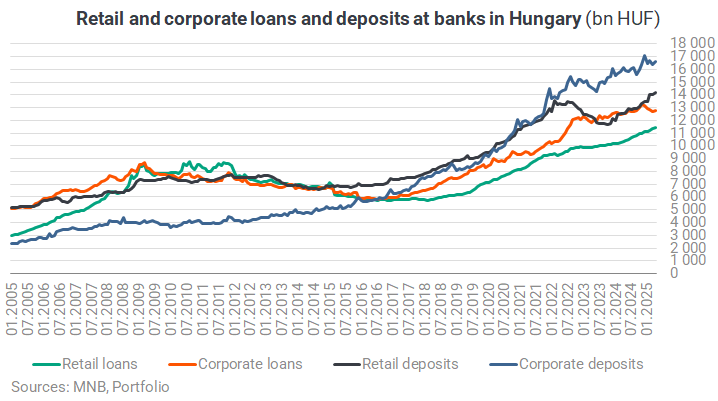
Overall, households owed 10.7% more to banks at the end of April than a year earlier, with an outstanding principal of HUF 11,458 billion, which is a new record.
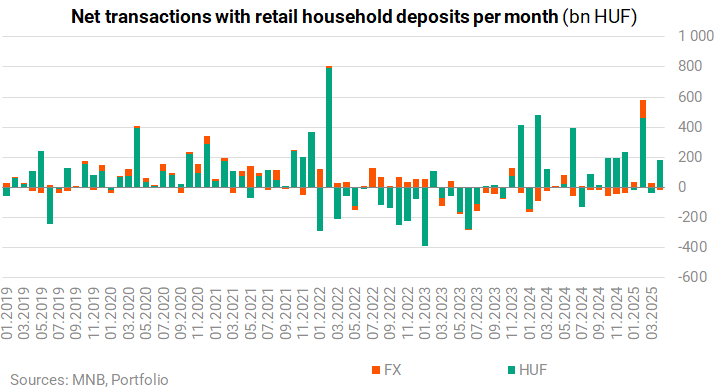
In terms of deposits and current accounts, households deposited HUF 169 billion more than they borrowed in April, which is presumably mainly due to the impact of interest payments on government securities. Since the beginning of the year, household deposits have grown by HUF 765 billion through transactions alone.
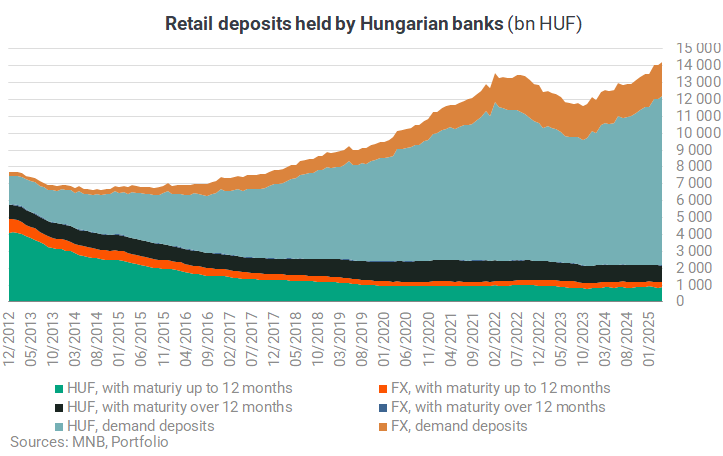
Banks pay an average interest rate of 5.4% on fixed deposits to companies, but only 1.5% to households.

This also explains why the stock of uncommitted household deposits reached a new high of HUF 12,037 billion at the end of April, accounting for 84.8% of total deposits.
The corporate lending sector continues to struggle: this year, firms repaid HUF 159 billion more than they borrowed.
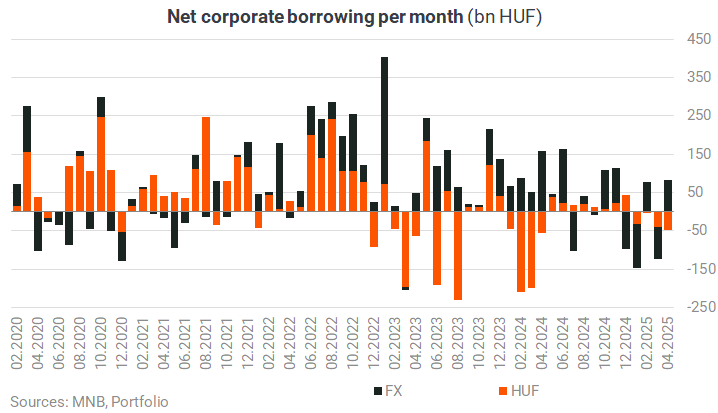
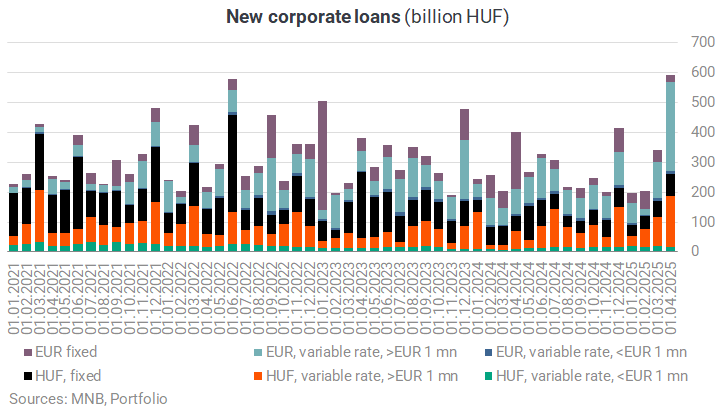
There is a glimmer of hope, however, in the fact that corporate loan transactions reached HUF +37 billion in April, with new contracted amounts reaching a new high, mainly thanks to variable-rate euro loans of more than EUR 1 million. However, bankers say that a significant proportion of these loans are not currently being drawn down by companies. Perhaps this will change in the coming months.
So far this year, total loans to companies have fallen by HUF 342 billion (2.6%), while their deposits have fallen by 2.8%. In contrast, household credit has grown by 3.2% this year alone, compared to an increase of 10.7% over the past year.
Cover photo: Portfolio





