Gigantic MVM dividend comes to the rescue of Hungary's budget


At first glance, the May surplus of HUF 129.5 billion is outstanding compared to previous years. The last time the central government subsystem recorded such a large surplus was in 2016.
In a statement, the Economy Ministry said that "this month, a HUF 213.5 billion dividend was paid into the budget by MVM. Although the deadline for corporate tax payments was 2 June this year, tax revenues totalling HUF 238.4 billion were received by the end of the month".
It is important to note that MVM's dividend payment in May does not alter the full-year budget outlook, which indicates that developments are worse than anticipated. When the 2025 budget was adopted last year, we already pointed out that dividend payments from state-owned companies would provide a significant boost to the budget this year.

The ministry later pointed out that the central budget closed May with a surplus of HUF 129.5 billion, which was HUF 80.5 billion higher than in the same period last year. However, the May balance should take into account the HUF 213.5 billion dividend payment from MVM that was received by the budget that month.
The deadline for corporate tax payments is 31 May. However, the legislation stipulates that if this falls on a weekend, the deadline is extended to the next working day. In this case, the deadline was Monday 2 June. Nevertheless, a significant number of businesses paid their corporate tax by 31 May, with HUF 238.4 billion in tax revenue being received by the end of the month.
Without the HUF 213 billion MVM dividend payment, the May budget balance would have been HUF -84 billion. This would have been consistent with previous years' May budget balances, with the fifth month readings of the last ten years showing an average deficit of HUF -80 billion. This also confirms our view that the surplus figure for May does not significantly improve the annual budget as a whole, which is worse than the government had previously anticipated.
On Tuesday morning, it was also revealed that the government now officially expects a higher annual deficit in 2025. It has raised its accrual deficit target to 4.1% of GDP and its cash deficit target by HUF 651 billion. The government attributes the higher expected deficit to three factors: 1) A shortfall in EU recovery fund resources. 2) A worse-than-expected macroeconomic outlook. The new government's forecast of 2.5% GDP growth this year also seems unrealistic — even a 1% increase in output would be a pleasant surprise. 3) Balance-worsening measures decided by the government just a few months after the adoption of the 2025 budget (e.g. personal income tax exemptions for mothers).
Worse-than-expected fiscal developments
In fact, the government only admitted today that this year's budget is showing worse-than-planned trends.
The Economy Ministry announced on Tuesday, just hours before the publication of the May public finance data, that it would increase the projected cash deficit for this year.
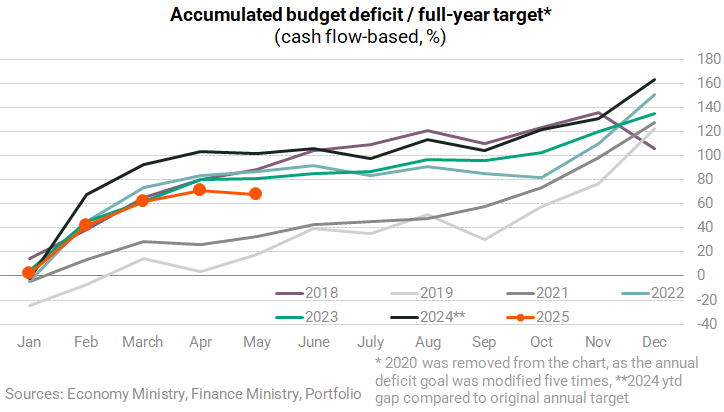
The annual deficit target has been raised to HUF 4,774 billion from HUF 4,122 billion.
By the end of May, the central sub-system of the general government had recorded a deficit of HUF 2,800.9 billion. The central budget showed a deficit of HUF 2,747.2 billion, while the ex-budgetary funds showed a surplus of HUF 45.3 billion and the social security funds showed a deficit of HUF 99.0 billion, according to a statement released by the ministry on Tuesday morning.

The shortfall reached 68% of the original cash deficit target of HUF 4,122 billion by the end of May. The 'extra' payments received in May will therefore improve the deficit trajectory only temporarily. However, compared to the increased annual cash deficit target, the deficit for the first five months is 58.6%.
Let's see some details!
On the expenditure side, interest payments amounted to HUF 2 217.7 billion by the end of May, HUF 457.1 billion higher than in the first five months of 2024. As in previous months, this is due to the different interest payment dates of the maturities and the different structure of public debt, the ministry explained.
Spending on pensions and similar benefits, including the 13th-month pension, also increased to HUF 3,292.9 billion. Meanwhile, spending on curative and preventive medical care totalled HUF 1,250.6 billion.
Tax and contribution revenues were 7.8% higher in the central subsystem than in the same period the previous year, with consumption-related taxes increasing by almost 12%. The ministry said that both general sales tax and income tax revenues had exceeded the previous year's level.
Cover photo: Kornél Kisgergely, state secreatry for public finances of the Economy Ministry, speaks during the debate on the bill on the foundation of Hungary's 2026 central budget at the plenary session of the National Assembly on 23 May 2025. Source: MTI Photo/Zoltán Balogh





