Péter Ákos Bod: Hungary is overtaken in the bend


According to the official narrative, the best way to assess our economic performance is to compare it with the EU average or with a previous point in time. This is accurate: progress is being made, but more could certainly be done. However, confusion arises when Eurostat publishes data on gross domestic product per capita, real household consumption, wage levels and labour productivity, at which point we find ourselves at the bottom of the European Union's country rankings.
Dissonance may be addressed by attributing measurement errors to comparative indicators or by seeking indicators that demonstrate a more favourable ranking. A common defence in the context of an unfavourable ranking is to claim that it is sensitive to the indicators used. Indeed, in cases of small ranking differences, the measurement methods used to calculate price levels and exchange rates may be open to question.
Confrontation with the facts, however, can stimulate critical interpretation of the Hungarian economic trajectory, as has happened in professional circles in response to Romania's rapid progress. It is important to realise that, when it comes to assessing our situation realistically, it is the comparative framework that is important, not the methodology of measurement.
But what should be the frame of reference? What should be the benchmark?
The EU average provides some guidance for descriptive analyses. As a point of reference, it is useful to measure an index against a baseline of fifteen years or more. For businesses, however, the real benchmark is the group of countries that are currently relevant. Thirty years ago, the Visegrad Group was used to assess Hungary's economic, financial and social indicators. Today, this is only partly true.
One of our main findings here is that Hungary has gradually ‘slipped south’.
Another related aspect is that the relative loss of position usually occurred at times of external shocks.
In any case, the fact that Slovakia is classified as an advanced economy, the Czech Republic as 'other advanced', and Hungary as a European emerging market in the current International Monetary Fund classifications says a lot about the differences in the development paths of the former transition countries. Global financial market participants usually view Hungary in the same way. While I accept this classification with reservations, it is justifiable.
The recent announcement by Fitch Ratings to affirm our country risk rating (BBB) is a fresh and instructive case. The commentary is instructive too, not least the names of the other countries on the BBB rating list: Bulgaria, Indonesia, Kazakhstan, Peru, Philippines, Uruguay (in the EU, only Romania is now behind us with a BBB- rating from Fitch).
The Kazakh or Peruvian sovereign risk measure hardly tells us much. What does tell us something is that the Bulgarians' is on a par with ours (and ahead of ours in other ratings agencies). Only Romania has a worse rating in the EU than all three major rating agencies; we are now behind Croatia (especially since their entry into the euro area) and of course all the other regional states, whether they use the euro or not (Czech, Polish).
Country risk is just one measure, albeit one with significant consequences. However, there are other grouping criteria that continue to justify using the Visegrad Group yardstick to judge our relations and prospects. However, it is no longer possible to talk of catching up with the EU average, let alone Austria, without risking ridicule.
We could use the Austrian context as a point of comparison, in terms of history or the social psyche - but why?
In investor circles, Hungary is considered a peripheral member of the EU when forming business opinions. The past is only really used as a benchmark in economic decisions when the truth of an accepted idea needs to be reviewed. It was once widely held that Hungarians were ahead of most 'transition' countries in terms of market economy institutions, such as European-style accounting, commodity and stock exchanges, and trade and financial law.
This was certainly the case for a while. In the decade following the 1989 regime change, it was generally believed that the Czech, Hungarian, Polish and, to a lesser extent, Slovakian economies were among the first to be able to successfully integrate into Europe as mature market economies. Since then, the Baltic region and South-Eastern Europe have also moved beyond institutional and structural integration, albeit in very different ways.
The former Eastern bloc now forms the eastern outskirts of the EU. But these economies also show many signs of ‘fragmentation’.
Unfortunately, Hungary is no longer in the top three according to the established benchmarks. You don't need to be self-deprecating to see that. We have seen commendable performances in several countries undergoing regime change, which has resulted in a shift in relative positions. This process is ongoing, and it is a contest to determine which league a country belongs in.
The Hungarian relative situation, which is the subject of our analysis here, cannot be placed on a single indicator scale. As far as the evolution of gross domestic product (GDP) is concerned, over the last two decades we have seen that, as external conditions have become more difficult, the Hungarian economy has been relatively slipping back compared to the regional benchmark. We have had better years and more difficult years than others in our comparative framework, but there has been much variation in the ebb and flow of performance.
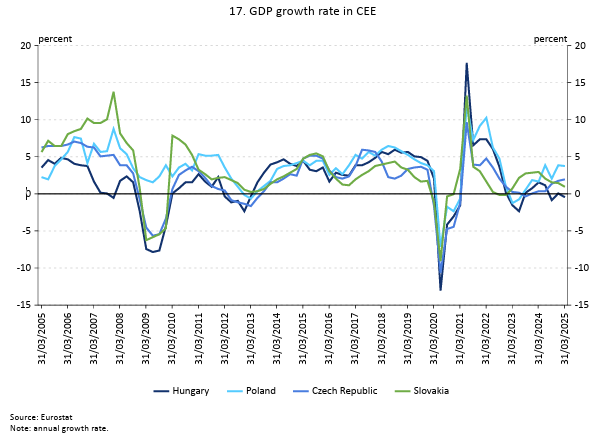
The trends of the last two decades show that major shocks, such as the financial crisis of 2007-2010, the pandemic in 2020 and the Russian-Ukrainian war after February 2022, have had a different impact on economic performance. Looking at the Visegrad region as a framework, it is striking that, compared to the others, Hungary's economic performance has fallen most in the really difficult times. At a time of euro area troubles that only indirectly affected the region, around 2012, our GDP also contracted the most.
So the pattern is: after a disruptive event, Hungarian performance falls relative to the V3 group. This also applies to most of the new Member States. Our ability to turn around is therefore relatively weak.
It is worth looking for structural factors behind this, but it is also worth mentioning economic policy practice. It is necessary to mention crisis management economic policy, if only because the opposite of what has been repeatedly said in high office: ‘we will overtake at the bend’. If that was the programme, it has not worked. The comparative figures show something quite different.
at most, we have seen impressive quarters of growth in those transitional moments preceded by deeper declines than others.
Speaking of the car metaphor in the economic policy narrative, the Hungarian economy has not proved to be a low-slung sports car with good road holding, which - although dangerous and to be avoided in daily life - can enter sudden bends quickly and then take off at high speed. If it's a vehicle, it's more like a loaded truck. Given the load it is carrying, it is very important to brake before a sharp bend, and from there you can only accelerate back again at the speed of the truck engine - following the other vehicles.
If this was the pattern so far, what would change it now, in 2025? To our great relief, Fitch has retained the previous rating and has not even added a negative outlook, even though its own macroeconomic model suggests that BBB- would follow from the key Hungarian data. Among other things, it said that Hungary's economic performance is struggling to recover from the loss of momentum caused by the recent shocks, with a forecast of only 0.7% for 2025. This is far below the 2.8% growth expected for the Fitch BBB-rated group this year.
Perhaps, one day, in 2026, we too will have a growth rate above 3%. Of course, we've already heard that for 2023, 2024. Until this spring, that was the official target for 2025...
But why is this particular engine not running here? What is it about the overweight load that makes the bendy track so disadvantageous?
Fitch itself included a whole list of problems in its comments on the decision.
- Compared to the median of countries with a BBB rating, Hungary's public debt ratio is too high.
- Difficult to understand (“unorthodox”) economic policy practices pose a problem.
- The economy is highly open and therefore highly exposed to external shocks.
- Another issue that tends to be omitted from government press releases on rating decisions is that the indicators of government functioning have, in recent years, been moving towards the average for countries with a BBB- rating (e.g. Peru, the Philippines and Kazakhstan).
And this is where a particular, unpleasant predicament arises. Over the years, Hungary has become an emerging market in a number of structural and governance terms, sharing their financial and trade exposure, but far from being as dynamic. The catching-up of development relative to the EU average, which is modest at best, only serves as a counter-argument to those who criticise Hungary's performance, as long as we ignore the average growth performance of the new member states or the dynamism of non-European ‘emerging markets’.
The outlook is not encouraging either. The European Commission's forecast published in May this year - which is close to the outlook of other analysts and international institutions - shows that Hungary's GDP growth rate will lag behind the world average, the regional average and especially its less developed peers.
| GDP estimates in the European Commission's Spring 2025 Economic Forecast | |||||
| Country/region | 2022 | 2023 | 2024 | 2025 | 2026 |
| Global average | 3.5 | 3.4 | 3.3 | 2.9 | 3.0 |
| Average of EU candidates | -1.4 | 5.0 | 3.3 | 2.7 | 3.7 |
| Slovenia | 2.7 | 2.1 | 1.6 | 2.0 | 2.4 |
| Estonia | 0.1 | -3.0 | -0.3 | 1.1 | 2.3 |
| Czech Republic | 2.8 | -0.1 | 1.1 | 1.9 | 2.1 |
| Poland | 5.3 | 0.2 | 2.9 | 3.3 | 3.0 |
| Slovakia | 0.4 | 2.2 | 2.1 | 1.5 | 1.4 |
| Hungary | 4.3 | -0.8 | 0.5 | 0.8 | 2.5 |
| Croatia | 7.3 | 3.3 | 3.9 | 3.2 | 2.9 |
| Romania | 4.0 | 2.4 | 0.8 | 1.4 | 2.2 |
| Bulgaria | 4.0 | 1.9 | 2.8 | 2.0 | 2.1 |
| Sources: European Commission | |||||
The 'upper house' of the new member states was also affected by post-Covid inflation and a rapid and drastic shift away from exposure to Russian energy. The transition in Estonia, in particular, had a significant impact on growth in the specific context of the Baltic region.
The region's leaders will remain in the top league. As for the second wave, former growth star Poland is still performing well. Slovakia, which grew rapidly in the previous period, is now only a middling performer, partly due to structural issues we are familiar with, such as an overdeveloped automotive industry.
Growth projections for the formerly less economically developed Southern member states, which are catching up rapidly, remain strong. Against this background, Hungarian data (actual for 2022–2024, projected for 2025 and for 2026) certainly presents a unique pattern.
Hungary is unique in that it has now been in a recession-stagnation phase for three years.
You could say that, on a winding track, the vehicle moves in this way. The promise for 2026 remains: barring another hairpin bend, the perceptible growth rate will return. This is the kind of growth that can rightly be expected from an 'emerging market'.
However, even these projections for 2025 and 2026 are based on the assumption that the theoretical amount of EU funding available can actually be accessed. Even the Commission's forecast should not make the realistic assumption that there will not be a change in government direction before the 2026 elections, which would make the hypothetically additional resources actually accessible.
At the same time, the resilience funds and regular cohesion funding are at the disposal of all the other member states. While it is clear that these additional funds do not fundamentally determine economic growth, they do support the process of economic adjustment, boost macroeconomic demand, and stabilise the affected economies even financially. But the Hungarian economy is losing a lot of this stimulus / dynamic element, at a time when it has not been able to grow for years.
The complexity of the situation can be interpreted in many different ways. What seems certain is that the overloaded vehicle must be freed of excess ballast. Fitch has held up a mirror to us, and the picture is quite clear.
This isOn The Other Hand, the Portfolio opinion column. The articles reflect the views of the authors, which do not necessarily reflect the views of the Portfolio editorial team.
Cover image (for illustration purposes only): Getty Images





