4,700 people sacked from the largest Hungarian factories in one year


According to data by Opten,
the number of people employed by Hungary's 15 largest factories declined by 4,655 between April 2024 and April 2025.
Of the companies surveyed, 11 had reduced their workforce, while only four had slightly more employees at the end of April than a year earlier.
The 15 large companies had 64,446 employees in April 2024, which figure has fallen by 7.2% to 59,791 by April this year.
Audi, which was and remains the biggest employer, had 653 fewer employees this April than a year earlier. Samsung SDI, the second-largest employer, axed 631 jobs, while third-placed Mercedes in Kecskemét increased its workforce by 68.
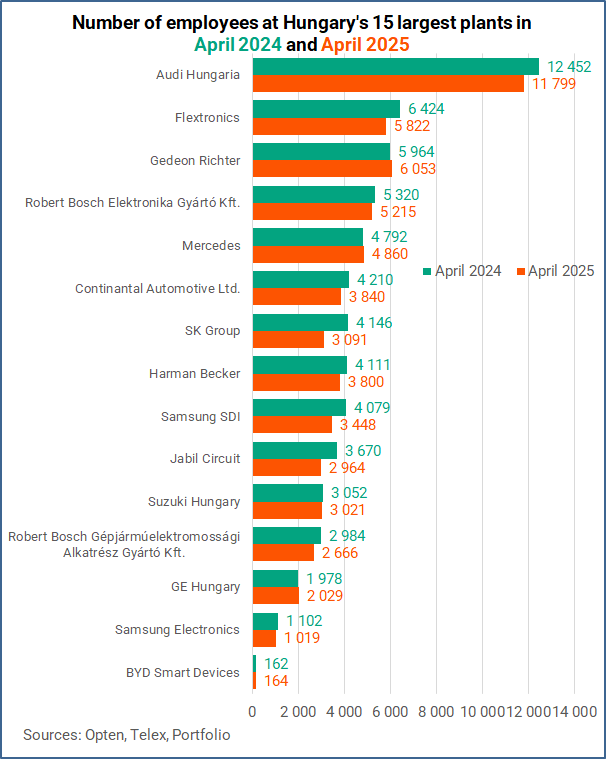
The sharpest downsizing was carried out by SK Group in its two plants in Komárom and Iváncsa, as it laid off more than 1,000 workers or 25.4% of its workforce. Jabil Circuit in Tiszaújváros came in second, with 706 employees sacked, a 19.2% staff cut, followed by Samsung SDI in Göd, with 631 jobs axed, a 15.5% downsizing. SK Group and Samsung SDI have been suffering from significantly falling orders.
Only four manufacturers were able to add to their workforce in the period under review, but the growth was moderate. The biggest staff expansion was carried out by GE Hungary, a 2.6% increase which meant 51 people, followed by Gedeon Richter with 1.5% (89) more workers and Mercedes with a 1.4% (68) expansion. BYD in Debrecen added two people to its staff.

Hungarian industry has been unable to grow since 2023, with the first quarter of this year showing even worse results. According to trade union leaders and employers' representatives, this is why most factories have been slowly downsizing for some time, reducing staff numbers by cutting hours, not advertising new jobs, and not replacing departing colleagues.
When asked about the situation in the Hungarian industry, union leaders and organisers told Telex that there have been cutbacks in virtually all firms, which seems realistic based on the above figures. Of course, some new investments are just starting up and actively recruiting, but the question remains as to when and how many Hungarian workers will be hired.
The statistics are probably just the tip of the iceberg, given that most domestic industries rely heavily on hired labour. The paper says that when demand falls, workers employed through recruitment agencies are the first to be made redundant, so the actual number of job losses is likely to be much higher.
Interestingly, official employment statistics did not show this trend until April this year. This could suggest that reports of redundancies are exaggerated, or that redundant workers are finding new jobs relatively quickly.
Cover photo: 2019 Bloomberg Finance LP





