Bank branches in Hungary keep disappearing, yet they are hiring by the hundreds


Based on our data collection encompassing commercial banks with total assets of over HUF 1 trillion,
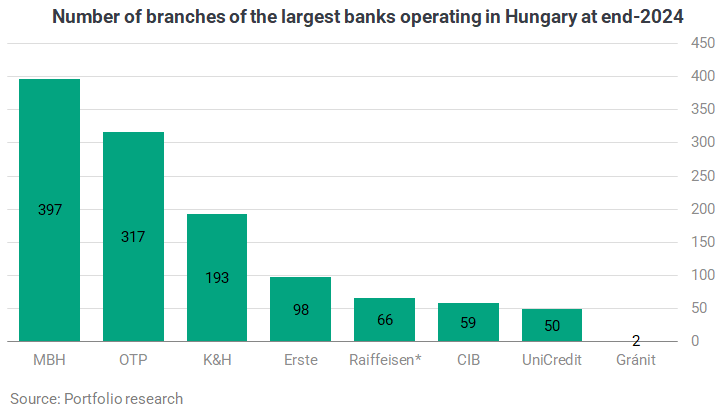
- MBH Bank had 397 branches,
- OTP Bank 317,
- and K&H Bank 193
at the end of 2024. Their branch network accounted for 65% of the branches of all credit institutions operating in Hungary, as
there were a total of 1,401 branches in the country at the end of last year.
Ten years ago, central bank statistics showed 3,086 network units, meaning that only 45% of branches remain today. There are two main reasons for this decline.
- The digitisation of banking and the rise of mobile banking have led to a sharp decline in branch activity, sales and profit contribution, with every bank closing more branches than it has opened over the past decade.
- However, the transformation of the savings cooperative network, which previously had between 1,500 and 2,000 branches, was even more significant in terms of the decline in aggregate numbers. Around 150–200 of these branches remain in the network of 397 branches at MBH Bank (comprising 221 branches at the predecessor banks MKB, Budapest and FHB in 2014), and this was also justified by the elimination of unnecessary redundancies.
Last year, OTP Bank, rather than MBH Bank (the bank with the largest network), reduced the number of its branches by the most (25 net), thus widening the gap between the two banks with the largest branch networks.
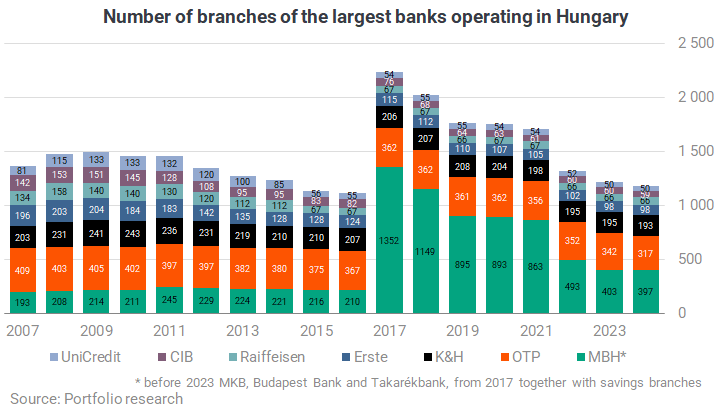
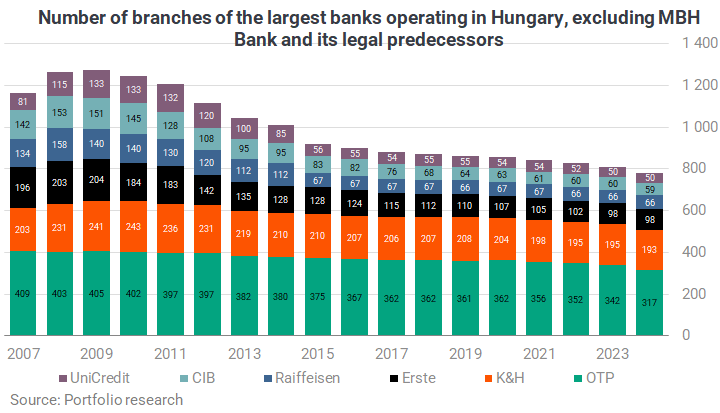
The last decade has seen a significant number of branch closures, particularly in the first half. The networks of UniCredit, CIB and Raiffeisen are around 41% smaller today than they were ten years ago. Erste has reduced its size by 23%, while OTP has reduced its size by 17%. Last year, OTP reduced its number of branches by 25, while MBH reduced theirs by six, K&H by two and CIB by one; the others remained unchanged. Gránit Bank, a digital credit institution, operates with just two branches, both of which are located in the capital.
For bank branches, the most important thing is qualitative change rather than quantitative change.
ATMs: a deceptive picture
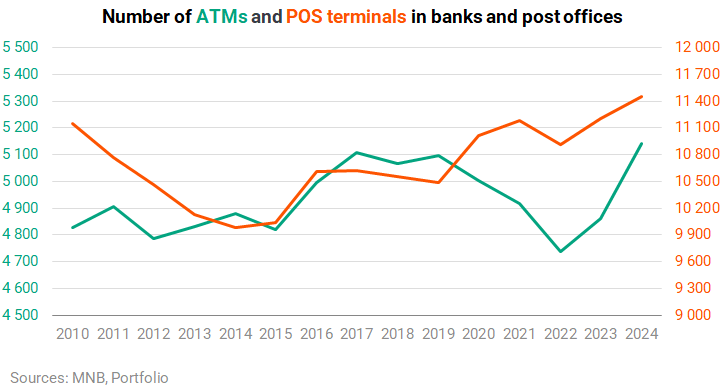
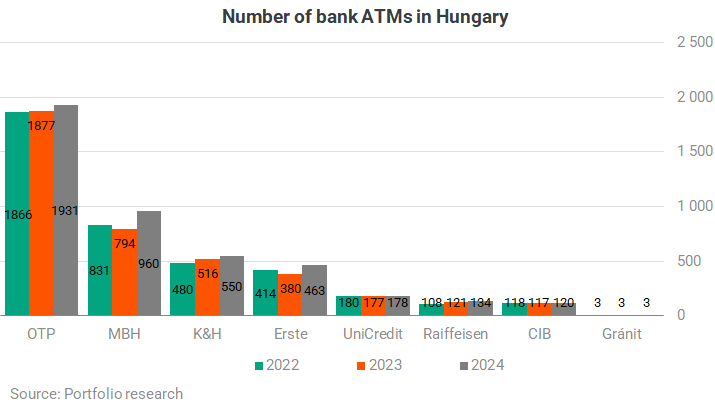
The picture is quite different when we consider the number of ATMs and POS terminals, as shown in the graph below. The number of ATMs in Hungary increased steadily until 2017, and the expansion of the network was paradoxically supported by digitalisation and technological development in its initial phase.
This trend was clearly broken during the coronavirus pandemic. By the end of 2022, there were 7% fewer ATMs in Hungary than at the peak five years earlier. The load on the Hungarian cash infrastructure increased after 2019, with a shrinking system having to cope with growing traffic, which led to network overstretch.
The central bank's (MNB) programme was the first to respond to this. On 1 February 2023, a new amendment to the MNB regulation on the processing, distribution, and protection against counterfeiting of banknotes (the 'Banknote Regulation') came into force. This amendment included new provisions regarding the minimum number of ATMs that commercial banks must operate.
This helped increase the number of ATMs to a new high of 5,140 by the end of 2024.
The regulation of ATM networks has reached a whole new level this year. First introduced by Economy Minister Márton Nagy, a government decision was subsequently adopted on 20 March to ensure that every municipality in Hungary has at least one ATM. At the beginning of April, a draft law was submitted to Parliament, and the bill on the installation of ATMs was subsequently adopted by the ruling coalition.
Further details were regulated by the Ministry of Economy and the MNB in subsequent legislation on ATM installations. Although the Hungarian Banking Association suggested that banks could voluntarily install ATMs in settlements with populations exceeding 2,000, the government's decree on ATM installations was published in the Hungarian Gazette at the end of May. The decree stipulates that ATMs must be provided in all settlements with populations exceeding 1,000 by 31 December 2025 and in all settlements with populations exceeding 500 by 31 December 2026.
The government decree published at the beginning of June eases the original restrictions somewhat, meaning that existing ATMs can still be dismantled or relocated. We understand that the MNB is currently discussing the allocation of ATM numbers and locations with banks. This could significantly alter the figures below over the next year or two.
Headcount: rationalisation and growth at once
Digitalisation is also challenging the human workforce, particularly in low-value intellectual roles and repetitive or monotonous tasks. Automation, robotisation and, more recently, artificial intelligence are increasingly capable of replacing the work of employees in both the back office and the front office (sales and customer relations). This is indeed the case, but this phenomenon is not necessarily reflected in the number of employees at banks. This figure is affected by a number of other factors.
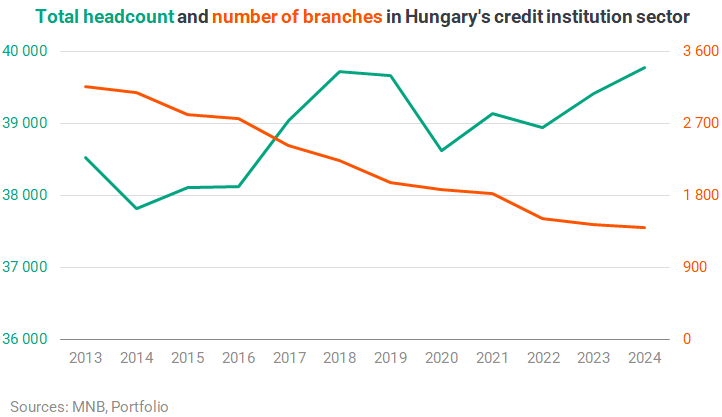
According to MNB statistics, ten years ago, 37,817 people were employed by Hungarian credit institutions — the lowest number since the financial crisis.
This figure has increased by 5.2%, with 39,773 people now employed in banking,
according to data from the fourth quarter. of 2024 However, the number of institutions has also fallen since then.
Before the onset of the pandemic, there was only a major upturn, followed by a wave of redundancies. However, the numbers have now recovered, approaching levels seen at the start of the 2008 crisis. It will certainly take several years for the sector to reach its 2008 peak of 43,932 jobs, if it ever does.
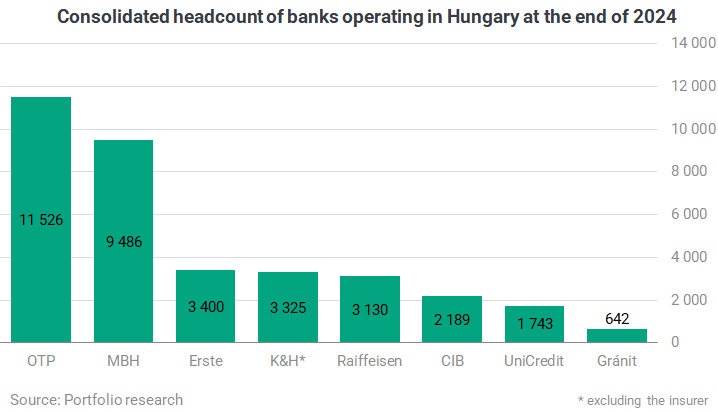
According to our research, the consolidated number of employees was
- 11,526 at OTP Bank,
- 9,486 at MBH Bank, and
- over 3,400 at Erste Bank
at the end of 2024. Since these figures include not only employees of credit institutions (in the case of K&H, insurance companies are excluded), we can only compare the number of employees of the major banks with the MNB's statistics on credit institutions with caution. In any case, the share of the three largest banks is 65%, and that of the eight largest is 89%, which is probably fairly accurate.
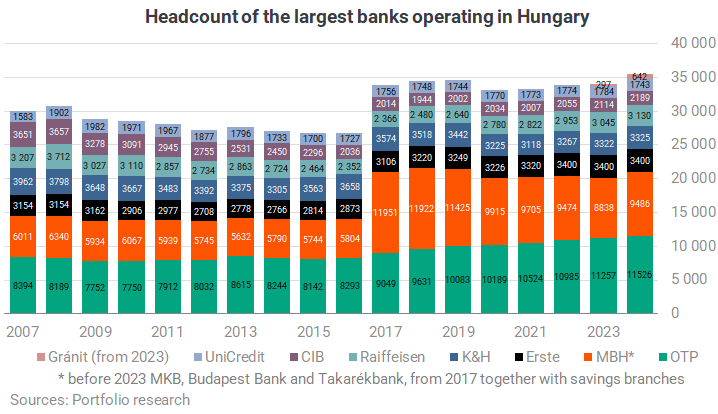
Despite the proliferation of digital phenomena triggering job creation, the number of employees at large banks has grown steadily since 2016. Even MBH Bank, which was still undergoing rationalisation, added around 650 employees last year, mainly thanks to the acquisition of Fundamenta. However, this did not change the figures for the sector as a whole, as Fundamenta was already part of the credit sector.
In general, the increase in staff numbers at banks is explained by an increase in business activity and the growing complexity of work processes and regulatory requirements. Over the past decade,
the number of people working in OTP Bank's Hungarian operations has increased by 40%, while at Erste Bank it has risen by 23%. Raiffeisen's headcount has grown by 15%,
and K&H and UniCredit's numbers have remained broadly flat. In contrast, CIB's workforce has fallen by 11%. However, compared to its 2019 low, CIB's headcount has already increased by 13%.
Cover image (for illustration purposes only): Getty Images





