This is how the 'Trump shock' could impact Hungary


Economists at BNP Paribas kick off their analysis by pointing out that the Hungarian economy experienced a technical recession in Q2 and Q3 2024 but recorded a moderate GDP growth of 0.5% over the year as a whole. In Q1 2025, growth unexpectedly fell by 0.2% q/q.
They have revised their growth forecast for this year downwards by 0.9 percentage points compared with last January to just 0.9%,
mainly because of the tariff shock, which should result in a fall in exports and a postponement of investment projects in the short term.
This is sort of underpinned by a recent development in which China's CATL was rumoured to be putting off the second phase of its mammoth investment in Debrecen, although the company has subsequently rebuffed the relevant press report, saying that they are "currently reviewing the technology and investment schedule for the second battery cell plant in Debrecen."
At the same time, this illustrates the practical consequences for an open economy such as Hungary's of the US-China trade tensions and the tariff war launched by the US President.
Analysts at BNP Paribas are not the first to lower their growth forecasts.
Economic prospects
Despite this, growth is expected to improve modestly in 2025 compared with 2024, the economists said.
The resilience of the economy is expected to be underpinned primarily by household consumption, thanks to strong wages alongside with the gradual decline in inflation.
The economists agree with the assessment of credit rating agencies on election-related risks, namely new fiscal steps.
Fiscal measures are likely to be generous in the run-up to the general election scheduled for 2026 and will provide support for consumption,
they said.

The analysts noted that the 2025 budget provides for the continuation of the 13th month's pension, higher salaries for teachers and healthcare staff, an income tax exemption for mothers and generous family allowances.
"The budget for 2026 aims to support families even though the government's ability to significantly increase spending is limited," they said.. The analysts also reminded that the country is already subject to an excessive deficit procedure and must therefore adjust its public accounts (Hungary has a four-year timeline) as part of its commitments towards the EU. At the same time, it is worth noting that the excessive deficit procedure is moving in a positive direction.
Hungarian economic growth is set to accelerate from 2026, but is likely to remain below its long-term trend (2010-2019: 2.9%) and its medium-term potential (estimated at 2.8% by the IMF). As far as exports are concerned, Hungary should benefit from a brighter outlook for demand from Germany over this period. The effects of the German recovery plan for defence and infrastructure (EUR 1,000 billion over 12 years) should be positive for Central European countries and should contribute to moving up the value chain, the analysts said.
Certain sectors, such as armaments, machinery and electrical equipment, will undoubtedly see their activity grow over the next few years (they represented 29% of the added value of the Hungarian manufacturing sector in 2022), as will the construction sector.
However, the implementation of the recovery plan will take time, and its effects will probably only be visible from 2027 onwards.
The outlook for public investment remains conditional on the lifting of the suspension of European funds. At present, the blocked funds represent around EUR 19 bn (9% of GDP).
The economists also noted that inflation in Hungary remains contained (4.4% y/y in May), following a temporary rise between October 2024 and February 2025 (5.6% y/y).
"The relief is due, in particular, to the temporary introduction of a cap on margins for companies in the agri-food sector between March and May 2025," they said. In their view, average inflation should be slightly higher this year than in 2024 due to high figures at the start of the year. A return to the 3% inflation target is expected in 2027, they echoed the central bank's recent forecast.
In recent months, there has been a lively debate about how effective the government's price-restricting measures are at containing inflation. According to a recent forecast by the MNB, the measures introduced this year could reduce the rate of price increases by 0.8 percentage points per year by 2025 — but this could come at a cost next year.
Interest rates could finally decrease
The economists believe that expectations of a fall in inflation, albeit gradual, may pave the way for monetary easing later this year. "The central bank is likely to remain cautious in the short term. The risk of volatility in the Hungarian forint, in particular, is likely to weigh on the monetary authorities' decision, even though the Hungarian currency has appreciated against the dollar and its depreciation against the euro has been contained since the announcements on US tariffs."
The key rate could therefore be cut to 5.75% at the end of 2025 and 4.50% at the end of 2026, they project.
The Monetary Council had its monthly policy meeting just this Tuesday.
Trump 2.0: impact on trade flows
The economies of Central Europe have not escaped the rise in US tariffs, even though their trade deficit with the United States is marginal.
In Hungary, the average effective rate of US customs duties rose from 1.4% at the end of March 2025 to 18.8% today.
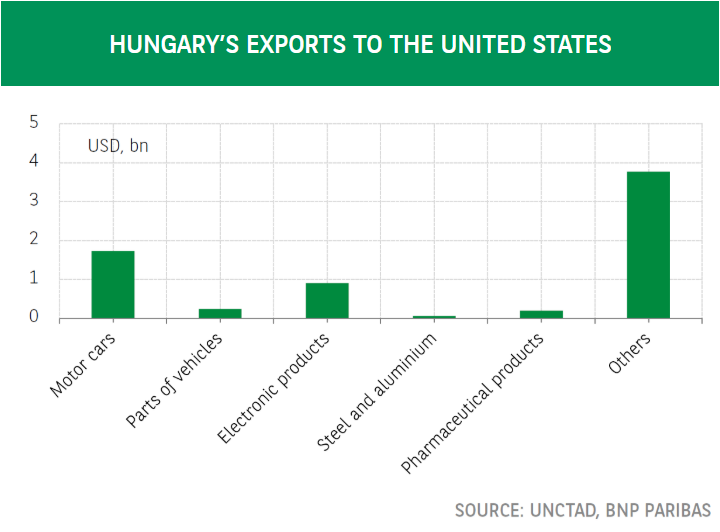
They provided further details on this:
- exports of vehicles and spare parts to the United States are subject to a 25% tariff;
- the tariff on steel and aluminium rose to 50% on 4 June.
- the rest of the goods exported are subject to a rate of 10%.
"The effective rate could rise further to 25.8% if the reciprocal rate is increased to 20%. The pharmaceutical and electronics sectors may also be targeted by Donald Trump's administration. They account for 16% of Hungarian exports to the United States," they said, presenting why Trump's trade policy is a threat to Hungary.
The analysts added that "in Central Europe, Hungary is one of the countries most exposed to a trade shock, as it is a very open economy. Between 2022 and 2024, combined exports and imports of goods represented an average of 154.8% of GDP (77.1% for exports alone). Admittedly, the share of exports going to the United States is low (4.1% of total exports and 2.9% of GDP in 2024), but given the importance of its trade link with Germany (25.1% of exports in 2024 and 17.5% of GDP),
Hungary will be affected indirectly and more markedly than other countries in the region.
The analysts estimate that the cumulative loss of activity linked to the negative effects on exports could represent between -1.4% and -2.3% of GDP.
According to their calculations, which include tariff rates differentiated by sector, the direct impact would be -0.9% of total exports and -0.5% of GDP (with an elasticity of 1). On the other hand, assuming a 5-10% drop in exports to Germany,
Hungary would suffer a loss of around -0.9% and-1.8% of GDP respectively.
(By way of comparison, exports fell by an average of 1.3% in 2019/2020, 11.3% in 2015 and 26.8% in 2009. Last year, exports to Germany fell by 7.3%.)
The analysts also warned that "against a backdrop of slowing global demand, and with all our trading partners affected by US customs measures, the ability to find new outlets for export products will be limited."
"It cannot be ruled out that products from Asia, particularly China, will compete with locally manufactured goods intended for export, particularly in the medium and high-tech segments. Hungary specialises in the production of machinery and transport equipment, which accounted for an average of 55.5% of the country's total exports in 2024. Hungary's gains in market share in Germany in this segment since the 2000s (2000: 3.8% of German imports from Hungary, 2024: 4.9%) could be eroded somewhat in favour of China, which also has a revealed comparative advantage in these goods according to the UNCTAD indicator.
The analysts also pointed out that in the meantime, China has also become one of Hungary's key partners in terms of foreign direct investment (FDI). Hungary has received the largest share of Chinese FDI in Central Europe, mainly in the automotive sector (USD 6.1 billion of Chinese FDI in stock in Q12025, 32.6% of Chinese investment). This is part of its strategy to become a key player in the production of electric batteries and electric vehicles. Hungary's strategy is to encourage foreign direct investment in the medium term.
Hungary remains an attractive destination for FDI and should continue to benefit from nearshoring in the short and medium term.
FDI inflows rebounded strongly in 2021 and 2022 (5.6% and 8.4% of GDP respectively). These flows edged down in 2023 and 2024 (2.2% of GDP in 2023 and 2% in 2024) but remain well-oriented in the region.
In the short term, the negative impact of tariff measures should prevail. The scope for monetary and fiscal policy to offset these effects is relatively limited.
As part of the EU's defence plan, Hungary should benefit from a degree of budget flexibility in the medium term, should the need arise. The country, like other Member States, has activated the escape clause for defence, which allows defence spending to be excluded from the budget rules by up to 1.5% of GDP per year for 4 years. Moreover, a line entitled "defence reserve" has been included in the budget for 2026. For the time being, the Hungarian authorities plan to maintain defence spending at 2% of GDP in 2026, after 2.1% in 2024.
The analysts believe that in the short term,
the negative impact of tariff measures should prevail. The scope for monetary and fiscal policy to offset these effects is relatively limited.
They also think, however, that as part of the EU's defence plan, Hungary should benefit from a degree of budget flexibility in the medium term, should the need arise. The country, like other Member States, has activated the escape clause for defence, which allows defence spending to be excluded from the budget rules by up to 1.5% of GDP per year for 4 years. Moreover, a line entitled "defence reserve" has been included in the budget for 2026. For the time being, the Hungarian authorities plan to maintain defence spending at 2% of GDP in 2026, after 2.1% in 2024.
Cover photo: US President Donald Trump speaks about the new US tariffs on US trading partners in the Rose Garden of the White House in Washington, 2 April 2025. Source: MTI/EPA/Jim Lo Scalzo





