Vienna-based research institute publishes stark analysis of Hungary's economic prospects


On Tuesday, the Vienna-based International Institute for Economic Research, which regularly analyses the Central and Eastern European countries, published its latest summer forecast. In the title of the chapter on Hungary in the current edition, they point out that the economy's performance is far from the 'flying start' heralded by the prime minister, but rather that the stumbling continues.
The institute's economists point out that Hungarian GDP was a big surprise in the first quarter, falling by 0.4%, with industry and construction primarily responsible, and agriculture to a lesser extent. The services sector's 1.1% growth saved the economy from an even bigger fall. They add that disinflation is not progressing as expected either, with the inflation rate rising to 4.6% in June, while the budget deficit for the full year was more than 70% of the target by the end of April.
So far, there are no signs of any improvement in the disappointing economic situation,
wiiw's analysts wrote.
They say that the government's margin freezes are only masking the real inflationary pressures, and they do not expect any meaningful fiscal consolidation before next year's elections. The second half of the year could bring some improvement in economic performance, mainly as a result of the large investments announced earlier. Even so,
the Hungarian economy is expected to grow by only 0.7% in 2025,
with some acceleration to around 2% in 2026-2027, but still below the government's target of 3-4%.
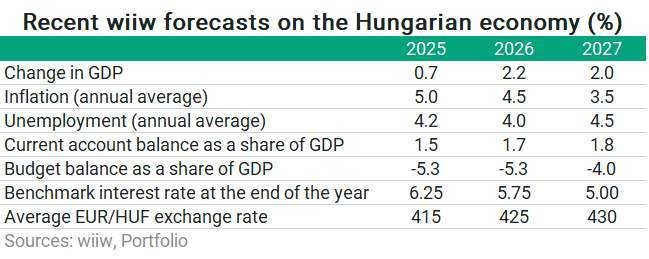
According to the analysts, inflation could accelerate to an annual average of 5% this year and ease to 4.5% in 2026. The current account balance could be around 1.5-2% of GDP over the next two and a half years. The precarious fiscal position has already been alluded to, with
the recent forecast for the budget deficit to rise from 4.9% in 2024 to 5.3% of GDP, and then to remain unchanged from there next year.
According to wiiw, the National Bank of Hungary (MNB) will be able to cut the base rate by 25 basis points to 6.25% by the end of the year, with room for two further cuts in 2026 and three in 2027. The experts expect the forint to weaken substantially, as they think the average euro-forint exchange rate could be 415 this year, 425 in 2026 and 430 in 2027.
Cover photo (for illustration purposes only): Getty Images





