Hungarian government makes big announcement, green-lights greater spending

On Thursday, the Economy Ministry published an important statement which essentially says that
it is preparing to increase spending from the budget next year.
However, it can only do so with the European Commission's approval, via the emergency clause, a mechanism within the EU that allows member states to temporarily exceed budgetary spending limits for defence investments.
The escape clause was activated due to the exceptional circumstances of the war in Ukraine and the resulting need for increased defence spending. This allows member states to increase their defence spending beyond what is usually permitted under the EU's economic governance framework. Any additional defence spending must be linked to the increase in defence expenditure as a percentage of GDP since 2021, which is considered the baseline year. The total increase in defence spending permitted by the escape clause is capped at 1.5% of the relevant member state's GDP.
The ministry pointed out that "Member States that had not increased their military spending after 2021 can now only increase defence spending". However, Hungary has significantly increased its defence spending in recent years, in line with NATO's expectations, so the government interprets
this room for manoeuvre as meaning that Hungary can incur additional expenditure on both defence and non-defence projects under the EU's rules.
The ministry also said that it will "use the resulting room for manoeuvre to develop the economy". This was foreseeable, given that the recently adopted 2026 budget included an expenditure line called 'Defence Reserve'.
The ministry also emphasises that there is no need to worry about next year's budget because of this overspending.
"The recently adopted Budget Act 2026 does not need to be amended. It remains sound and valid; the finances are in order, and the country's finances are secure. The government is committed to reducing public debt and the budget deficit," they stressed.
They also pointed out that, "since the name 'Economic Development Facility' more accurately reflects the government's intentions than 'Defence Reserve', the government will use its statutory powers to change the name and activate the fund.
The envelope
will permit additional targeted expenditure in 2026
that is not yet included in the current budget law.
"The government will only spend up to the spending limit agreed with the European Union in 2026, which allows the country to spend without facing sanctions." They ensure investors and credit rating agencies that "the government remains committed to reducing the budget deficit and public debt through the replenishment and use of the Economic Development Facility."
What is this all about?
This is about the National Escape Clause (NEC) that we have recently analysed in more detail:
As noted above, activating the NEC would allow an additional 1.5% of GDP to be spent on defence capabilities. As with everything in Brussels, this is not quite what it seems: the benchmark is not the defence expenditure in 2025, the year of implementation, but in 2021.
According to some calculations, Hungary could gain an elbowroom of 0.9 percentage points of GDP this year. In nominal terms, this could equate to HUF 770–780 billion.
According to simulations in a European Commission report, the main NEC scenario (a linear increase in protection spending between 2025 and 2028) would have the following impact on Hungary:
- By 2028, the budget deficit could be 1.3 percentage points higher than in the no-NEC baseline scenario.
- Government debt-to-GDP could increase by 2.5–2.7 percentage points over the same period.
- The deterioration in the structural primary balance (SPB) would accelerate at a rate of 0.375 percentage points per year, resulting in a deviation of 1.5 percentage points from the baseline scenario by 2028.
According to the Commission's simulations, this path requires a significant adjustment in the medium term. In the second adjustment cycle (2029–2032), Hungary will require a fiscal adjustment of 0.4 percentage points per year above that in the baseline scenario.
A few weeks ago, the Economy Ministry published a budget analysis on Portfolio in which the experts also wrote about the activation of the escape clause and its consequences. In the analysis, the ministry stated that Hungary's decision to activate the NEC, like many other Member States, creates room for budgetary manoeuvre.
An augmented control account will be in place for those Member States approved to activate the NEC, to ensure that the flexibility resulting from increased defence spending is captured and assessed.
It is important to note that the upper limit of the flexibility is accounted for in the augmented control account in the cumulative deviations (i.e. not in the annual deviations). The "flexibility" that can be taken into account is the difference between the defence spending as a share of GDP in a given year and the actual defence spending as a share of GDP in 2021, up to a maximum of 1.5% of GDP, they wrote in their analysis.
"The Fiscal Council also examined this expenditure line in detail in its opinion on the 2026 budget. 'Within the central subsystem's reserve provisions, the government has created a new budget line, Defence Reserve, in anticipation of an EU regulation currently under negotiation that would exempt defence spending from budgetary regulation and permit EU accounting of defence spending of up to 1.5% of GDP.
"The Defence Reserve appropriation covers expenditure incurred when using general or defence-specific flexibility margins resulting from increases in defence spending. This appropriation is currently set at HUF 1.0 million.
"The government may transfer funds from the Defence Reserve up to the extent of the general or defence-specific flexibility margins, provided that the relevant EU provisions are activated. "The transfer may only be made if the specific conditions of the EU regulation are met, and if using the reserve would not jeopardise the ability to meet the public debt requirement of the Fundamental Law," said the document published in May.
However, the Council explains that there is still a risk associated with increasing public assets.
In other words, this provision poses a risk to achieving the debt reduction set out in the draft bill, as it permits excess expenditure accounted for through the Defence Reserve (now known as the Economic Development Facility) to largely fill the 0.8% margin between the expected 2025 and projected 2026 debt-to-GDP ratios.
Even at that time, FC emphasised that "the margin of flexibility that will be revealed later, along with how it is used, will affect the budget deficit, the evolution of public debt, and compliance with fiscal rules".
Therefore, the Council recommended that, following the European Commission's final assessment of the national escape clause and the amendment of the relevant EU legislation, the government should examine, alongside the Council's own examination, whether the 2026 budget complies with EU rules. If it does not, the government should take the necessary measures to ensure compliance with Article 3/A of the Stability Act.
At the press conference on the submission of next year's budget bill in May, we asked Economy Minister Márton Nagy about the emergency clause in detail. In response to a question from Portfolio about next year's budget leeway in relation to the defence spending escape clause, Márton Nagy explained that this amounts to 1.5% of GDP and consists of a general margin and a defence spending leeway.
The general elbowroom can be calculated as follows: from 2021 to 2024, how much defence spending has increased. In Hungary, it rose from 1.1% to 1.9%, which implies an elbow room of 0.8-0.9 percentage points.
The EU says that member states have increased their defence spending by this amount, reducing spending on other objectives. Therefore, it is returning this amount to member states as a general margin of manoeuvre. The other aspect is the defence spending margin, but it is not yet clear what the exact definition of this will be or whether the EU will adopt a new definition or use the narrower NATO interpretation.
The minister explained that infrastructure investments, such as road construction or energy network investments, could also be included in this expenditure line. Defence spending, however, does not include the defence industry.
He said that significant defence spending could be used next year or even as early as 2025.
He added that if this is applied to the 2026 budget and the 3.7% deficit target, this leaves a margin of 0.6-07% for defence.
He stressed that the budget deficit will be reduced next year, but admitted that the deficit will be higher than the original target (2.9%).
What can be expected?
In light of this, it will be interesting to see if the ministry responsible for the budget consults the Fiscal Council on this issue.
The implication of the current measure is that next year's surplus spending will be effectively limited by the requirement to reduce debt.
However, what is clear from the latest report by the ministry is that, as soon as the government has the smallest fiscal flexibility, it uses it immediately and 'maxes it out'.
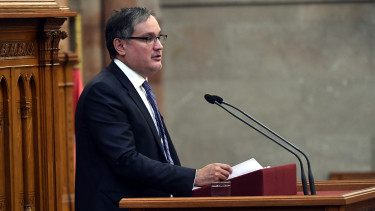
Cover image: Economy Minister Márton Nagy gives an exposé during the debate on the bill on Hungary's 2026 central budget at the plenary session of the National Assembly on 21 May 2025. Source: MTI Photo/Lajos Soós





