Analysts not happy about Hungary's grim retail sales


Retail data for May was disappointing,
commented Gábor Regős, Chief Economist at Gránit Fund Management.
According to the Central Statistical Office (KSH), the volume of domestic retail sales in May was 1.3% down on the previous month, partly offsetting the rise in April. On an annual basis, May's expansion was 2.1%, driven mainly by sales in non-food stores.
In retail, something similar to what happened in industry occurred: the second quarter started off very strongly, and then there was a sharp slowdown. We ended up back at the level of March, which was not exactly high,
said Gábor Regős.
Real earnings in April (i.e. what households were able to spend in May) increased by 5.2%. This would have allowed for a much higher increase in retail sales, although this increase only affected employees. The real value of benefits for pensioners did not increase and even decreased slightly until the expected compensation in November, according to Regős.
However, today's data also indicates the continued presence and resurgence of [households'] cautionary motive,
the economist stressed. He added that Hungarians are being cautious due to economic uncertainties, negative labour market news and high — and rising — prices for many products.
- Grocery store sales growth is surprisingly low at just 0.5%. This suggests that, despite the margin cap, prices are still high in many cases, so households are reconsidering whether to pay as much for a given product or to look for cheaper, lower-quality products. However, today's data indicates that there has been no overall increase or decrease in shopping.
- Non-food sales grew by a significant 4%, making this the only type of store to show meaningful growth in May. However, this is a growth rate that we would be comfortable with in the long term. Several product groups showed strong growth where purchases had previously been postponed due to poor financial circumstances. The sales of industrial goods increased by 9.1%, while that of furniture and technical goods rose by 7.1%. At the same time, sales at second-hand goods shops fell by 2.5%, indicating that households can now afford to buy new goods and have less need for second-hand products.
- Fuel sales fell by 1.1%, which was unexpected given the recent fall in oil prices and the fact that fuel prices have been falling due to the weakening dollar.
'Today's data is therefore another negative sign for second-quarter GDP. Historically, consumption has been the main driver of GDP, but this seems to be fading. Therefore, it is questionable whether it can still pull the economy up enough this year," said Regős.
"There is also a clear need to raise real wages. However, the question is whether the current labour market is strong enough to do so. The April figure was surprisingly strong for wages, but it remains to be seen whether this will be sustained. However, the cautionary motive also needs to be mitigated, which would require more good news than bad from the economy," he concluded.
According to Péter Virovácz, Chief Economist at ING Bank, the data is disappointing.
The Hungarian retail sales volume underperformed all expectations,
he pointed out.
Today's retail sales data, together with industrial performance data, will certainly have a negative impact on the overall economic outlook, as it seems that the strong start to the second quarter was just a temporary improvement, and negative corrections in both major segments have already occurred in May.
However, when we look at the longer-term trend, the 'two steps forward, one step back' pattern continues to hold true, with retail sales volumes growing at a saw-tooth pace in line with the trend. Nevertheless, this growth trajectory is far from smooth. Virovácz said that volatility remains high and is likely to be driven mainly by one-off effects, such as the interest payouts on government securities, corporate bonuses, and even extreme calendar effects.
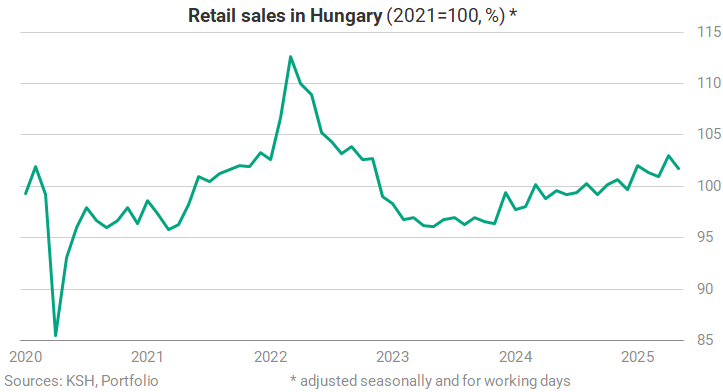
Based on the data for the second quarter so far, this is better than the first quarter, so we can expect consumption to still make a positive contribution to GDP.
However, Virovácz pointed out that
grocery sales fell sharply in May on a monthly basis.
The last time the KSH recorded a decline of around one per cent was in September last year.
It seems that the government's announcement of an extension to the margin caps came too late, as the public did not start hoarding in May. It therefore seems that the public expected the measure to be extended, so there was no real surprise and thus no increase in demand.
The month-on-month decline in non-food trade was also 1%. After two months of strong growth, mail order and online shopping fell sharply. However, the much-publicised cuts to drug prices have presumably also reduced sales in these shops, as the public may have been adopting a wait-and-see approach. Sales of books, computers, and other industrial goods also plummeted. The expert said that the wait-and-see approach due to the pending price cap on household goods may also have been a factor here, although government price measures were in place for the last third of the month.
Despite falling fuel prices, fuel sales in May showed a sharp drop compared to April, following a big surge the previous month,
he added.
Consequently, this sector also contributed significantly to the substantial decline in overall retail sales in May.
"Overall, then, we are seeing a disappointing performance across the board. This again leaves room for doubt about how strong the recovery for the economy as a whole can be in the second quarter after the downturn in the first," he said.
In light of the past two years, we can expect 2025 to be a better year for retail trade, but the outlook has deteriorated again based on the latest data. ING Bank expects the sector to grow by an average of 2.5–3.5% this year.
Cover image (for illustration purposes only): Portfolio





