June inflation data shows accelerating price increases again in Hungary


The general picture of domestic inflation is that it is stubborn enough to prevent it from being pushed down to the 3% level considered to be price stability in the short term. This became really clear at the end of 2024 and beginning of 2025, when an unpleasant food price shock was added to the “sticky” pricing behaviour of service providers.
When core inflation was already above 6%, the government intervened: by freezing margins and persuading service providers to make “voluntary” price corrections, it pulled the CPI back below 5%. However, the biggest effects had already been reflected in the price statistics by May, leaving only the price-reducing effect of minor household supplies for June. This is why no one expected inflation to fall significantly further in the first summer month.

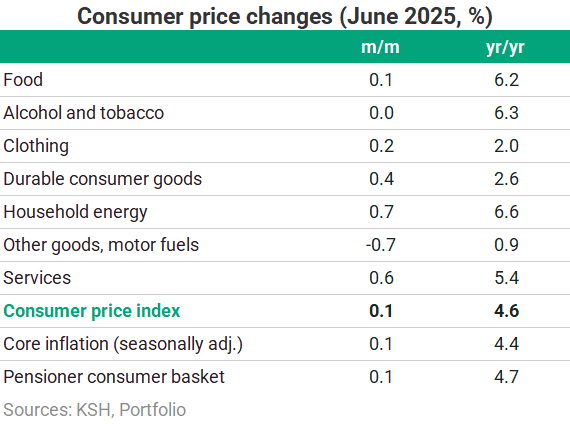
There are three main factors responsible for the increase in inflation. The most striking is that food prices have continued to rise despite a broad-based margin caps. The annual rate of price increases rose from 5.9% to 6.2%. The main reason for this is price developments for seasonal food. Vegetables rose by 8.4% on an annual basis and fruit by 17.7%.
June is typically a month of seasonal food price falls, so much so that the price of the whole range of food products tends to fall at the beginning of summer. This has not happened this time, showing that food is still the most vulnerable point for inflation. Typically, the core inflation indicator (which excludes weather-dependent, hectically variable-priced raw food), which captures more persistent inflationary trends, retreated to 4.4% from 4.8% in June.
More surprisingly, consumer durables rose by 0.4% on a monthly basis. Due to the high import content, the evolution of the forint exchange rate is a key factor in this product group. However, it appears that despite the stabilisation of the forint, price pressures still remain in this area (the biggest price increase was reported by the KSH for motorcycles, up 6.4% on a monthly basis.)
The third factor pushing up inflation is the increase in the price of piped gas. This is a product whose price is set by the authorities, and whose average price depends on the volume of consumption. The KSH has been calculating for months that a price increase should technically be recorded.
In addition to the above, there are also downward factors on the inflation front. Most importantly, the 0.6% month-on-month increase in services was down from 1% in June last year, bringing the 12-month price index down from 5.9% to 5.4%. It is worth noting that price pressures in the services sector remain noticeable. While the telecoms and financial services sectors absorbed price cuts in May, overall price levels for services such as health and repair services have already started to rise again in June. However, it is somewhat reassuring that most price increases on a monthly basis are linked to seasonal holiday pricing.
Presumably related to the drugstore margin cap, both personal care and cleaning products have become around 5% cheaper on a monthly basis.
Overall, today's data suggest that inflation developments are in line with expectations. The economy is far from price stability, and inflation in Hungary would be around 6% in the absence of official price measures. The price index is not even expected to fall back to the central bank's target range of 2-4% this year, and indeed, it does not look likely to be achieved on a sustained basis until 2027.
Today's data is likely to reinforce the central bank's cautious approach, with no monetary policy easing anticipated in the near future.
Last week, MNB Deputy Governor Zoltán Kurali indicated that the bank would need to see faster and more sustained disinflation before considering easing monetary conditions. However, recent inflation data do not show such signs, despite the fact that the moderation in core inflation is considered a positive development.
Details in numbers
On average, consumer prices rose by 0.1% in June compared to the previous month. Food prices rose by the same amount (0.2% lower when catering services were excluded). The prices of cooking oil, eggs, margarine, soft drinks, chocolate and cocoa, cold cuts, sausages, bread and cheese fell by 2.4%, 1.8%, 1.2%, 1.0%, 0.7% and 0.6%, respectively.
Within this product group, the prices of bakery products, poultry meat, salami, dry sausages, ham, dry pasta and snack bars increased by 1.4%, 1.1%, 0.9%, 0.7% and 0.6% respectively. The largest increase was for household energy, which rose by 0.7%, including a 1.4% increase for piped gas and a 0.5% decrease for cylinder gas.
On a yearly basis, food prices increased by 6.2% (4.9% excluding catering services), with notable increaes seen in the prices of eggs (26.0%), flour (24.4%), edible oils (22.2%), coffee (20.3%), chocolate and cocoa (19.6%), fruit and vegetable juices (14.1%), snack bars (10.4%), pastries (8.1%), milk (7.3%) and soft drinks (7.1%). However, within this product group, prices fell for margarine (31.2%), dairy products (7.2%), cold cuts and sausages (6.9%) and pork (2.0%).
Cover photo (for illustration purposes only): Getty Images





