Public spending on the rise in Hungary, government will miss important targets


New developments that keep everyone's eyes peeled
With next year's budget only just adopted, all the experts who are closely following the situation and prospects of the Hungarian economy have been waiting for the government to publish its updated macroeconomic forecast for this year. The current GDP growth forecast of 2.5% for 2025 is considered extremely optimistic.
The majority of analysts expect GDP growth of around 1% this year, whereas the central bank (MNB) forecast growth of 0.8% in its June Inflation Report. Further deterioration in GDP growth could have several unpleasant consequences.
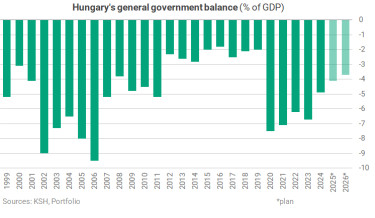
- The 2025 budget deficit target will be exceeded by an even greater margin than previously anticipated. The original target of 3.7% is worth less than the piece of paper it is written on, as the Economy Ministry, which is responsible for the budget, is already discussing a revised deficit expectation of 4.1%. Our earlier calculations suggested that this year's deficit could rise to 4.8% of GDP due to a deteriorating macroeconomic environment.
- The second consequence is that the base for the 2026 budget, which has already been approved, will be even weaker, putting next year's budget in an even more precarious position.
- The slow start to economic growth means the government is forced to take action, and it will support the recovery by any means possible, especially measures that directly affect the population. One such measure is the 3% preferential housing loan.
Kick-starting growth versus fiscal disipline
In this regard, last Thursday's announcement by the Economy Ministry that the Defence Reserve expenditure line in next year's budget will be renamed the Economic Development Facility was an interesting (but not surprising) development. The government has also announced that it will increase spending through this line in 2026.
The ministry also openly admitted in the briefing that it would "use the resulting room for manoeuvre to develop the economy". As a reassurance, however, it added that "the government remains committed to reducing public debt and the budget deficit".
Given that the government has the means to spend, it is not surprising that there is political will for fiscal loosening. With the 2026 general election fast approaching and the latest polls showing the governing parties at a steady disadvantage against the main opposition (Tisza Party), this is hardly surprising.
Increasing voter welfare directly (see the 2022 personal income tax refund) is a well-established way for the government to improve its popularity among the population. The government is actively pursuing economic policy measures that were not included in the budget.
- Mothers with three children will receive their first PIT-exempted wage in November 2025, at a cost of HUF 50 billion for the budget.
- Mothers will be the first to receive the PIT-exempt infant care allowance (CSED) and childcare fee (GYED) in August 2025
- Food vouchers for pensioners to be distributed by the end of the year.
- New wage increases for government officials.
- The government has increased the budget for the Demján Sándor '1+1' Programme from the originally earmarked HUF 48 billion to HUF 130 billion to stimulate investment for SMEs.
- 3% preferential loan for first-time home buyers.
(And let's not forget that there are measures which directly improve the well-being of the population/voters. However, the cost of these measures is not borne by the state, and therefore not by the public purse. Examples include margin caps on food, pharmacies and household supplies, as well as 'voluntary' price cuts in the telecoms and banking sectors.)
All of this suggests that
the government has already begun to spend excessively in preparation for the election, and that this is presumably only the beginning.
As expected, the need to support growth has once again taken precedence over fiscal discipline.
It is no coincidence that the spending spree has resulted in the state requiring additional financing, which the government covered last time by issuing extra foreign currency bonds.
Analysts taking action one by one
Domestic analysts have already started to factor in the underperformance of fiscal discipline and the impact of the deteriorating macro environment into their forecasts.
In a recent article, we summarised the latest analyses from ING Bank and Raiffeisen Bank economists, focusing on their key message regarding the budget.
- Raiffeisen Bank estimates a 5.5% of GDP budget gap and ING Bank a 4.6% deficit for 2025.
- Raiffeisen Bank sees the shortfall reaching 4.7% of GDP in 2026.
However, even the MNB does not rule out the possibility of the government missing its deficit targets for this year and next, considering a deficit of 4.1–4.4% to be more realistic than the 3.7% target for 2025. It also anticipates a budget deficit of up to 4% by 2026, rather than the targeted 3.7%.
A fiscal analysis by OTP analysts, released after the publication of the government sector's first quarterly data, fits into this pattern. In their assessment of the fiscal situation, the analysts begin by noting that, despite adverse macroeconomic conditions, the government has reduced the deficit, which has remained at around 7-8% for many years, to 4.9% in 2024. Previously high in the region as a whole, the Hungarian deficit level has fallen to an average size.
At the same time, the achievement of the already increased deficit target (4.1%) this year is questionable, because despite the more favourable interest balance, a no-policy-change deficit of around 4.8% is outlined. In addition, there is a negative risk of further fiscal easing before the parliamentary elections,
the analysts stressed.
On the other hand, the analysts noted that there are a couple of factors that will reduce the deficit in 2025. Based on data from the first five months of the year, VAT revenues started to increase again following two years of stagnation, which could be supported by consumption growth and additional fiscal measures before the elections.
Lower interest expenses due to decreasing interest rates also reduce the deficit, while interest revenues will also shrink for the same reason, but dividend revenue, which became a significant part of the budget, is expected to increase. (The state-owned energy company (MVM) has already paid HUF 213.5 billion dividend to the budget, plus Budapest Airport paid HUF 106 billion, they noted, They added, however, that it is likely that only around HUF 40 billion will be taken into account from that in the ESA balance.)
OTP's analysts believe that under a no-policy-change scenario the budget deficit will reach 5.2% of GDP in 2026, as tax exemptions and extra bonuses for public employees kick in.
They pointed out that as a result of the new rules of the excessive deficit procedure, there is less pressure on the government to adjust the budget. Although central bank experts have recently forecast that Hungarian public debt as a share of GDP will rise this year, only the expectation of a falling debt-to-GDP ratio will effectively constrain the government.
The EDP against Hungary and several other EU members started last summer, but the EU delayed penalties. According to the rules adopted in February 2024, member states have a four-year budget adjustment period, which can be extended to seven years if the government makes investments that improve the growth potential. Hungary prepared a four-year plan this spring. At the same time, Hungary has made a commitment, along with other NATO members, to increase its defence spending to 5% of GDP until 2035, which will be a burden on the budget in the coming years.
Overall, we can expect a series of announcements in the coming months that will underpin the easing of fiscal discipline, if the international environment and market financing allow. This has now become the baseline expectation of analysts and rating agencies. However, we are not suggesting that this is a risk-free strategy.
Firstly, it is certain that this comes at a price. The persistent fiscal alcoholic, whose strategy for quitting is not necessarily credible, does not get extra resources cheaply. They pay a premium compared to others and debt servicing costs are high, draining resources away from other spending targets and essentially strangling economic development opportunities. Secondly, an international situation could arise when those hooked on deficit will have a more difficult time to get to the bartender or find that the whole bar is closed.
Cover image (for illustration purposes only): Getty Images





