Hungary in mounting trouble: debt-to-GDP ratio might not be reduced this year


What happened to the Hungarian public debt?
Before the 2020s, public debt was on a declining path, falling from a peak of over 80% in 2011 to 65% of GDP in 2019. This process was helped by a number of factors, including the nationalisation of private pension assets at the beginning of the period, a budget deficit that fell to acceptable levels, and dynamic economic growth in the second half of the period, which contributed most to the decline in the debt ratio. Then, in 2020, the whole world was hit by the coronavirus pandemic, with governments having to spend to save lives and keep the economy alive. The sudden slowdown brought a fall in GDP on top of the extra spending, so debt ratios rose worldwide. Hungary was no exception, with the all-important debt ratio rising to 78.7% in a single year, almost wiping out years of debt reduction efforts. From there, 2021 and 2022 still saw a noticeable decline, mainly as a result of the post-COVID shock bounce and the economic growth that was released into action in time for the election, but in the meantime the fiscal turmoil showed that further debt reduction could be a problem. And indeed,
compared to the end of 2022, Hungary's debt ratio looks to be stuck.
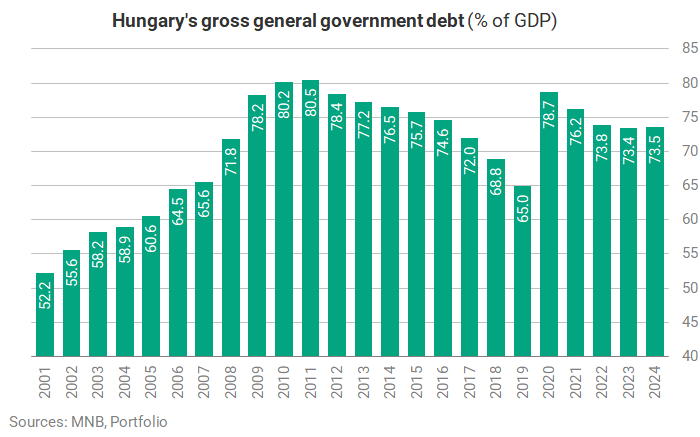
The graph below shows that two and a half years ago, gross debt was 73.8% of GDP, and from there it declined very slightly to 73.5% by the end of 2023, before rising minimally to 73.5% by the end of 2024. Moreover, some year-end debt adjustment tricks have already played a role, as shown by the fact that the debt ratio was already 75.3% at the end of the first quarter of this year.

But why hasn't the Hungarian debt ratio dropped for two and a half years?
Growth in the Hungarian economy has been stuck for years, with GDP falling by 0.9% in 2023 and growth remaining subdued at 0.5% in 2024. From this perspective, this year does not look good either, with the first quarter figure falling far short of expectations, with analysts now expecting annual growth of 0.5-1%.
As mentioned above, there has been a drastic change in budget management: the previous discipline was not restored after COVID. In the years before 2020, the deficit was around 2% of GDP, and this was very good from a debt point of view, even though a cyclically more surplus budget would have been ideal. The deficit jumped to over 7% as a result of the pandemic, and the electoral divide and economic difficulties meant that this severe deficit persisted for four years. Even by 2024, it was only cut to 4.9%. For this year, the government originally set a target of 3.7% and then raised it to 4.1%, but analysts say it is more likely to miss that too, with the main question being whether it can keep the deficit below last year's 4.9%. In other words, the current baseline is more like four years of 7% deficits followed by three years of 5% deficits - a far cry from a sustainable debt trajectory.

In other words, the debt-to-GDP ratio has been under pressure from both sides simultaneously in recent years, as the numerator of the fraction (debt) has been growing at a faster pace than before due to the higher budget deficit, while the denominator (GDP) has been virtually stagnant in real terms for years.
That is why the debt ratio cannot fall significantly either.
It seems hard to envision the debt ratio falling this year
The first quarter data already show that the above trend could continue in 2025, with at most a token decline in the debt-to-GDP ratio. In fact, it is more likely that the ratio will rise again after last year, with the National Bank of Hungary (MNB), for example, projecting a debt ratio of 73.7% by the end of the year in its latest inflation report published at the end of June.
In Portfolio's simple debt model, there are two main variables that affect the debt ratio at the end of the year: the nominal change in GDP and the cash deficit of the budget.
The change in nominal GDP depends not only on real GDP in the traditional sense, which is the most commonly quoted, but also on the so-called GDP deflator, which effectively reflects inflation in the economy as a whole. We now estimate that nominal growth could be between 6.5% and 8.5% in 2025, with the deflator accounting for the bulk of this. Thus, the gross domestic product could rise from HUF 81,514 billion last year to HUF 86,812-88,443 billion.
The cash deficit could reach HUF 4774 billion in 2025, according to the financing plan of the Government Debt Management Agency (ÁKK), as revised in June. At the same time, we mentioned that most analysts see the government's 4.1% accrual deficit target as risky, which will also affect the cash balance. Therefore, we have also considered two additional scenarios: a deficit of HUF 5,000bn and HUF 5,300bn is our alternative assumption.
The graph below shows how the debt-to-GDP ratio might evolve by the end of the year, depending on the variables:

It can be seen that
only two of the nine possible scenarios would have a rate below 73.5% at the end of 2024.
To achieve this, nominal GDP growth of 8.5% would be needed, and the cash deficit would need to be kept under control, so that it exceeds the full-year target by no more than HUF 250 billion. At first glance, 8.5% growth seems more challenging, as it would require real growth of around 2% even with a deflation rate of 6-7%, which now seems virtually impossible.
Parts in small print
In addition to the forecast uncertainty surrounding the GDP deflator, two other influencing factors should be highlighted. One of these is the EUR-HUF exchange rate at the end of the year, since with the exchange rate at around 30%, it makes a difference at what exchange rate government debt is converted into forint. In other words, a possible appreciation of the forint could even save the euro from the rising debt ratio, but it should be added that the exchange rate has been very stable in recent months, and most analysts believe that there is no serious room for a strengthening of the Hungarian currency from the current level of around 400, while experts expect a higher euro exchange rate at the end of the year. Last year ended with a euro exchange rate of 410, partly due to the weakening of the forint at the end of the year, which necessitated a debt adjustment.
The other uncertainty is the state's liquidity position at the end of the year. The government may choose to cover part of its overspending in November-December by spending its liquid financial reserves rather than debt. Therefore, it is not certain that nominal debt will increase by the size of the overall cash deficit during the year. (Of course, the treasury account will be depleted and will need to be replenished quickly early next year - this is usually done, for example, by large foreign currency debt issues at the beginning of the year.)
Why is it a worry if we fail to reduce the debt ratio again?
While the gradual reduction of the debt ratio is one of the government's main objectives, failing to maintain the downward path could also have market consequences sooner or later. In other words, it is not just a grand plan, but
an indicator that investors are watching closely.
Not only capital market investors, but also credit rating agencies are paying close attention to sovereign debt developments. In April this year, Standard & Poor's (S&P) projected a debt-to-GDP ratio of 72.6% by the end of 2025, and from there the debt ratio was expected to rise again to 75% by 2027. Another major credit rating agency, Fitch Ratings, highlighted in early June among the potential downside risks to the rating that lower-than-expected growth or looser fiscal policy could damage the downward path of debt.
It is often said that credit rating agencies do not look at one year's data, but at longer-term trends. However, if the scenario that now seems the most likely turns out to be the case,
this could be the third year in a row that the debt ratio has not fallen and the second in a row that it has risen.
In other words, the downward trend could slowly reach the pendulum threshold of the rating agencies, which would threaten to take negative action (an downgrade in investment recommendation or outlook). This would be particularly painful in the case of S&P, whose assessment of Hungary is only a hair's breadth above the threshold for the ‘no investment’ (junk) category, with a negative outlook. So a downgrade there could have tangible consequences.
Basically, the market will react sensitively when a country is moved into the junk category by two of the three major rating agencies. Then some conservative investors have to pull out, as they can only invest in investment grade assets. The World Bank has previously carried out a study on the potential market impact, which found that if a country was rated as junk by two major rating agencies, its short government bond yields rose by an average of 200 basis points in the past. In other words, in this case, it is mainly the Hungarian government bond market and the forint exchange rate that could be affected.
The question remains how credit rating agencies and investors will assess the stagnation or rise in the debt-to-GDP ratio over the past three years. The next opportunity to do so will come this autumn, with all three major firms planning another review for Hungary between October and December.
Cover image (for illustration purposes only): Getty Images





