Are the key elements of the Hungarian economic take-off being erased right now?


Electric car market takes a tumble
In many walks of life, it is true that one should not put all one's eggs in one basket. We can apply this analogy to our investments, our private lives and even Hungary's economy. If we look at the electromobility ecosystem - including car manufacturers, suppliers, battery factories - in this way, it seems that the biggest Hungarian investments of recent years have been put into this very basket.
The idea is understandable, of course, with market trends and regulation pointing in the direction of electric cars, and various long-term forecasts predicting significant growth in the EV market. However, in the shorter term, there are already some bumps in the road that are having an impact on investment in Hungary.
Compared to strong growth in previous years, the EU market for battery electric vehicles (BEVs) shrank by 5.9% last year, while the overall car market grew by a modest 0.6%. This year, demand has picked up in comparison, with 26.1% more BEVs sold in January-May than in the same period last year. However, last year's decline was already enough to cause the market to shift to a slower growth rate compared to longer-term forecasts.
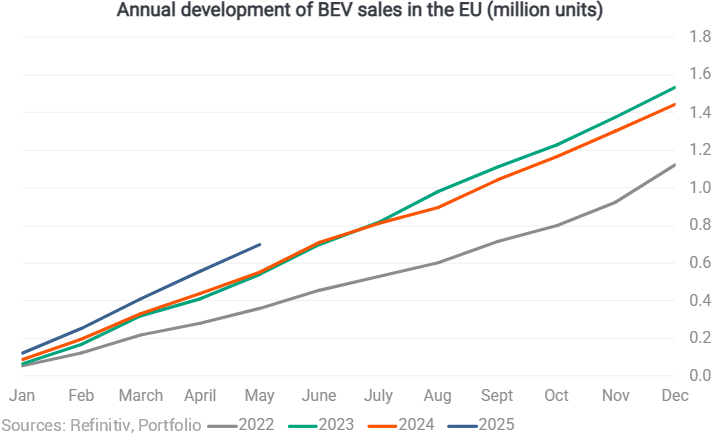
Nevertheless, it is encouraging for the BEV market that sales will grow at a higher rate than the overall market this year.

A number of analyses have looked at length at what is behind the slowdown in demand. In short, price sensitivity (low number of entry-level models); faster depreciation of used EVs; gaps in charging infrastructure; uncertainty around regulation; reduced subsidies (the main driver behind last year's decline); EU import tariffs on Chinese cars; uncertainty caused by the tariff war; and the rise in popularity of hybrids have all contributed to slower than expected uptake of EVs.
In summary, the European electric car market is no longer soaring, but is in a temporary stall.
Although there were encouraging signs early this year, it will probably take the next 2-3 years to determine with certainty whether Europe is back at the forefront of the e-mobility transition. The EV market slowdown has also left its mark on the battery market, with battery demand in the EU stagnating last year, according to the IEA's annual report.
This momentary pause seems to have been enough to make companies with significant investments in Hungary rethink their plans.
What's more, two strategic investments are involved, which the government intended to play a key role in the much-discussed "flying start".
But there have been worrying signs in our country for the past year and a half. The battery production capacity built up so far has not been performing well. It could be said that battery production has virtually collapsed in the last year and a half - as shown in the graph below - while the automotive industry in Hungary is also facing serious problems.

Although the last few months have shown the first signs of recovery, the clouds seem to be gathering over the two flagships of Hungarian industry. It has now become clear that ongoing large investments will support the performance of the Hungarian economy to a much lesser extent than previously expected. As a result, the GDP impact of battery and car manufacturing could be much smaller than planned in the year and a half to two years ahead.
“Based on the information and half-information released in recent months, it may well be that most of the large investments will provide less manufacturing capacity for the domestic economy in the first few years than analysts' consensus, so the short-term labour market impact may be more muted than preliminary forecasters' estimates,” said Péter Virovácz, Chief Economist at ING Bank, in response to a request from Portfolio.
With the global battery and vehicle industry in a difficult situation, to which companies are trying to adapt, the Hungarian growth outlook for 2026 is also deteriorating,
Virovácz added.
The National Bank of Hungary (MNB) has previously estimated that the output of BMW, CATL and BYD could contribute a combined 1.5% to GDP growth this year and next. However, it now looks very likely that the impact on GDP will be smaller. According to Péter Virovácz, the number of people employed in these factories will also grow more slowly, which is also due to the slower-than-expected production ramp-up.
BYD changes its strategy
Unfortunately, there has been a lot of negative news in recent weeks and months about BYD and CATL's investments in Hungary. Just yesterday, Reuters quoted unnamed sources as saying that
BYD is delaying the start of mass production at its plant in Szeged - although this has been refuted as "fake news" by a government official since then.
Earlier, there were rumours that BYD would start production in Szeged this year, some sources said the second half of 2025, while Mayor Lászó Botka said the start of production would be in November, so the last months of the year seemed realistic. In comparison, this recent press report quoted above suggest that mass production will only start in 2026, but it is not clear at which time of the year.
It is reported that although initial plans were for an initial production of 150,000 units per year, to be increased to 300,000, the final figure will be significantly lower, with only a few tens of thousands of models to be produced next year, and capacity may remain below plan in 2027. Furthermore, it seems that the company is shifting its focus from the Hungarian site to Türkiye, as while production in Hungary is delayed, BYD's plant in Türkiye will start production earlier than planned. Production at the $1 billion Manisa plant is expected to reach well over 150,000 cars in 2027, according to sources, with output set to increase significantly again in 2028. However,
there is still no official confirmation of the Reuters reports.
But if the reports prove to be true, BYD is probably prioritising production in Türkiye because of lower labour costs, faster production and the fact that the country is a member of the EU Customs Union, which allows duty-free exports of cars produced there to the EU.
- One of the main reasons is the significantly lower labour costs in Turkey. For a Chinese company, the ability to enter the European market as cheaply as possible is key, and minimising production costs is a key factor in this. Labour costs in Hungary have risen significantly in recent years, especially in the manufacturing sector, so this can be a serious competitive disadvantage when starting up a new factory.
- Another decisive factor is that Türkiye is a member of the EU Customs Union, so vehicles made in Manisa can enter the EU duty-free. This is a huge advantage, especially at a time when the EU is trying to curb the market penetration of Chinese electric cars through tariff measures. The Szeged plantproduces within the EU too, but for BYD, the Turkish customs union status is a quicker way to benefit from the scalability of production.
- Speed is also an important argument. The Turkish plant is reportedly moving faster, so mass production can start sooner.
All in all, BYD is prioritising a factory in Türkiye, which is quicker to activate, cheaper to operate and favourable from a customs perspective in the shorter term, while the Szeged plant could become a secondary European base that could ramp up in the longer term. This does not mean that the Hungarian investment is off the agenda - but it will reach its planned capacity more slowly than previously hoped.
Many questions around CATL
CATL's battery factory in Debrecen has been the subject of ongoing social and professional debate and questions practically since its announcement. The main concerns have been environmental and legal issues, but in recent months there have been reports of the suspension of the second phase of the project and the reduction of the domestic workforce.
Telex was the first to report that the company was laying off Hungarian workers and replacing them with Chinese workers, then the company denied this(?), after which the company's employees revealed that CATL had in fact laid off hundreds of workers in a matter of weeks. The NGM then launched an investigation, after which the company allegedly suspended the redundancies.
The situation around the second phase of the investment is similarly chaotic. According to press reports,
CATL has halted preparatory work on the second phase of the battery factory in Debrecen, and several members of the design team have been dismissed.
The company then issued another rebuttal, saying that the CATL headquarters experts were "reviewing the technology and investment schedule of the second cell factory planned for Debrecen... but the second phase was never questioned." Despite this, HVG has spotted that the company's official report submitted a few days ago only mentioned a suspension.
Despite the suspension of Phase II, the expected completion of Phase I and customer demands remain unaffected,
the report states.
Of the originally announced €7.3 billion (HUF 3,000 billion) investment in Debrecen, roughly one third will be realised in the first phase, so the total investment value is expected to approach HUF 1,000 billion by the end of this year.
The original plan was that once production started on the first phase, the company would start permitting and construction of the second phase (2026-2027), followed by the third phase, which would be completed by the end of the decade. Together, the three phases would provide 100GWh/year of production capacity, of which somewhere between 30-40 GWh/year would be allocated to the first phase. However,
it is not clear from recent information how much the second phase will be delayed, if at all, in the coming years.
Not surprisingly, macroeconomic analysts are becoming increasingly pessimistic. Industrial production has been particularly weak this year, and according to a recent forecast by the Kopint-Tárki Economic Research Institute, the negative trend is likely to continue.
The fact that CATL has suspended the investment in the second phase of the Debrecen plant due (also) to what promises to be persistent demand constraints suggests that the impact of the industrial mega investments nearing completion on the year-end industrial dynamics may be less than previously expected,
wrote Kopint-Tárki's experts in their analysis.
For now, most forecasters also expect continued contraction in the industry for this year as a whole - Kopint-Tárki expects an annual decline of 0.5-1%. And against this backdrop, GDP growth will not be robust either. Most analysts expect economic growth to be below 1% this year, but stagnation is not ruled out. And the delay in major investment may soon force
a revision of expectations for 2026.
Cover photo (for illustration purposes only): Getty Images





