Want a big pay rise? Here's what's happening in Hungary


The second half of the 2010s saw a growing number of vacancies in Hungary, with companies complaining about a shortage of skilled workers and in many cases having to give people ever larger pay rises.
All this is interesting because for a long time in Hungary's post-1989 regime change history, labour shortages were not even a news story, the problem was low employment and high unemployment, which did not go hand in hand with a strong labour bargaining position, to say the least.
But when companies found between 2015 and 2020 that there were no longer 40-50 applicants for a job advertisement, the tables turned. In many places, workers suddenly had to be given raises of over 10% to stop them going elsewhere. There were companies that threatened to strike - or even close down - if they didn't get the pay rises they expected.
But "luck" seems to be very volatile. In fact, the Hungarian economy has been in stagnation for some time, with no real GDP growth for more than 2 years. As a result, there is less demand for workers, so it is not surprising that the number of people in employment has fallen to a more than 3-year low, and vacancies have also fallen for a good 2 years; in other words, there are now far fewer open positions than before.
Companies are not tolerating the persistently weak economic situation and deteriorating prospects and have started to cut costs. This has now reached the workers. Most have so far only cut hours while retaining workers, but in the worst-performing industries they are already cutting back substantially. So it is not surprising that more and more people are declaring themselves unemployed, which is another warning sign.
The world is turning
All of this raises the legitimate question of whether the pace of wage growth is falling under these circumstances. The short answer is yes. The most recent data suggest that firms are no longer giving as generous wage increases as they used to.
The last time the rate of wage increases in the corporate sector was as low as it is now was after the Covid crisis.

The trend also shows clearly where wage dynamics have been heading over the past year and a half. Companies are now giving their employees "only" 7-8% pay rises, while a year ago average wage growth was well above 10%.
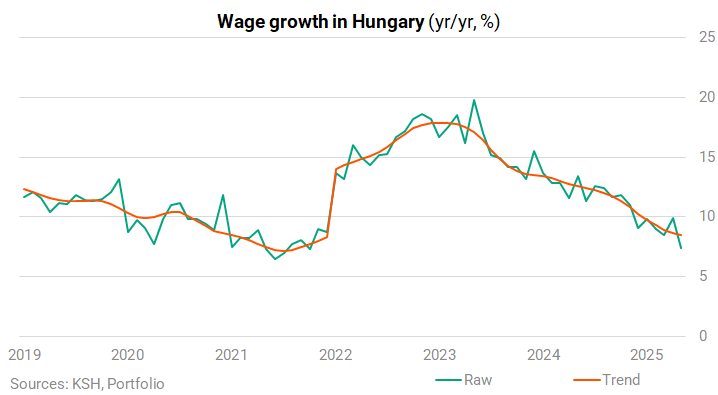
True, the 2022-23 period was heavily influenced by minimum wage increases of 20% and 16% respectively, while companies also had to raise their wages by a large amount due to galloping inflation. This year, however, the minimum wage has only increased by 9% (the minimum wage for skilled workers by an even smaller 7%), and as a result, there is not such a large increase in the salaries of those working at higher wage levels.
Also, economic constraints do not justify companies being too generous on wages.
This is also shown by the Beveridge curve, which shows that with unemployment rising over the past two years, the number of vacancies has been falling (the labour market is loosening), which does not bode well for workers' wages.

Many people see their wages cut
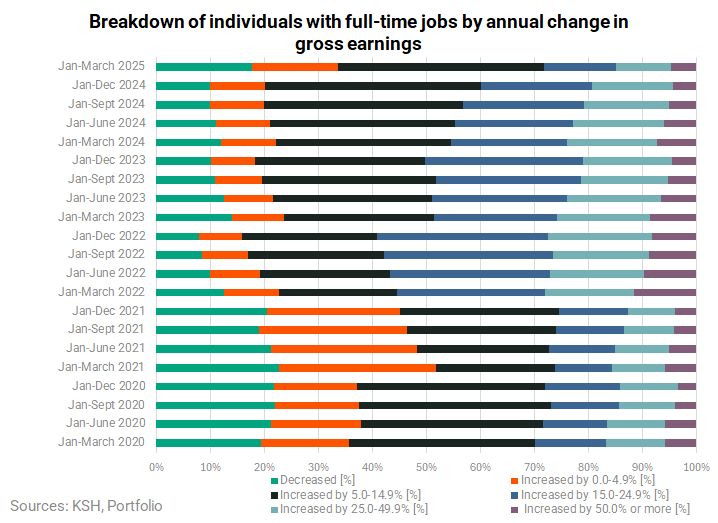
This is borne out by the fact that although average wages continue to rise, this year there are more and more people whose wages are falling.
- The nominal, or forint, wages of 18% of workers fell compared to the beginning of last year. The last time we saw such a high rate was in 2021, during the recovery from the Covid crisis.
- A further 16% have seen their wages increase by 5% or less, which is a decline in real terms, or at best stagnation.
- Most, 38% of workers, received pay rises of between 5% and 15% at the start of this year, while
- the share of those receiving increases of between 15% and 25% (13%) fell.
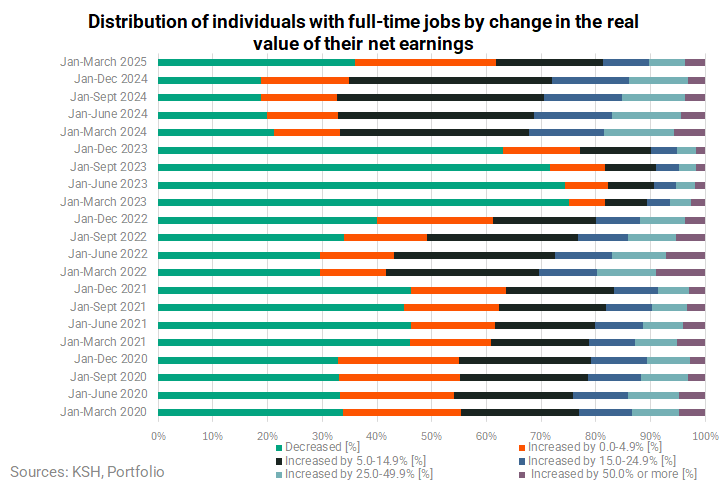
The situation is even more depressing when wages are measured in real terms. At the beginning of this year, more than a third of workers - 36% to be precise - saw their real earnings fall, while a further 26% saw them rise only slightly. So there are big differences behind the increase in average wages, which explains why consumption is so weak.
Industry in distress
There is also a big difference between sectors. The graph below illustrates both the complete disregard of economic trends in wage issues in the public sector (health workers vs. teachers) and the fact that in several sectors, the purchasing power of earnings increases by only 1-2%. In particular, wage dynamics have slowed down in industry and manufacturing related sectors, as these sectors are the most affected by the lack of external and internal demand.

What lies ahead for us?
The big question will be whether the slowing wage dynamics will continue. Based purely on the economic situation, there is no reason to believe that a trend reversal is imminent.
However, according to government plans - and the VKF agreement - the minimum wage will rise by 13% next year, which could drag down the median and average wages. In fact, the central bank says that, in order to avoid wage inequality, the wages of higher earners should also be increased if the minimum wage rises. The problem is that representatives of the business sector say that the minimum wage cannot be raised as much as the cabinet would like because of weak economic performance.
In addition, it is uncertain to what extent the guaranteed wage minimum (minimum wage for skilled workers), which affects many more workers, will increase, as there is no agreement on this yet. If the intention is still to abolish the minimum wage, it should be increased as little as possible. If, on the other hand, the logic of the election is to be followed, it should be increased substantially next year.
Overall, the next few months could see a wage increase of between 7-9%, which could return to double digits next year if the statutory minimum wage increase obligation is high. Economic trends would not justify an increase above 10% for the time being.
In the long term, however, labour shortages due to an ageing population will determine wage trends. And we know that a growing labour shortage will lead to rising wages - but without efficiency gains, inflation will follow. Sustainable wage increases would require the economy to find its feet and productivity to improve. This will be one of the biggest challenges and tasks for Hungary in the coming years.

Cover photo (for illustration purposes only): Getty Images





