Hungary receives stern warning: current plans are unsustainable


New risks emerge
S&P recently revised its growth forecasts for Central and Eastern Europe due to weaker growth prospects. The rating agency highlighted in its analysis that lower-than-expected economic expansion is increasing fiscal risks in the region. Looking at how the forecasts have changed makes it clear which countries the firm was primarily thinking about:


Clearly, S&P has barely revised its latest estimates (typically from this spring) for most countries. However, two countries have shown a significant deterioration in growth prospects: Romania, where GDP growth is now expected to be just 0.3% due to fiscal austerity, and Hungary, where the forecast has been cut from 1.5% to 0.8%.

The rating agency notes that most Central and Eastern Europe (CEE) sovereign ratings have stable outlooks, reflecting S&P Global Ratings’ expectation of medium-term GDP growth, contained balance-of-payment risks, gradual disinflation and cautious monetary easing, and moderate government debt.
It adds, however, that global trade and geopolitical uncertainty cloud the outlook for CEE sovereigns.
The outcomes of the U.S.-EU tariff negotiations remain uncertain, and the intensity of the Russia-Ukraine remains high.
S&P analysts note that growth in most CEE economies slowed over the first half of 2025 due to a combination of the uncertainty weighing on consumer and business confidence, slow utilisation of EU funds, and the German economy’s ongoing weakness.
Continued weak growth will likely complicate CEE governments’ fiscal consolidation plans,
which already faced one of EMEA’s weakest fiscal outlooks (due to generous social transfers and elevated defense spending) and complications due to electoral cycles and a fragmented political landscape, S&P warns.
The rating agency's analysts also identify risks in the Hungarian budget. They project a deficit of 4.5% of GDP this year, rather than the government's planned 4.1%, and 4.3% in 2026. However, when it comes to the primary budget balance (excluding interest expenditure), Hungary is in a much better position than many other countries.

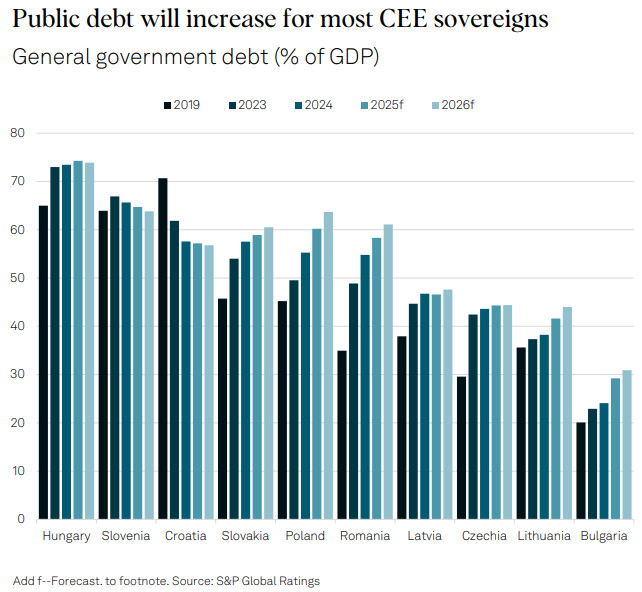
Apart from Hungary, the chart shows that only Slovenia and Croatia are expected to achieve debt-reducing primary balances in 2025 and 2026. The other countries in the region would require significant adjustments.
As a result, Hungary's debt ratio could rise only slightly this year. Next year, however, the debt-to-GDP ratio could fall again, despite the rating agency expecting an increase in several other countries in the region.
Another risk highlighted by S&P is that some EU funds might not be utilised and lost permanently. Some EU transfers, including the Recovery and Resilience Facility (RRF), are contingent on the rule of law and reforms. The deadline for utilizing RRF funds is Sept. 2026. If governments can’t deliver on related policy targets, some RRF funds could be lost, S&P warns. It notes that EU funds are important for investment and growth, but also for CEE economies’ external funding and investor sentiment.
További kockázatként emeli ki az S&P Kelet-Közép-Európával kapcsolatban, hogy az uniós források felszabadítása továbbra is akadozik, illetve egy részük végleg el is veszhet. A helyreállítási alap (RRF) forrásai ugyanis a jogállamisági reformok elmaradása miatt hiányoznak, 2026 szeptemberében pedig lejár ezeknek a forrásoknak a felhasználhatósága. Vagyis, ha addig nem sikerül felszabadítani a pénzeket, azok végleg elvesznek. While CEE countries have received over one-third of their RRF allotments on average,
the average is seriously dented by hungary's 9% share.
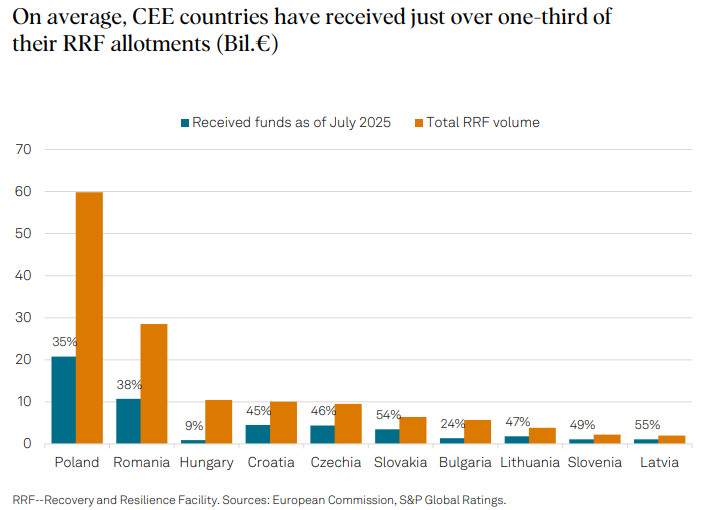
Even Bulgaria, which is right behind Hungary, has received 24% of these funds, whereas Slovakia and Latvia have already received more than 50%.
The fifth risk listed by S&P is that CEE central banks will be cautious of underlying price pressure (due to tight labor markets), administered price hikes, exchange rate volatility (due to the relatively high exchange-rate pass-through to domestic prices), and global energy price volatility. They expect stable policy rates in most of CEE, though Polish disinflation could provide room for easing.
In this respect, the National Bank of Hungary (MNB) is already attempting to mitigate these risks by emphasising the importance of anchoring inflation expectations and adopting a patient and cautious approach to monetary policy.
Government also working on updated plans
The government is reportedly preparing a new macroeconomic forecast, given that the latest S&P analysis indicates the projected 2.5% GDP growth for 2025 is unrealistic.In his press conference following last Tuesday's interest rate decision, central bank Governor Mihály Varga forecasted a similar path.
A few weeks ago, Gergely Gulyás, the Prime Minister's chief of staff, told journalists that, in light of the detailed public finance data for June, it would be worthwhile examining whether the government's expected economic path needs to be modified. The expected data was released last week, so
everything is now in place in principle for a review of the macroeconomic path.
The announcement is expected to be made at a press conference held by Economy Minister Márton Nagy early this week.
The most important question is how the government will address the fiscal impact of deteriorating growth prospects. So far, it has been emphasised that a worse growth trajectory will not result in a shortfall in tax revenues requiring a change to the budget target. However, most analysts already believe that achieving a deficit of 4.1% will be very difficult. The question is whether the government will respond or insist that no intervention is necessary.
Should we be concerned about a potential rating downgrade?
The large credit rating agencies are also likely to be keeping a wary eye on the government's latest plans, as all three major firms are planning to review Hungary in the autumn. Of these agencies, S&P is the one that should concern us the most, as
it rates Hungary only one notch above investment grade and has a negative outlook.
Thus, a downgrade would be painful for Hungary, as it would immediately result in the country being assigned a junk grade, meaning it would no longer be considered an investment-grade country. Based on the above analysis, the direction in which S&P's experts are heading is questionable, since Hungary is almost the only country in the region where the growth outlook has deteriorated. It is at the back of the queue in terms of access to EU funds, especially the Recovery and Resilience Facility (RRF), while the Hungarian fiscal position, even with the risks, is better than in most countries in the region and the path of public debt may be more favourable.
In other words, there are arguments in favour of both negative and positive outcomes of the rating review. With a credible macroeconomic path this autumn, Hungary miight avoid a painful step by the rating agency.
Cover photo: Portfolio