Hungary comes up with revised growth estimate for 2025


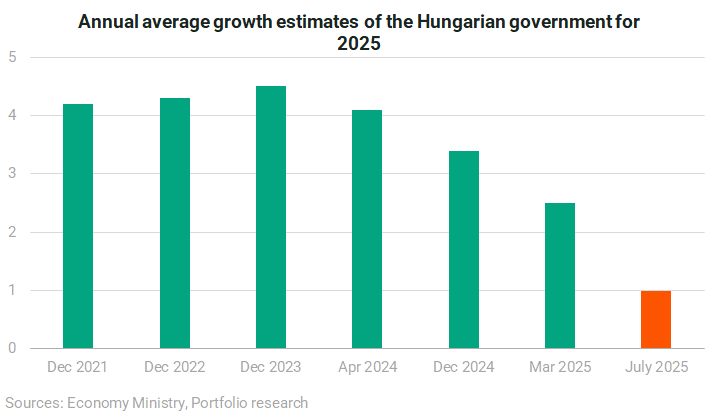
According to the ministry, the average annual GDP growth rate this year could be 1%.
It is worth noting that, while this is a more realistic expectation than the previous forecast of 2.5% growth, it is still the most optimistic assumption compared to the latest analyst forecasts. Therefore, it is good news that the government is adjusting its expectations in a timely manner, sending an important message to market players, credit rating agencies and financiers. Interestingly, the government has not adjusted the budget, making these new figures even more significant.
The ministry's projections also suggest that the Hungarian economy will achieve the long-awaited government growth target of 4% in the second quarter of 2026.
Next year's annual average growth is expected to reach 3.1%.
Chipping away at the 2025 growth estimate
Since March, the government has been forecasting growth of 2.5% for this year, although MPs had adopted the 2025 budget with a GDP growth assumption of 3.4%. The 2.5% forecast has now been revised further down. The graph below illustrates the gradual deterioration of the government's official expectation for GDP growth in 2025 over the past few years.
Specific measures and promises
Márton Nagy began the background discussion by explaining that the current economic policy is based on six pillars, which include 70 specific measures.
The government plans to launch a special housing assistance programme for state employees. There are 430,000 of them,
the minister announced. In addition to the 3% preferential loan, the government will provide them with extra support. They plan to launch this in September.
Further steps are being taken to support SMEs. Payments under the Demján Sándor 1+1 programme are coming to an end, and the intention is to launch a similar scheme.
The ministry is reviewing the Széchenyi Card Programme to determine whether the government can offer small and medium-sized enterprises greater interest rate benefits.
The government is working on
wage convergence and further tax cuts.
Growth and the fiscal situation
Márton Nagy also addressed this year's budget situation and the consequences of the new economic prognosis.
He explained that the slower growth will not significantly impact the budget. GDP growth may have stagnated in the second quarter. This is partly due to industry, but mainly to agriculture. He said that the latter would take 0.3–0.4 percentage points off growth.
He added that the annual growth rate in the third and fourth quarters could be around 1–2%.
'We are seeing a turnaround in electric car sales across Europe,' he said. This could lead to industrial growth for the Hungarian economy this year. He explained that, on a year-on-year basis, vehicle and battery manufacturing is no longer holding back economic growth.
Meanwhile, he continued, consumption is being strongly supported by government measures, which are now being showered on the population. 'Without growth in consumption, GDP growth would have turned negative a long time ago,' he said. 'If it weren't for the government's economic policies, GDP would already be in negative territory due to external factors, but we are managing to maintain growth,' he added.
'It would be premature to decide whether the economy is facing structural problems or if we are dealing with a cyclical issue,' he said. The Austrians, Slovaks and Hungarians are in a similar situation due to their economic exposure to Germany, he added. However, there is a chance of recovery in this area, which could support growth in the third and fourth quarters.
'If growth is sustained by consumption, then the budget is more secure, even if growth is slower,' said Márton Nagy, explaining why the 2025 budget is not at risk.
In this regard, he pointed out that, despite lower GDP growth, total budget revenues are coming in as expected and are higher than last year's figures. He highlighted that VAT and personal income tax revenues are flowing into the state coffers as anticipated by the Economy Ministry.
He said that there has been a decline in corporate tax revenue compared to last year. He added that the lack of growth is hitting companies harder, but has less of a negative impact on the retail sector.
No adjustments are needed for the 2026 budget, as the government has increased the general budget reserve and it will no longer function as it has done until now, i.e. it will no longer serve general purposes and no expenditure will be possible from it, he emphasised.
However, it is possible to spend money from the Economic Development Fund, he stressed.
He acknowledged that it is worth paying attention to how much money will be spent from the Economic Development Fund next year, as this will directly increase the deficit. He said that the government will use this tool to support the six pillars.
We wrote about this earlier here:
The government expects the budget deficit to be 4.1% of GDP this year. We would like to keep this year's gap close to 4%, while the government's goal is to achieve a figure below 4% by 2026. The official target for next year is 3.7%, he reiterated.
The government would also like to keep the debt-to-GDP ratio close to 74% and reduce it further.
The government is unwilling to give up keeping the primary balance close to 0%. This will only open up minimally in 2025, when the primary balance may be 0.3% in the red, but it will be back to zero the following year, Márton Nagy explained. Most of the deficit therefore comes from interest expenditure.
According to him, the government's budget has three key pillars.
- the budget deficit must be reduced every year.
- public debt must be reduced to around 74%;
- Hungary must avoid being subject to the excessive deficit procedure again.
The EU has given us permission to spend, but we cannot exceed the leeway permitted by the EU,' he emphasised. As finance minister, his key objective is to maintain a close-to-zero primary balance, he added.
He cited the latest regional analysis by Standard and Poor's, which dealt with budget prospects. He mentioned that Poland, Romania and Slovakia are experiencing significant budget deficits. In this respect, he noted that Hungary stands out favourably, as the primary budget deficit is significant in the aforementioned three countries, while in Hungary it is virtually zero.
Possibilty of extra spending
The Economy Minister stressed that the additional expenditure resulting from the escape clause cannot be used solely for defence purposes.
The ministry has determined that activating the emergency clause has created significant budgetary flexibility for 2026, helping to achieve economic development goals.
In 2024, Hungary increased its defence spending to 2% of GDP, up from 1.1%. This represented an increase of 0.9 percentage points. The new EU rules allow for a maximum margin of manoeuvre of 1.5%, meaning Hungary's margin for defence spending is 0.6 percentage points above the general margin of 0.9%.
The Hungarian government can spend 0.9 percentage points of GDP on any purpose,
Márton Nagy pointed out.
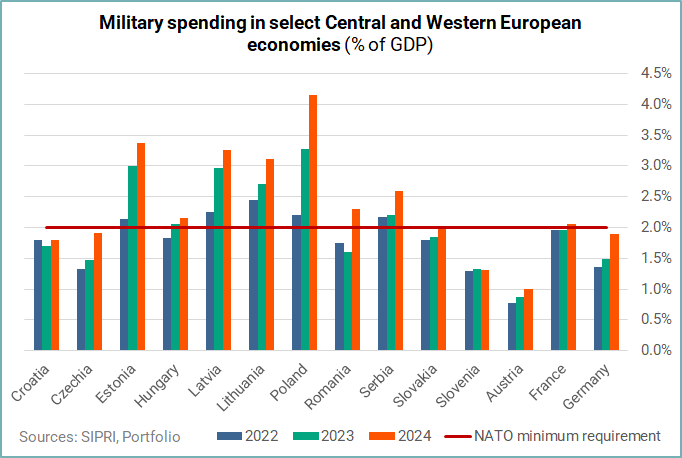

Next year, the government will spend more from the 1.5% leeway, but in such a way that the deficit does not exceed 5%. This spending will be covered by the Economic Development Framework.
The wage increase for municipal employees and the expenditure framework for the Home Start Programme have already been implemented at the expense of the Economic Development Framework.
In response to a question, he said that the general margin of manoeuvre and the defence spending reserve cannot be used at the same time next year, because otherwise the budget deficit would swell considerably.
Inflation outlook
"Inflation will continue to decline, reaching around 4% in July, and the significant base effect will also play a role. We are forecasting average inflation of 4.7% for this year and 3.7% for next year," Nagy emphasised.
He estimated that if there were no margin caps, annual inflation in June would have been 6.1% instead of 4.6%. They do not see cross-pricing, but we acknowledge that it is hurting retailers, he said. He also noted that the prices of fruit and vegetables have skyrocketed.
Pensioners
Pensioners will receive an additional 42,600 forints due to the expected 1.5 percentage point adjustment in the autumn. This will result in an additional budgetary expenditure of HUF 105 billion. The new government inflation forecast is 4.7%, up from 4.5%.
Impact of the measures implemented so far
The budgetary impact of the Home Start Programme will be neutral in 2026. If you purchase a property, you will be charged a property acquisition tax of 4% of the purchase price. If you purchase a new property, you will be charged a VAT of 5%. These rates are roughly equivalent to the interest subsidy. Therefore, the net impact of the programme in the first year is approximately zero. However, this will no longer be the case in the second year, as there will be no acquisition tax revenue in the budget. From 2027 onwards, the impact will be HUF 50-100 billion, he said.
Teachers' pay rises will begin in September, income tax exemptions for mothers with three children and food vouchers for pensioners will arrive in October, followed by the aforementioned inflationary adjustment of pensions in November, he listed.
He said that similar measures will continue next January, with hundreds of billions of forints entering the system each month as a result of government decisions.
Regarding retail government securities, we are considering creating a new structure in September,
he noted, adding that they want to keep the population involved in financing.
Wage convergence
Based on current macroeconomic forecasts and legal interpretation, it will not be necessary to renegotiate the three-year wage agreement in the fall, Márton Nagy announced.
Gross average earnings may increase by 8.7% this year. The increase in the volume of GDP may be 2.4 percentage points lower than agreed, while inflation may be 1.5 percentage points higher. Therefore, the sum of these deviations is -0.9%, which is less than 1%. Legally, this proves that the wage agreement does not need to be renegotiated. However, he acknowledged that it may be necessary from an economic point of view.
Therefore, the wage agreement clearly needs to be renegotiated, which could begin in November once the GDP growth for the third quarter has been taken into account. He said that the government is interested in maintaining the double-digit minimum wage increase next year.
The gross average regular wage must reach 50% of the minimum wage by 2027, which is the target that has been set,
Márton Nagy emphasized. This 50% must be maintained by the end of 2027, i.e. by 2028, regardless of how the wage agreement develops following the macroeconomic trajectory, he stressed.
The goal is to raise the minimum wage as much as possible, but it is important not to make empty promises. The rate of increase will depend on the economy's performance. The government will provide all the necessary assistance to achieve the highest possible increase in the minimum wage next year.
According to the ,inistry's calculations, a 1 percentage point increase in the minimum wage equates to a 0.2–0.3 percentage point increase in the average wage. He said that there are 250,000 people on the minimum wage and 750,000 on the guaranteed wage minimum.
Credit rating
"Downgrades must be avoided, especially by Standard and Poor's," Márton Nagy emphasised during the background discussion, referring to the fact that such a move would land Hungary in junk grade. He added that it is particularly interesting that Hungary's first rating review is scheduled at S&P in October.
In response to a question, he emphasised that a rating downgrade in autumn would not be an acceptable risk for Hungary.
"If necessary, I will talk to them myself and travel to London to do so. We are paying close attention to these issues," he said.
"We also need to pay attention to the market to see what it will allow in terms of extra spending and increasing the deficit." While the EU will allow it, it is not certain that the market, and thus the credit rating agencies, will allow it.
A new measure
The government has applied for €20 billion of SAFE funding. This is a financing instrument. Converted into Hungarian forints, this represents an HUF 8 trillion loan for the development of defence capabilities.
This financing option is cheaper than if the Hungarian state were to borrow on the open market. In fact, it is 200 basis points cheaper. This saves the government a lot of money. This affects interest expenses, not the primary balance.
The government would like to borrow the maximum amount possible from this fund. Assuming all other factors remain unchanged, interest savings in the tens of billions of forints could be achieved annually from 2026 onwards, rising to savings in the hundreds of billions of forints from 2030 onwards.
He said that by the end of August, it will be clear how much Hungary will receive from this.
In practice, this also means that there may be no need to issue bonds on the foreign currency bond market in 2026 and 2027.
However, this will not reduce the foreign currency ratio, he emphasised.
The SAFE framework was not designed to increase defence spending. It will not increase the defence spending-to-GDP ratio from 2% to 5%.
Why now?
The timing of the presentation of the new government's GDP forecast is no coincidence. For one thing, the second-quarter growth data is due on Wednesday morning, so the Ministry should already have reliable information on this. Furthermore, weeks ago, the government promised to update this year's macro trajectory later this summer.
We have recently published several articles on the factors that could influence the growth prospects of the Hungarian economy. An analysis published by Economy Ministry experts on Portfolio's pages also offered insights into what the new official forecast might be.
What's the consensus on the market?
In recent months, analysts have repeatedly lowered their growth forecasts for this year.
The Kopint-Tárki Economic Research Institute, for instance, has provided a bleak outlook for Hungary's economic growth, projecting GDP growth of just 0.5% by 2025. Their analysis reveals that this forecast is subject to considerable negative risk.
The think tank's bleak forecast is based on the assumption that after stagnation in Q1, GDP will eventually start growing again in the remaning three quarters of of the year. The key factors of this assumption are rising private consumption and that investment will decline at a lower rate.
Their expectation is that private consumption growth will accelerate compared to the 2.2% recorded in the first quarter, helped in Q2 by an increase in real earnigs as a result of moderating inflation. The latter impact will likely dissipate in the second half of the year, but various measures designed to stimulate demand will come into effect, such as increased family allowances, tax exemptions for mothers with three or more children, and food vouchers for pensioners. – which will boost consumer demand. For the time being, the annual growth rate of private consumption is expected to exceed 3%.
Their second assumption is that the rate of decline in gross fixed capital formation will slow significantly on average throughout the year, with the decline turning into stagnation by the end of the year. (This indicator shows how much an economy invests in new or existing assets.)
This expectation is based on the fact that, while consumption is picking up and exports are showing signs of modest growth, the industrial downturn is also slowly coming to an end on the production side. Under these circumstances, the sharp decline in investment will gradually become a thing of the past, provided there are no further negative shocks. However, this does not necessarily mean that investment will increase.
Even the prospect of the industry remaining stable after the decline of the past two years has now faded, not to mention growth.
Although the rate of decline slowed somewhat in April and May compared to the first quarter, the chances of recovery are slim. Although analysts had expected large-scale industrial investment to increase towards the end of the year, the recent announcement regarding CATL suggests that this effect may be smaller than anticipated.
The company has suspended the second phase of its investment in the Debrecen plant due to promising demand constraints.
Most forecasters now expect the industry to contract throughout this year. According to Kopint Tárki's forecast, the annual decline could be 0.5–1%.
Growth in services is expected to strengthen alongside the anticipated increase in consumption, although the extent of this growth is uncertain. Despite the poor start to the year, the chances of growth in the construction industry this year have increased, rather than a decline or stagnation.
However, all of these assumptions involve significant risks. These arise primarily from the unstable global situation.
- The baseline scenario, according to which the EU, and within it the German economy, will slowly regain strength, could be undermined by the escalation of the trade war threatened by Donald Trump in August.
- Conversely, trade relations between the EU and China seem to be deteriorating rather than improving. The latter could have particularly negative consequences for Hungary, whose growth strategy relies heavily on the stability of existing East-West relations. Any new negative shock from either direction would delay the stabilisation of industry, exports and investment.
- Furthermore, Kopint-Tárki's expectations of a revival in consumption may be overly optimistic. There has been an increase in group layoffs in recent months, mainly in industry. The unusually high level of self-classified unemployment may also affect consumer confidence over time.
The latest GDP consensus from Portfolio was published on Tuesday morning, ahead of the second-quarter GDP data due on Wednesday. It shows that
analysts are forecasting an average annual growth rate of 0.7% for 2025.
The table below shows that 1% growth is the most opotimistic forecast on the market currently.

Cover photo: Márton Nagy's Facebook page





