Hungarian gas reserves haven't been this low in years


With a fill ratio of around 61% at the end of July and gas reserves amounting to slightly more than 3.6 billion cubic metres, it is estimated that around 0.1 billion cubic metres of gas was added to domestic storage facilities since the middle of the month, for which the Hungarian Energy and Public Utility Regulatory Authority (MEKH) published preliminary official data. According to ENTSO-G data and trends observed at the end of July, Hungarian gas storage levels are increasing by an average of 0.26% per day. This figure is lower than the EU average of 0.34%, but not the lowest in the EU.
In recent years, Hungarian natural gas storage facilities have usually been more than three-quarters full by mid-July. It should be noted that
the EU's fill ratio is also significantly below the long-term average.
In 2024, Hungary's total natural gas consumption was approximately 8.5 billion cubic metres.

From a Hungarian perspective, 2022 was exceptional, with gas prices rising sharply due to the Russian–Ukrainian war and a reduction in Russian gas supplies. This significantly reduced traders' willingness to store gas.
As a result, domestic gas storage facilities were less than 50% full in mid-July 2022 (2.84 billion cubic metres). However, gas prices started dropping at the end of summer, which accelerated storage. By mid-November, storage capacity was between 85% and 90%.

The current storage period began in mid-April, with the country's gas reserves falling to the level they were at the end of the last heating season, with domestic gas storage facilities at 35-37% capacity (2.22 billion cubic metres).
The storage period kicked off at even lower levels in 2018, 2019 (1.8 bn cubic metre) and 2022 (1.22 bcm), but by the start of the heating season high fill ratios were achieved - around 71% in 2018, around 97% in 2019 and around 80% in 2022.

Hungary is still required to do this under EU regulations. In July, the Council of the European Union extended the gas storage obligations of member states, which were due to expire at the end of 2025, by two years until the end of 2027. This means that countries must reach 90% storage capacity to guarantee energy supply security and stabilise European gas markets.
However, it is a relief that the mandatory target of 90% can now be met more flexibly, at any time between 1 October and 1 December instead of by the strict deadline of 1 November.
The EU rule change was partly intended to give member states more flexibility to adapt to changing market conditions, thereby avoiding speculative market movements.
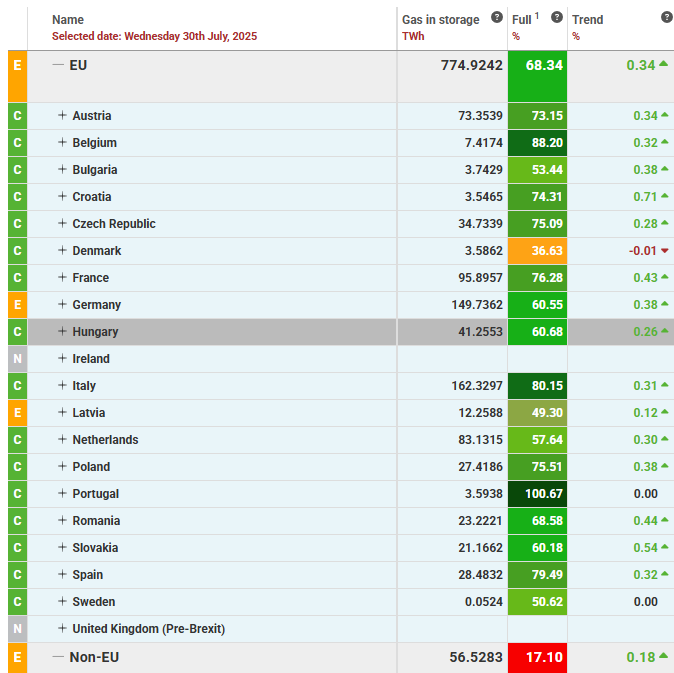
Presumably due in part to the latter, and in part to the stabilisation of the supply situation, gas storage in Germany has also been relatively sluggish until recently. In November, the government of the EU's largest economy reduced the filling requirement for German gas storage facilities from 90% to 80%, citing the easing of supply constraints.
Berlin has eased the alert level of its emergency plan, which was introduced in June 2022 due to the Russian invasion. The decision was made due to market stabilisation and a stable supply situation, which is partly thanks to the LNG terminals that have been built off the country's coast in recent years.
However, analysts warn that reducing gas storage requirements could pose a risk to the supply if winter is colder than expected, or if political events or conflicts occur that could disrupt the market.
The market remains sensitive
The main reason for filling gas storage facilities from spring to autumn is that gas prices are generally lower during this period than during the heating season, when demand is higher. However, market movements resulting from storage obligations can also cause fundamental changes in this regard, known as the winter-summer spread.
Thus, unlike in previous years, traders were less motivated to build up significant stocks for the winter, as Gábor Orbán, CEO of MVM Partner Zrt., pointed out at the Corporate Energy Management 2025 conference organised by Portfolio in April.
He says that the market remains sensitive to regulatory trends and fundamental outlooks. In 2025, he believes that the future of storage obligations, transatlantic relations and geopolitical tensions will be the decisive factors.
Storage activity may have been boosted by the fact that gas prices on the Dutch TTF — Europe's largest gas market —
fell to a nearly one-year low at the end of July
owing to easing tensions in the Middle East and stable LNG supplies. This also impacted other markets.

Although EU natural gas consumption increased by 6.5% in the first half of the year due to weather conditions, LNG shipments to the EU are also rising, with the potential to grow by 5.5% this year and a further 7% in 2026. In light of this, Commerzbank analysts have reduced their year-end gas price forecast significantly, from €45 to €35 per megawatt hour.
Cover photo: EU





