Here's the European Q2 GDP ranking!


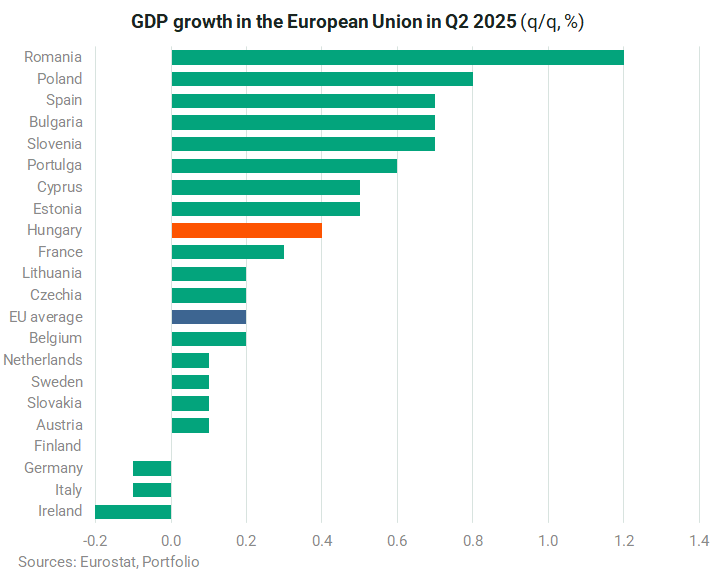
Although Romania tops the EU's quarterly growth rankings with 1.2%, this figure is likely to be the result of statistical anomalies rather than genuine economic growth. Economists at ING comented:
"Today’s release also brought an eye-catching 1.2% advance in quarterly terms, which was also fuelled by revisions and potential discrepancies between the gross and seasonally adjusted series.
We choose to look through these discrepancies and focus on what is clear: the economy expanded by 0.3% after six months.
Detailed GDP data following today’s release is set to be published on 5 September.
Following Romania, Poland recorded the strongest quarter with growth of 0.8%. However, Bulgaria, Spain, Slovenia and Portugal also have reason to be proud, with growth of 0.7%, 0.7%, 0.6% and 0.6% respectively.
Meanwhile, Ireland is languishing at the bottom of the rankings with a 1% decline. Large fluctuations in the Irish economy have become the norm, as many multinational companies have chosen the country as their European headquarters for tax optimisation purposes.
The current sharp decline is primarily due to the optimisation of pharmaceutical exports in the context of the US trade war. In addition to these two countries, contraction is also evident in Germany and Italy, at -0.1% each.
Although Ireland tops the year-on-year growth ranking, the reasons mentioned above mean that this should not be given too much attention.
Bulgaria, Cyprus, Poland and Lithuania are also showing strong growth, while Austria and Hungary are performing the worst with figures of 0.1% and 0.2% respectively.
This fits perfectly with the pattern whereby Mediterranean states that benefit from the tourism boom are at the top of the growth rankings, with the exception of the region's less developed countries.
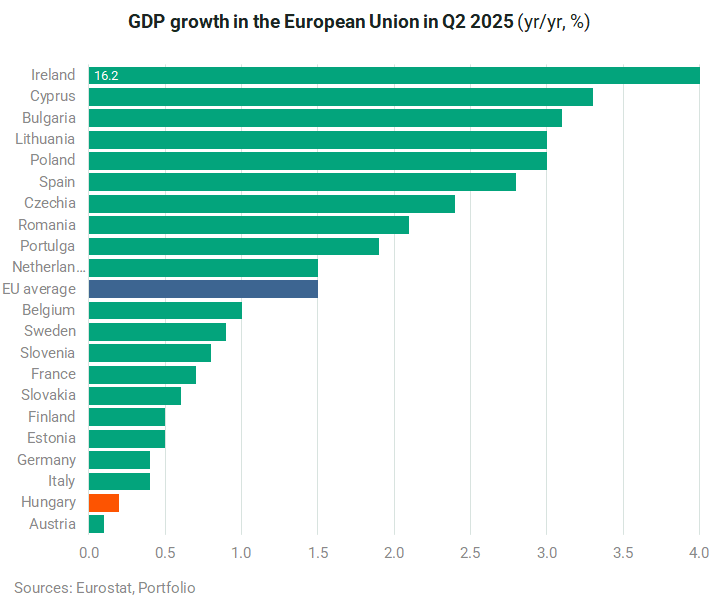
The ranking does not include Denmark, Greece, Croatia, Luxembourg, Malta or Latvia because they have not yet sent their figures to Eurostat, the statisical office of the European Union.
Cover image (for illustration purposes only): Portfolio





