Why can't the Hungarian economy gain momentum?


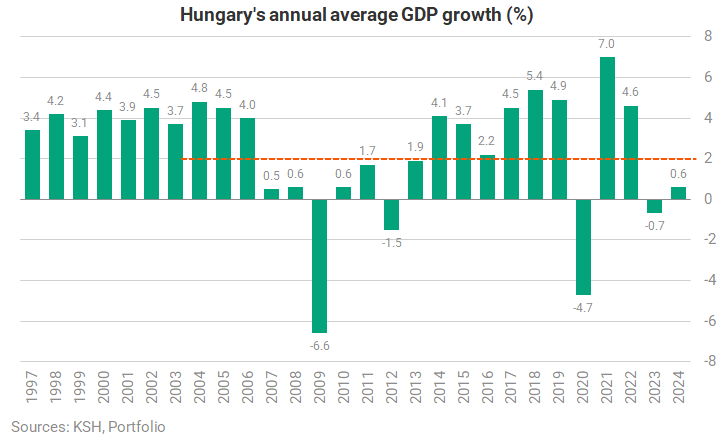
The Hungarian economy is unlikely to grow much this year. Yet 2025 began with high expectations. Not only did the government anticipate a flying start, but macroeconomic analysts and research institutes also predicted quite promising growth prospects. Then, slowly but surely, everything went wrong. Economists repeatedly revised their forecasts downward, citing either the slowdown in the external economy or internal problems. Even the government is now projecting only 1% GDP growth, while the vast majority of economists are forecasting even more modest growth. The latest forecasts are around 0.5% (by the Kopint-Tárki Economic Research Institute, for example), but stagnation is no longer an unimaginable scenario.

We are in a déjà vu situation. The same thing happened last year and the year before. Those years also began with optimism, but then the bad news kept coming. War, energy crisis, inflation crisis, livelihood crisis, investment slump, German recession – there was always something that spoiled things. According to the cabinet, the latest shock may be caused by the EU-US tariff agreement. Although there have indeed been a series of unexpected situations and events in recent times, not every country has been affected as much as ours. It seems that the engines of growth in the Hungarian economy have stalled, while its resilience to shocks has also deteriorated significantly. To understand why there is no growth, it is worth looking at what drove it when it was still there.
Three things have brought significant economic growth to Hungary over the past 30 years: FDI, indebtedness, and EU funds.
A few years ago, we discussed this with one of the country's leading economists. In the period following the 1989 change of regime, the influx of foreign capital provided momentum, which later turned into (unsustainable) economic growth due to massive indebtedness. Following EU accession, EU funds boosted the economy to higher speeds. Now, however, we have reached the point where the previous engines have run out of steam.
Following the shock caused by the change of regime in 1989, foreign capital contributed greatly to the acceleration of the Hungarian economy. The collapse of uncompetitive socialist industry and the arrival of world-class foreign multinationals proved to be a positive change. Even if they only came for the cheap labor and brought manufacturing with relatively low added value. The problem is that while these companies brought about real growth at a low level of development, today almost everyone who matters in the world is here. The arrival of a new company no longer brings the same know-how, knowledge, and technological development as it did decades ago. Moreover, there are no longer hundreds of thousands of unemployed people who need to be provided with jobs. In other words, at Hungary's current level of economic development, inviting foreign companies (with tax breaks or other incentives) no longer brings about a growth spurt, so this does not bring us closer to the technological forefront.
Then let's take out even more loans! Well, economic growth based on debt is never sustainable. It is a basic principle of economics that there is no such thing as a free lunch. We already paid the price for this before and during the 2008-09 crisis. Of course, higher debt levels are temporarily tolerable at very low levels of indebtedness, but a persistently high budget deficit and a level of public debt far exceeding that of other emerging economies represent an obstacle for Hungary, meaning that further indebtedness would entail more risks than benefits. The markets would immediately become nervous, credit rating agencies would quickly downgrade our debt rating, and the forint would weaken significantly. In other words, this option does not really exist, although the government will certainly flirt with it before the elections.
Then let's have the EU money! That's the least controversial option. But EU funds are not coming. The rift between the EU and the Hungarian government is so deep that the money taps are now barely trickling, when they could be gushing.

However, EU funds played a key role in one of the strongest periods of growth in the Hungarian economy after the change of regime, between 2014 and 2019. (It is clear that the lack of funds in 2016 caused GDP to dip slightly.) Of course, it is also true that we were not at the forefront of efficient use of EU funds; in fact, many investments were made with poor returns. However, it seems that EU funds support the economy (and the labor market) even if they are only used to dig a hole and then fill it back up.
Most azonban egyre inkább egy olyan időszak képe rajzolódik ki előttünk, ahol nem látni, miképp kerülnénk ki a növekedési csapdahelyzetből.
Now, however, we are increasingly facing a period where it is unclear how we will escape the growth trap. An economy based on cheap labor and the adoption of foreign technology is no longer capable of generating higher income levels. Furthermore, while employment growth has contributed to GDP growth in recent decades, the opposite will be true in the coming period due to aging. Signs of this are already visible in this year's employment data: the number of workers is already declining because more people are leaving the labor market than entering it.
This means that either labor must be imported (which will be the case with large-scale investments on an exclusionary basis) or the skills of the existing workforce must be improved. Only a skilled workforce is capable of creating high added value, but in Hungary the growth in the proportion of young graduates has stalled, while the favorable trend continues in the EU. Yet wage data also show that better qualifications mean much higher wages, thus enabling a sustainably higher level of consumption in the long term.

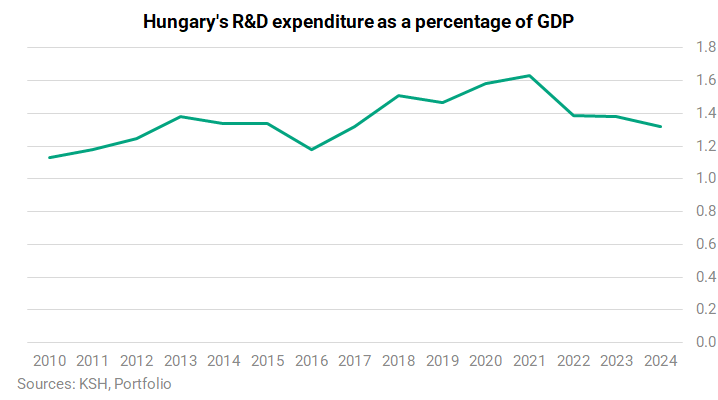
The other way is to increase the return on capital in addition to labor efficiency, which can be achieved by moving from the sadder points of the smile curve to the happier ones (manufacturing-assembly). However, the level of research and development as a percentage of GDP has been declining for years in Hungary (even though GDP is not particularly strong either), which is also bad news for the economy's longer-term growth prospects.
However, good ideas, support for start-ups, and an effective institutional system will sooner or later give rise to rapidly growing companies. You have to search hard to find Hungarians among the champions of the region. The Czechs and Poles are getting stronger and stronger, and they are also doing better and better in terms of investing in foreign countries. And it looks like they are investing here. We can buy durable consumer goods from the Czech company Alza, order tomorrow's breakfast from the Czech company Kifli, and sell what we no longer need on the Lithuanian website Vinted. These could have been domestic companies. But it is not Hungarian companies that are conquering our increasingly technology-based world. Over the past 5-10 years, life has increasingly moved to the internet, but Hungarian companies have lagged far behind in this regard.
If we want to put the economy back on a path of sustained high growth in the coming years, we need to resort to tried and tested recipes: short-term growth can be boosted by EU funds, while the foundations for long-term development lie in a stable institutional system and improving the skill levels of the workforce. In this way, in a few years' time, we may be able to celebrate Hungarian success stories among the best companies in the region.
Cover photo (for illustration purposes only): Getty Images





