Hungarian tourism reaches not one, but two milestones


In the first half of 2025, both domestic and foreign guests spent 4.5% more nights in Hungary than in the same period in 2024. Following several years of growth (which has sometimes stalled and not been consistent across all areas), tourism has now reached a new peak.
This is because tourist visits have now reached 2019 levels for the first time, indicating a recovery from the decline experienced during the pandemic. The fact that
it took six years to return to pre-Covid levels
clearly demonstrates the severity of the impact on tourism.
If we look at the official data, the time series available for the entire sector does not provide much information about the processes as it only covers the period from 2021 onwards. We have written in detail here about the strange reasons for this and other mysteries surrounding accommodation statistics, as well as the communication that exploits this.
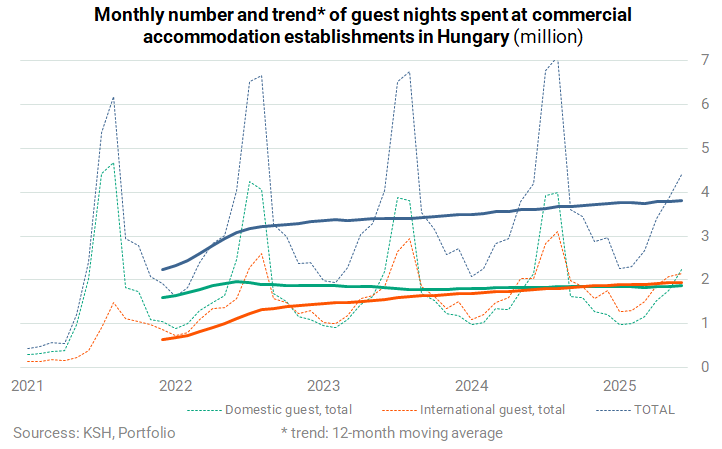
However, we have a longer-term data series for 'commercial accommodation', which accounts for between two-thirds and three-quarters of total tourist traffic. Since this closely tracks the turnover of all tourist accommodation, we can also make longer-term observations.

The big picture of tourism trends can be summarised as follows:
- Domestic tourism recovered more quickly from the sharp decline caused by the Covid crisis, reaching its 2019 peak in 2022. However, the subsequent recession and decline in real wages put domestic travel on a slightly downward trajectory. Although there has been a slight increase in the number of domestic guest nights over the past year and a half, we still cannot talk about dynamic growth. This is why turnover did not reach the level seen in 2022, even in the first half of this year.
- Foreign tourism declined more sharply during the coronavirus crisis, but began to recover quickly until 2022, after which it slowed down. By the end of last year, two milestones had been reached: (1) the number of nights spent by foreign guests exceeded the 2019 peak, and (2) international tourists outnumbered domestic guests. We saw this briefly before the crisis, but it has now taken three years of greater dynamism in foreign tourist traffic than in domestic traffic to achieve it.
Based on data from the first half of 2025, we can say that the number of guest nights spent by foreigners (in commercial accommodation) exceeded the figure for the first half of 2019 by 3.9%, while the number of guest nights spent by domestic visitors fell short of that figure by 1.4%. The combined result of these two trends is a 1.3% increase in traffic.
The two main accommodation statistics indicators are the number of guests and the number of guest nights. In our view, the latter is significantly more important for understanding the situation of the sector, as it provides an accurate reflection of accommodation establishments' occupancy rates and demand.
Until January, the Central Statistical Office (KSH) probably held the same view, at least according to the illustrations and graphs attached to the monthly report, which referred to guest nights. However, from February onwards, the situation changed unexpectedly and the same graphs were prepared with reference to guests.
This has made it more difficult to collect data and update time series. The KSH's standard charts now refer to a less authoritative indicator. The reasons for the change are unknown.
Interestingly, in February, the Hungarian Tourism Agency (MTÜ) and the Ministry of Economy announced that 2024 had been a record year for tourism based on the number of guests rather than nights spent. (The announcement of a record year came as no surprise, given that, according to the MTÜ, the past three years have all been record years. This will be the first time that this statement has been accurate.)
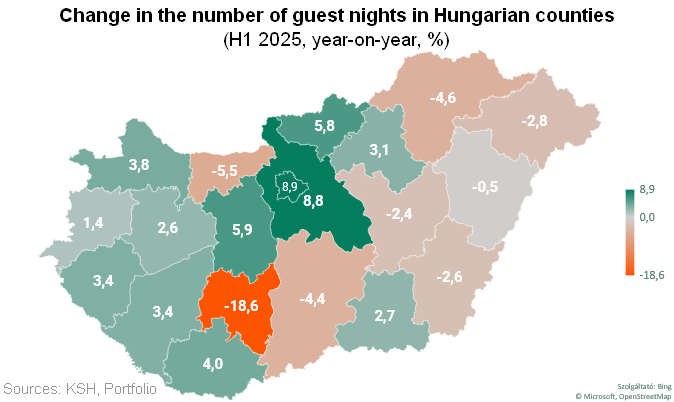
The structural characteristics behind the major tourism trend also mean that certain sector players face a visibly different business environment. The faster growth in foreign visitor numbers means that tourism in the capital is growing more quickly than rural tourism, which is influenced by domestic visitors.
In terms of numbers, the number of guest nights in Budapest in the first half of the year exceeded the previous year's figure by nearly 9%. In contrast, the Tokaj and Sopron regions saw a decline in this period (although this geographical classification does not correspond to the county). Even the 3% increase at Lake Balaton is lower than the national average. It is worth noting that the first half of the year does not include the peak summer tourist season. Therefore, the overall picture for 2025 could still change significantly.
In economic terms, tourism has not yet recovered from the impact of the pandemic, as visitor numbers have not reached the level that would have been achieved if the crisis had not occurred.
The development of revenue from tourist accommodation shows that tourism operators face different economic environments. Total revenue in the traditional hotel industry grew by 17% in the first half of the year, while revenue from guesthouses grew by only 6.6%, and revenue from community accommodation and holiday home complexes grew by less than 2%.
Therefore, overall, it is not necessarily the Hungarian culture of complaining that is to blame if many people working in tourism are not ovejoyed despite a record year. Returning to the level of six years ago does not necessarily indicate a high level in absolute terms. Furthermore, not everyone benefits equally from the recovery of tourism, which is dominated by foreign visitors.
Cover image (for illustration purposes only): Getty Images





