Hungary EcoMin hints at possible new tax cuts

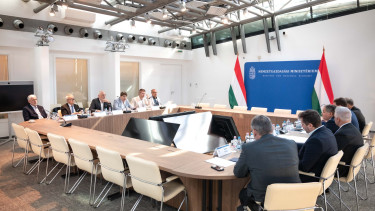
It was already known that the government was preparing new economic policy measures aimed at domestic businesses. The government justifies this on the basis that the EU concluded an unfavourable tariff agreement with the United States.
The EU has concluded a terrible customs agreement that is detrimental to both Hungarian and EU businesses. We will protect Hungarian industry and jobs!,
wrote Márton Nagy.
A few days ago, Viktor Orbán stated that the government intends to protect jobs. Two action plans are to be implemented, with decisions to be made at one of the government's summer meetings.
It appears that preparatory work has begun at the Ministry of National Economy, as the minister revealed in a Facebook post this morning that he had held talks with the MKIK. "We have immediately begun developing an action plan for industrial and job protection. The prime minister's expectations are clear," Nagy wrote, emphasising emphasised that the goal of protecting jobs and Hungarian businesses is shared following consultations with the Chamber.
To this end, the following proposals were put forward at the meeting, as described below:
- The extremely popular 1+1 investment stimulus programme, implemented under the Demján Sándor Programme, will continue with a budget of 20–50 billion forints.
- The interest rate on the Széchenyi Card Programme to be reduced to a uniform 3%, including for working capital loans.
- Raising the current VAT exemption threshold.
- Increasing the entry and retention thresholds for small businesses' tax.
- Increasing the cost ratio for flat-rate taxpayers who are sole traders.
- Making the social contribution tax base more favourable.
- Supporting the adoption and application of artificial intelligence through training and targeted capital funds.
- Further reducing tax and administrative burdens.
The following representatives of the ministry were present at Monday morning's meeting, according to the Facebook post:
- Economy Minister Márton Nagy;
- Richárd Szabados, State Secretary for the Development of Small and Medium-Sized Enterprises and Technology;
- Máté Lóga, State Secretary for Economic Development and Industry;
- Botond Besesek, Deputy State Secretary for Tax Regulation and Accounting.
The following chamber representatives were present:
- Elek Nagy, President of MKIK;
- Ádám Balog, Vice-President of MKIK;
- Tamás Síkfői, President of the Pécs-Baranya Chamber of Commerce and Industry;
- Attila Kőkuti, President of the Csongrád County Chamber of Commerce and Industry;
- Imre Pintér-Péntek, President of the Győr-Moson-Sopron County Chamber of Commerce and Industry; and
- Ákos Csókay, Secretary General of MKIK.
It comes as no surprise that the government is open to proposals for tax cuts. A few weeks ago, Márton Nagy revealed to journalists during a background briefing that the government was working on tax reductions. We subsequently published a detailed analysis explaining how further fiscal easing and tax cuts could still be covered despite the current unfavourable budget situation.
The necessary funds are expected to come from the gradual replenishment of the expenditure line resulting from the escape clause approved by the EU, specifically the Economic Development Framework. As we mentioned in our previous article, general and significant tax relief cannot be ruled out, particularly given that the 2026 parliamentary elections are approaching. During this intense election campaign, the incumbent parties will be under significant pressure to implement economic policies aimed at enhancing their popularity, which could have a substantial impact on the budget.
Cover photo: Economy Ministry





