Something is brewing on the forint market – the only question is what it will be


We are slowly reaching the end of summer, which may finally bring the long-awaited movements to the forint market. In recent months, the Hungarian currency has been trading in a narrow range, but last week there were signs that a more significant movement in either direction could be on the way.
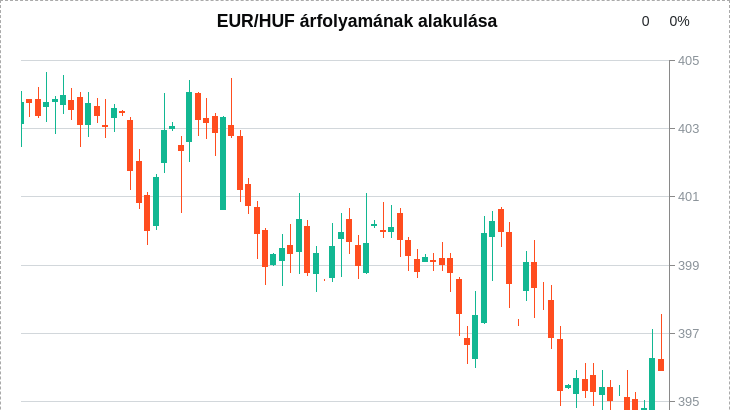
All that remains to be seen is in which direction this shift will occur. We are no closer to figuring this out, as the Hungarian currency reached a nearly one-year high against the euro at around 393.5 in the first half of last week, then rebounded sharply on Thursday, reaching over 397 in the second half of the week.
The forint continues to be driven primarily by international factors, moving in parallel with the dollar. Before the weekend, the US currency fell below 1.16 against the euro, which is traditionally bad news for emerging market currencies, including the forint.
However, the fluctuations clearly show that
something is brewing in the forint exchange rate; the only question is which direction it will move in.
The high base rate continues to provide significant support for the forint, and from this perspective, the fact that the 6.5% benchmark rate is not expected to fall on Tuesday may support its strengthening. At the same time, with the end of the summer holidays, investors may shift towards riskier positions instead of carry trade, which would be bad news for the Hungarian currency.
With the above statements, we have already previewed what will be the most important event of the week from a Hungarian perspective, but let's take it one step at a time! On Monday, we will see the detailed report on public finances for July, which will reveal the background to last month's HUF 12.8 billion deficit. This is unlikely to shake the markets, but experts and investors are paying close attention to the budget situation due to the risks involved. In Germany, the latest IFO index data will be released at the beginning of the week.
| Macroeconomic calendar 25-31 August 2025 | ||||||
| Hungarian macroeconomy | ||||||
| August | 25 | Monday | 11:00 | NGM | Detailed public finance report | July |
| August | 26 | Tuesday | 14:00 | MNB | Interest rate decision | |
| August | 26 | Tuesday | 15:00 | MNB | Press release | |
| August | 27 | Wednesday | 8:30 | KSH | Earnings | June |
| August | 27 | Wednesday | 8:30 | MNB | Prudential data on cash registers | Q2 |
| August | 27 | Wednesday | 8:30 | MNB | Preliminary balance sheet and results of credit institutions | July |
| August | 28 | Thursday | 8:30 | KSH | Employment and unemployment | July |
| August | 28 | Thursday | 8:30 | KSH | Vital events | July |
| August | 29 | Friday | 8:30 | KSH | Foreign trade | July |
| International macroeconomy | ||||||
| August | 25 | Monday | 10:00 | Germany | IFO index | Aug |
| August | 26 | Tuesday | 14:30 | USA | Durable consumer goods order stock | July |
| August | 27 | Wednesday | 8:00 | Germany | GFK consumer confidence index | Sept |
| August | 28 | Thursday | 11:00 | Euro area | Business confidence index | Aug |
| August | 28 | Thursday | 13:30 | Euro area | ECB minutes | |
| August | 28 | Thursday | 14:30 | USA | GDP (detailed) | Q2 |
| August | 28 | Thursday | 14:30 | USA | Jobless claims | |
| August | 29 | Friday | 8:00 | Germany | Retail trade | July |
| August | 29 | Friday | 8:45 | France | Inflation | Aug |
| August | 29 | Friday | 8:45 | France | GDP (detailed) | Q2 |
| August | 29 | Friday | 9:55 | Germany | Unemployment | July |
| August | 29 | Friday | 14:00 | Germany | Inflation | Aug |
| Source: Portfolio research | ||||||
Tuesday will see the most important event from a Hungarian perspective, as the Monetary Council will meet to decide on the fate of the base rate. A change in the 6.5% benchmark rate would be a major surprise, as July's inflation rate of 4.3% still exceeds the MNB's target range, and any reduction in interest rates was previously linked to the sustainable achievement of that target. The most important question for analysts now is whether there will be another interest rate cut this year, as the inflation outlook suggests that the central bank has little room for maneuver. This is supported by the fact that MNB Governor Mihály Varga reiterated last week the need to maintain a cautious and patient monetary policy. In other words, not only are interest rates expected to remain unchanged, but the central bank's main messages will also remain the same as before. In the US, the trend in durable goods orders may be an important economic indicator to watch in the second half of the day.
On Wednesday morning, the Hungarian Central Statistical Office (KSH) will publish the latest earnings data for June, while the MNB will report on the results of credit institutions in addition to prudential data on cash registers. In Germany, the latest data from the GFK consumer confidence index will be released.
On Thursday morning, the KSH will publish unemployment and population movement data, but it would be surprising if these had any significant impact on the market. In the second half of the day, it will be worth paying attention to the detailed US GDP data, which could even influence the Fed's September decision.
On Friday morning, July's foreign trade data will be released, along with important announcements from Europe, including French GDP data and German inflation statistics, which could cause waves in the currency market.
Cover photo (for illustration purposes only): Getty Images