Hungary sees mid-summer lull in retail sales


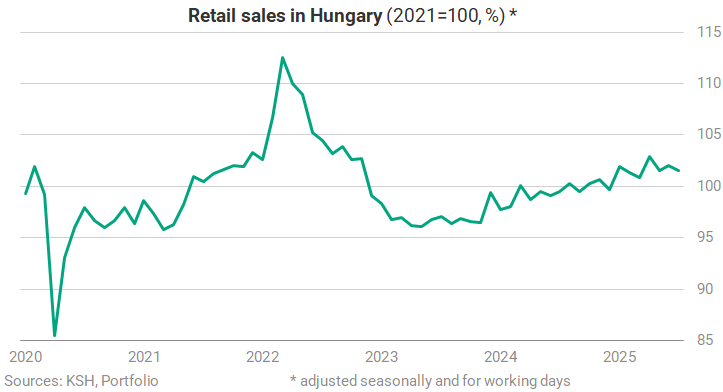
In July, the volume of retail sales decreased by 0.5% compared to the previous month, following an increase of the same magnitude in June. Although volume has been on an upward trend for a year and a half, it remains apparent that this trajectory has been quite erratic. This is evident from the fact that the sector achieved more modest annual growth of 1.7% than in previous months.
Nevertheless, we can see that
an increase in real income provides sufficient purchasing power to ensure slow growth in store turnover.
Pumps brake growth
The volume of sales increased by 2.3% in both specialised and non-specialised food retail outlets. Sales in non-specialised food and beverage shops increased by 3.4%, accounting for 76% of food retailing, while sales in specialised food, beverage and tobacco stores fell by 1.2%.
Turnover in non-food retailing increased by 2.9% in volume. Sales volumes rose by 5.4% in pharmacies, medical goods stores and cosmetics shops, by 3.6% in general merchandise stores and by 0.9% in furniture and electrical goods stores. Conversely, sales volumes decreased by 0.9% in bookshops, computer equipment shops and other specialised stores, by 1.2% in textile, clothing and footwear shops, and by 1.6% in second-hand goods shops.
Mail order and internet retailing, which accounted for 8.1% of all retail sales and involved a wide range of goods, grew by 6.8%.
Meanwhile, the volume of sales at automotive fuel stations decreased by 2.4%. This data can be partly explained by the tourism statistics published by the Central Statistical Office (KSH) on Wednesday, according to which domestic guests spent 2.7% fewer guest nights in commercial accommodation establishments.

Overall, it appears that the data received so far for the first months of the third quarter are not particularly strong, which
does not suggest a significant rebound in GDP after stagnation in the first half of the year.
Although the increase in family benefits in the second half of the year may slightly increase purchasing power, it remains to be seen how much this will be reflected in consumption. This is because consumption has been growing at a slower pace than real wages due to low consumer confidence.
Cover image (for illustration purposes only): Portfolio





