Hungary's inflation stays on the expected trajectory in August

Inflation has remained between 4% and 5% for the past six months. On the one hand, this looks better than the trajectory of nearly 6% seen at the beginning of the year during the sharp revaluation, but on the other hand, it should not be forgotten that margin caps are pulling market prices down by about 1.5 percentage points;
without them, the rate of inflation would still be close to 6%.

Although the inflation rate has not changed, there are several interesting developments beneath the surface. The least surprising developments have been in the food sector, which has caused much excitement in recent months. The entire product range had a monthly price index of 0% in the summer, which was due to the expected fall in the price of fruit and vegetables and the rise in the price of other food products. However, we are seeing a significant increase in the price of tobacco and alcoholic beverages.
Clothing sales are showing signs of the end-of-summer seasonal clearance, but surprisingly, the price increase of durable consumer goods has accelerated despite the stable forint.
The fall in fuel prices had a dampening effect on inflation, and the statistical rise in gas prices did not accelerate price increases after several months. We could have imagined an even greater dampening effect in the latter case; we last wrote about the details of this here.
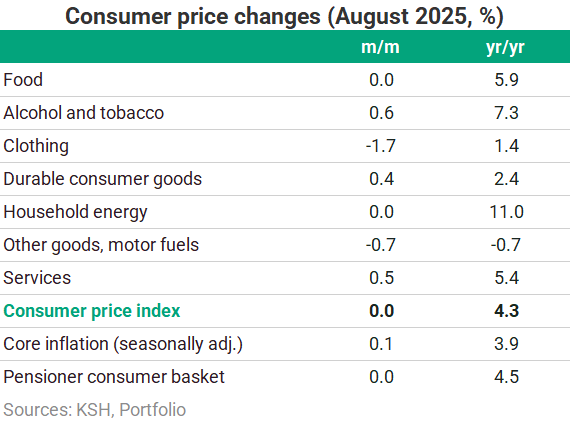
In the services sector, there continues to be a strong tendency toward repricing, except in areas where companies did not exercise self-restraint due to strong government pressure (in the financial and communications sectors). We are seeing double-digit annual price increases in rents and a similar pace in repair services.
Overall, the data does not change the inflation picture we have seen so far. Our economy is not in a state of price stability, although fuel prices, margin caps, and forced price freezes on market services are putting a lot of pressure on the main indicator. The same is true for the short-term core inflation indicator, which does not look bad at less than 3%, but here too, it must be taken into account that the willingness to reprice is only muted due to government measures.

What's next?
We do not expect any major changes in the coming months, with the consumer price index likely to hover around 4% until the end of the year. However, there could be a sharp decline at the beginning of next year, as it is almost certain that the government will not allow the major inflation shock seen at the turn of 2024-2025 to repeat itself before the elections.
There will certainly be no tax increases or official price rises (Minister of National Economy Márton Nagy has already announced an inflation-linked fuel tax increase), service providers will continue to be under considerable pressure not to raise their prices, and we can be sure that economic policy will keep a close eye on the forint exchange rate. Part of this is keeping the central bank interest rate at 6.5%. The risk lies in income policy, as some of the companies forced to implement double-digit wage increases at the beginning of 2026 will probably be unable to avoid price increases. Even so (if no other shocks occur), we will see inflation rates well below 4% at the beginning of next year, and if not, then taking into account the temporary slowdown, it would be very bad news.
The moment of truth is expected to arrive in the second half of the year, when, after the elections, the abolition of market-distorting margin caps and budgetary balance issues come to the fore.
Cover photo (for illustration purposes only): Getty Images





