Appalling estimates suggest that another energy crisis would bring Hungary to its knees


A model-based analysis by the IMF notes that Russia’s war in Ukraine brought energy security to the policy forefront, and highlighted Hungary’s vulnerability to energy supply shocks.
As supply disruptions and concerns about frictions in the gas pipeline network to Europe led to a price spike in mid-2022, Hungary’s current account deficit doubled as a percentage of GDP to -8.5% of GDP and its retail gas, electricity and fuel subsidies surged from 0.1% of GDP in 2021 to 1.1% in 2022 and 1.9% in 2023.
Findings from IMF staff’s research (Di Bella et al. 2024) show that
Hungary could face the steepest output losses in the event of an EU-wide Russian natural gas cutoff—exceeding 4% of GDP.
"This highlights the critical need to accelerate energy diversification, improve efficiency, and promote stronger integration in the regional electricity market," the IMF stresses.
The findings clearly indicate that high energy intensity and dependence on a single energy source pose serious macroeconomic risks. This is why it is particularly important for Hungary to familiarise itself with the energy security scenarios and reform proposals presented by the IMF.
Hungary's energy map
Despite recent progress in diversifying the energy mix, Hungary remains heavily reliant on Russian energy imports, the IMF notes.
In 2024, up to three-quarters of Hungary’s gas and oil consumption was imported, with 74% of gas and 86% of oil sourced from Russia—up from 64 and 66% in 2018. Beyond high dependence, energy flows to Hungary rely on a few critical transit routes, notably TurkStream via Serbia and the Adria pipeline via Croatia, increasing vulnerability to disruption.
Efforts to diversify supply—such as new imports from Azerbaijan and Türkiye—remain limited in scale,
according to IMF staff.

While electricity generation is largely domestic, driven by nuclear and a growing share of solar (installed solar panel capacity exceeding 8 GW), Russian energy continues to dominate Hungary’s overall supply mix, they added. It should be noted that as soon as the sun goes down, Hungary still needs to import a significant amount of electricity.

At the same time,
Hungary is one of the most energy-intensive economies in Europe.
Hungary uses significantly more energy per unit of GDP than the EU average, reflecting structural inefficiencies and a legacy of energy-intensive production. Industry accounts for a large share of final energy demand, particularly in sectors like chemicals, basic metals, and automotive manufacturing—where energy costs are a major determinant of output and investment.


The Hungarian economy is particularly vulnerable to energy price shocks due to its high import exposure and energy-intensive economic structure. According to the IMF, Hungary is one of the most vulnerable countries in Europe in terms of both energy intensity and supply dependency.
Vulnerable position
IMF staff employed a state-of-the-art global CGE model to assess Hungary’s energy security risks relative to other EU economies.
The IMF-ENV model is a recursive dynamic computable general equilibrium model that integrates standard neo-classical optimization of production, consumption, trade, and factor markets—with an energy module that explicitly links energy demand and supply to greenhouse gas (GHG) emissions. The model is particularly suitable for this analysis due to its unique features.
Energy security is a multidimensional concept that can be quantified in many ways. Following the recent literature, the IMF's focus is on two dimensions, security of supply and economic resilience to energy shocks.
- Security of supply refers to the risk associated with disruptions in foreign energy supplies. The index incorporates two components—energy import dependence and the geographic concentration of energy sources.
- Economic resilience: To capture an economy’s ability to absorb energy price and supply shocks, IMF staff used the energy expenditure share of nominal GDP. This ratio serves as a proxy for macroeconomic vulnerability to energy price volatility. Higher energy intensity signals greater exposure, while lower values reflect stronger resilience. Combined with the supply security index, this metric offers a dual perspective on cross-country energy vulnerability and underpins the empirical foundation of our model-based analysis.
Hungary scores poorly on both measures of energy security,
with a composite energy supply insecurity index that is nearly twice the average of the EU’s four largest economies and more than double that of the rest of Europe—reflecting high import dependence and low diversification of non-EU import sources. Hungary’s energy expenditure share of GDP is also elevated, about twice that of Western European peers, largely indicating the energy-intensive nature of the country’s key sectors such as automotive manufacturing, chemicals, and metals.

As the EU moves to phase out Russian energy imports by end-2027, the case for decisive policy efforts on energy security has grown stronger. It should be noted that, according to the EU's decision in spring, member states — including Hungary — must phase out Russian natural gas and crude oil by 2028 at the latest.
A full EU-wide phaseout of Russian energy supply would weigh heavily on the Hungarian economy, underscoring the urgency and macro-criticality of energy security reforms,
the IMF found.
With limited alternative supply routes and high energy intensity, Hungary is especially vulnerable to both supply disruptions and price shocks.
Findings from IMF staff’s research (Di Bella et al. 2024) show that Hungary could face the steepest output losses in the event of an EU-wide Russian natural gas cutoff—exceeding 4% of GDP. This highlights the critical need to accelerate energy diversification, improve efficiency, and promote stronger integration in the regional electricity market.
The planned EU-wide phaseout of Russian energy imports by end-2027 would pose a critical stress test for the Hungarian economy, given the country’s high energy intensity and continued reliance on Russian supplies. To evaluate the energy security implications, IMF staff simulated two scenarios: (i) a business-as-usual path with no additional measures, and (ii) a comprehensive policy package combining domestic reforms with deeper EU electricity market integration.
- Under business-as-usual (red bars), Hungary would face a marked deterioration in energy security. The full cutoff of Russian energy raises both import risk and energy expenditure significantly, exposing the economy to heightened vulnerability. This outcome reflects the continued reliance on concentrated, high-risk external suppliers and the absence of mitigating domestic or regional policy responses.
- With the full policy package (green bars), these risks could be largely contained. The combination of tighter efficiency standards, renewables permitting reforms, subsidy phaseout, and EU electricity market integration substantially reduces both energy insecurity and costs. The shock is transformed from a severe disruption into a manageable adjustment, demonstrating the payoff from coordinated, forward-looking policy action.

While largely illustrative, the simulation results show that these policies would have a modest impact on real GDP growth over the medium term, reflecting trade-offs and complementarities across policy instruments (left chart, Figure 9).
The removal of fossil fuel subsidies provides the largest GDP gains,
as it improves allocation efficiency and decreases the government budget deficit.
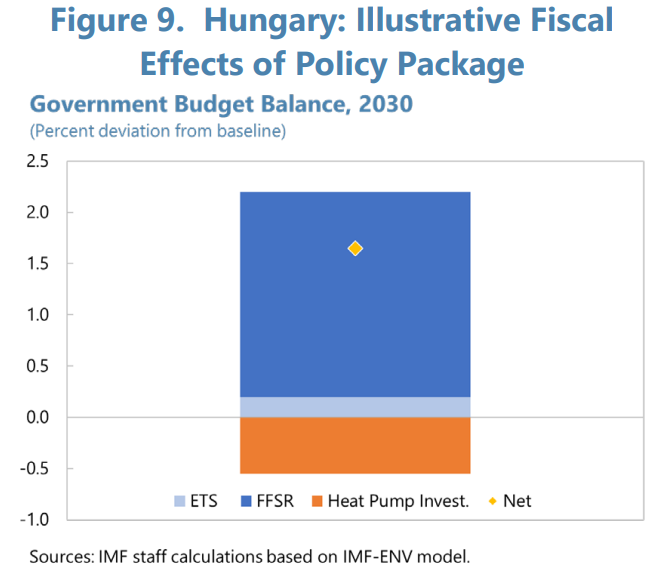
Market-enhancing measures, such as electricity market integration and streamlined permitting for renewables, yield modest growth benefits by improving efficiency and spurring private investment.
In contrast, the EU ETS can weigh on short-term output—although conditional on how the revenues are recycled. Partial recycling of carbon pricing revenues to households can help build political support for the green transition, but using the revenues to reduce the fiscal deficit and/or increase public investments could have more favorable growth outcomes.
Enhanced energy efficiency standards, while imposing short-term cost burdens on firms and households, can strengthen long-run resilience. Importantly,
the competitiveness and diversification gains from these proactive policies could significantly mitigate potential output losses from a full Russian energy cutoff while promoting long-term resilience (right chart, Figure 9).

IMF recommendations
The IMF study examined a range of comprehensive policy scenarios for addressing the above challenges, combining EU-level measures with reforms in Hungary. These measures would improve security of supply and support the green transition simultaneously. The analysis's main recommendations were as follows:
- Higher EU-wide carbon prices: The IMF assumes in the baseline that the implicit carbon prices from the EU (and UK) Emissions Trading Systems (ETS) are 70 euro per tonne between 2024 and 2030. For the policy shock, the carbon price is gradually increased to 110 euro in 2030. Higher carbon prices create stronger market incentives for energy efficiency and replacing fossil fuels, provided that the generated revenues are used appropriately, the analysis adds. The IMF assumes that all revenues from the EU-ETS are transferred back to households.
- Deeper EU Energy Union: This scenario models increased cross-border electricity trade driven by lower trade costs under deeper European market integration. It explores how greater import dependence within the EU—offset by reduced reliance on concentrated non-European suppliers—can enhance energy supply security across the EU, including in Hungary. As regards the model shocks, the IMF assumes that changes in regulation and internal market developments reduce the barriers on electricity trade such that overall trade increases by 50%. Hungary is well positioned in this regard, as it has electricity grid connections with all seven of its neighboring countries.
- Tighter regulations on energy efficiency in road transport and buildings: This scenario simulates stricter energy efficiency standards, including for road transport and buildings. It captures the effects of regulatory policies aimed at reducing energy demand by improving the performance of vehicles, buildings, and household consumption behaviour. As regards the associated costs / savings, the IMF notes that Dolphin et al. (2024) estimate these energy efficiency measures to cost 0.6% of yearly gross fixed investment in the case of road transport and 2.2% in the case of buildings. The total (2.8% ) gross fixed investment is deducted from total investments in the model each year.
- Accelerated renewables permitting: This scenario assumes 40% faster permitting processes for wind and solar energy projects, modeled as a significant improvement in deployment efficiency. The objective is to reflect the potential gains from cutting administrative delays, thereby facilitating greater investment in renewable energy infrastructure. This seems to be a lower priority given that Hungary has a very high level of solar panel penetration on a global scale.
- Tighter energy efficiency standards for households: This scenario represents tighter household energy efficiency standards, combined with targeted public investment toward the adoption of heat pumps. It reflects a structural shift in residential energy use away from fossil fuels and toward electricity, aligned with broader goals of electrification and energy transition. As for the related costs / savings, the public investment in heat pumps in residential buildings in Europe is estimated to cost 0.42% of gross fixed investment per year. For Hungary this represents around USD 236 million per year.
- Fossil fuel subsidy removal: This scenario simulates the full phaseout of fossil fuel subsidies by 2030, calibrated using pre-crisis estimates. It captures the impact of removing price distortions that artificially lower the cost of fossil fuel consumption, thereby aligning energy prices more closely with environmental and security objectives. As regards the model shocks, based on information provided by the authorities, total energy subsidies are estimated to be close to 2% of GDP in 2023. Of this, 75% represent subsidies to household consumption of natural gas and the remaining 25% to household consumption of electricity. According to the estimated costs / savings, 50% of the savings are transferred back to households and 50 percent are used to reduce the budget deficit.
A comprehensive policy package comprising the layers above could greatly enhance Hungary’s energy security and macroeconomic resilience,
the IMF said.
The results suggest that such a policy package can help diversify Hungary’s energy supply and reduce energy security risks by up to 30% and cut the energy expenditure share of GDP by up to 10% over the next five years.
These gains reflect Hungary’s high reliance on imported fossil fuels and its energy-intensive economy, making it particularly responsive to measures that lower import concentration, boost efficiency, and accelerate the clean energy transition.
The message of the analysis is clear: reducing Hungary's energy dependence and moderating the energy intensity of its economy is not a luxury, but a matter of survival. Resource diversification based on timely, professional decisions and investments in energy efficiency could provide real scope for manoeuvre. However, the danger of procrastination is that the opportunity for free choice will slip through our fingers and external factors will ultimately bring the country to its knees, rather than us shaping our own future.
Cover photo: MTI/EPA/Martin Divisek





