Erste: Hungary's downgrade to junk status is unrealistic


Analysts at Erste Bank have on Wednesday revealed their outlook on Central and Eastern European economies, including Hungary.
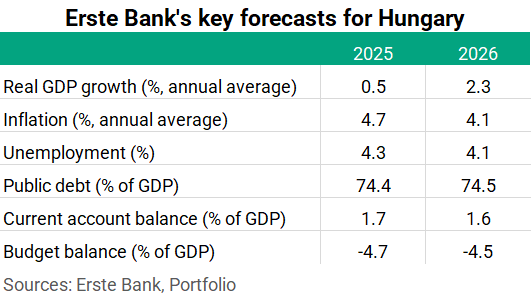
They expect growth of 0.5% in Hungary this year. Since the summer, however, they have slightly lowered this forecast, as the European Union agreed less favourable tariffs with the US than the bank's analysts had anticipated. Additionally, large investments will contribute less to GDP than anticipated. In fact, BMW's factory in Debrecen may be the only one that can contribute to domestic industrial production by the end of the year.
We finally have more clarity regarding tariffs - a uniform rate of 15% with comprehensive accompanying measures. Although the rate is higher than the 10% we assumed as a baseline scenario in April when the tariffs were announced, the removal of a 25% tariff for the automotive sector supports the region’s overall position. It seems that most of the damage has already happened (in Slovakia and other CEE countries), as growth has slowed considerably. It seems that the direct negative impact in 2026 is going to be quite contained. We hope that, with more clarity regarding tariffs, economic expectations and development improve in 2H. Less uncertainty, as evidenced by the decline of the Trade Uncertainty Index, should mean growing investment activity, analysts at Erste wrote in their latest CEE Macro Outlook.
“Everyone hopes that things will get better soon.”
This is how János Nagy, a macroeconomic analyst, described market sentiment regarding the German economy. However, based on the available data so far, it seems that the upturn is still a long way off. For example, the Bundesbank's weekly activity index showed a downward trend until the beginning of August.
Given that Hungary appears to have joined German industry in exporting to China, and given that German exports are losing ground, we cannot expect prospects for Hungarian industry to improve in the near future. Therefore, it is more realistic to expect growth in Europe's largest economy to begin later,
which will also delay an improvement in Hungary's external environment.
Food prices will need to rise sooner or later
The Hungarian food and agricultural industry is less competitive than the rest of the EU, which means that it is particularly vulnerable to shocks. Price pressure in the food sector has not ceased, despite margin caps still keeping it under control. However, market forces will inevitably have to be reflected in prices sooner or later. A positive trend can be seen in industrial products, where price pressure has eased significantly thanks to the strong Hungarian forint.
Rate cut possible at end-2025
Turning to the pace of price increases, János Nagy emphasised that the problem is that inflation expectations have remained persistently high.
The situation is the same as at the beginning of 2024, with welfare measures now coming into play. People feel that now is the time to raise prices.
This may explain why inflation cannot be significantly reduced. Furthermore, the price increases shown in the statistics are much lower than they would be in the absence of government intervention. Without margin caps, the rate of price increases would be 5.5–6% this year.
Based on pricing, the market does not expect interest rates to be lowered this year. However, Erste analysts believe that
the expected interest rate cuts by the Fed and the ECB could enable the MNB to cut rates, potentially as early as the end of the year.
However, it is also possible that the central bank will wait until the beginning of next year to see how prices develop before taking action.
Due to the international environment, no significant decline in government bond yields is expected. Additionally, investors may be concerned that further budgetary resources will be required prior to the election. Nevertheless, the current financing requirements appear to be manageable.
Downgrade by S&P unlikely
Of the major credit rating agencies, S&P has given us the lowest rating, placing us just one notch above junk status. This is also a cause for concern for the government. Their current welfare measures are likely to lead to a deterioration in the deficit in the medium term. Orsolya Nyeste, chief macroeconomic analyst at Erste, said that,
based on the fundamentals, the downgrade is not justified.
Hungary is not in the same category as countries that are not recommended for investment by the credit rating agency.
EUR/HUF to be at 400 even 18 months from now
The stability of the forint exchange rate has been a major positive surprise this year. This is unexpected given that the war in Ukraine is still ongoing and the economy has not yet started to grow strongly. The support is probably due to the significant interest rate differential. However, interest rates will eventually be cut in Hungary too, so the exchange rate may weaken slightly from current levels, but not dramatically.
Over the next one-and-a-half to two years, the exchange rate of the Hungarian forint against the euro may fluctuate between 400 and 410 forints, according to erste.
EU trade deal reduces uncertainty
Finally, the year's biggest story, the customs war, was also discussed. Orsolya Nyeste stated that
it had played a decisive role in ensuring that Hungary's annual growth would not exceed 0.5% this year.
However, she believes that the majority of economic damage will occur in 2025 and that the trade agreement between the US and the EU has finally brought an end to the period of uncertainty.
RRF funds
Hungary suffers from low investment, as RRF funds disbursement is particularly low compared to other CEE countries, the analysts noted.
The RRF funds can be disbursed until the end of 2026 conditional on meeting milestones and targets by countries. So far, all CEE countries have EUR 46bn disbursed (EUR 26.3bn in grants and EUR 20bn in loans). CEE countries have already requested another EUR 14.2bn (EUR 10.3bn in grants and EUR 4bn in loans), but EUR 66.6bn remains available. The majority is in loans, however (EUR 35.6bn).
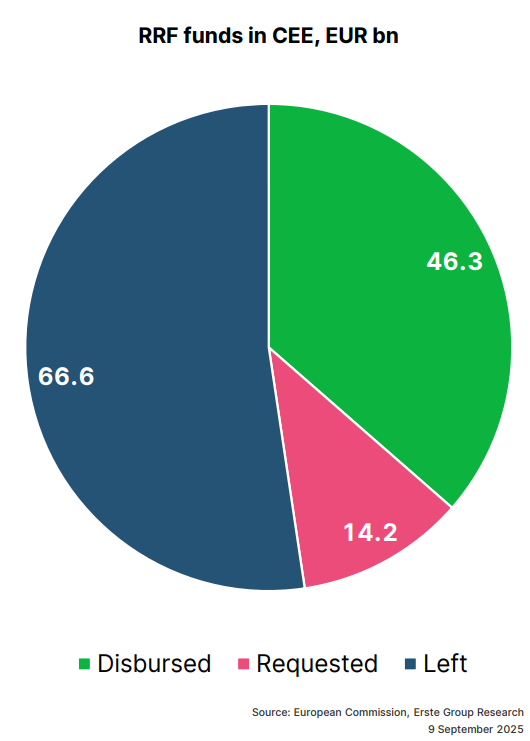
Looking country by county, so far, only Croatia and Slovakia have had more than 50% of grants disbursed. All other CEE countries still have at least half of the grants available (part of that could already have been requested) and an even higher share of loans to be utilized.
Taking full advantage of RRF funds will be a priority next year and has the potential to support the growth in a more meaningful manner.

Falling investment in Hungary
One of the key developments affecting the weak economic development in Hungary is a visible fall of investment activity.
Actually, no other CEE country is in such a position as Hungary. Investment growth has been declining for three years in a row (continuous negative y/y growth since the third quarter of 2022).
Hungary is also the only country that has not used the RRF funds almost at all.
Disbursement of grants has been minimal (EUR 140mn out of EUR 6.1bn available) and roughly 20% of available loans have been drawn so far.

Why is Czechia picking up and Hungary is not?
Both economies are small open economies with potentially similar negative impacts stemming from the global slowdown due to tariffs. Both economies have been growing below potential, but Czechia has picked up over the last couple of quarters.
Extensive use of RRF funds may be one of the factors supporting the growth.
The lower real interest rate in Czechia may also be considered a growth-positive impulse. The monetary easing cycle, which was disrupted in Hungary due to volatility on the FX market, puts Czechia in more favorable positions.

Cover photo: Portfolio





