Tisza Party presents its detailed tax plans

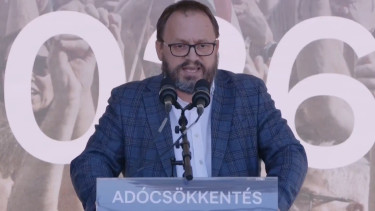
The objective is a humane budget, because behind every tax forint there are people and families, began András Kármán, who believes that Fidesz's economic policy has steered Hungary's ship poorly. The country is in a growth crisis, there is no growth, and the economy is stagnating. Sooner or later, reserves will run out; that is the reality today, said the politician, who believes that what we have now is not economic policy, but Russian roulette.
The Tisza Party promises a simpler, more predictable, and fairer tax system,
said the former state secretary, who promised that small businesses and the self-employed would once again be eligible for the KATA tax regime. According to him, the losers of Tisza's tax policy will be the oligarchs and billionaires.
András Kármán also spoke in detail about Tisza's residential tax program, after the draft had been the focus of attention in recent weeks. According to some information, which Péter Magyar has categorically denied, the largest opposition party plans to apply a multi-rate personal income tax. However, Péter Magyar has refuted this on several occasions in recent days and presented the new plans.
András Kármán promised fair and equitable public taxation for the population. He said that Fidesz claims that the flat tax system makes the tax system proportional, but in reality this is not the case. He argued that it is not a single tax type that determines the characteristics of the entire tax system, but rather the system as a whole. He mentioned the high VAT rate, which hits the poor harder because they spend a larger proportion of their disposable income on consumption, while the rich also spend on other things, such as savings.
The Hungarian tax system as a whole is seriously disproportionate and unfair,
he emphasized. The EU-record 27% VAT rate, the lack of taxation on extreme wealth, and the current form of the flat-rate personal income tax together mean that those living on the minimum wage are taxed at a rate that is 6% higher than the wealthiest members of society, he explained. He promised a truly proportional tax system on this point. Therefore, Tisza would adjust the current tax system in proportion to income, wealth, and consumption if it came to power after next year's parliamentary elections.
The specific promises:
- For minimum wage workers, the 15% income tax rate will be reduced to 9% through tax credits. This will mean an additional HUF 20,000 per month, or HUF 240,000 per year, for those affected in the first year.
- Everyone who earns less than the expected median wage for next year, i.e. HUF 625,000 gross, will benefit from tax relief. This amounts to more than 2 million people. For many, this tax reduction program will mean savings of HUF 240,000.
- Those earning more than average will not see an increase in their income tax burden; they will continue to be taxed at 15% in the future.
- The Tisza Party does not plan to raise any taxes on wages.
- In the name of justice, Tisza would introduce a 1% annual wealth tax on the richest individuals, those with assets exceeding HUF 5 billion. This would apply to all assets, including cars, boats, company shares, estates, and foreign assets. Assets registered in the names of family members would also be taken into account.
- VAT on prescription drugs would be reduced to 0%.
- Healthy foods and firewood would be subject to a VAT rate of 5%.
He also indicated that the Tisza Party would abolish decree-based governance, prohibit retroactive legislation, and restore predictability for businesses.
The budget will once again reflect reality, promised András Kármán, adding that
the forint is currently vulnerable and volatile, and families are prisoners of unpredictable exchange rates.
The introduction of the euro is not merely a currency change, but also means security, lower interest rates, and stronger economic ties, he noted. When we set the goal of introducing the euro, we are declaring that we are returning to the mainstream of Europe, he added.

It is worth mentioning that from June 2010 to November 2011, the politician from the Tisza Party was the State Secretary for Tax and Financial Regulation at the Ministry of National Economy. From December 1, 2011, to 2014, he held the position of Deputy Director for Hungary on the Board of Directors of the European Bank for Reconstruction and Development (EBRD). He later held management positions at the Erste Group.
Cover photo: András Kármán delivers a speech in Kötcse. Source: Tisza Party Facebook page





