No need to halt Hungary's Paks NPP expansion even after ECJ ruling

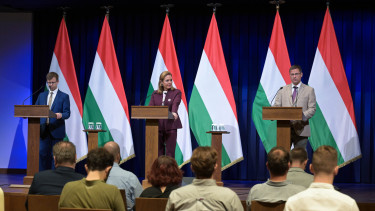
The most important topics discussed today are as follows:
- Paks II can continue despite a recent ruling by the European Court of Justice. A new Commission decision on state aid is required, but implementation will continue.
- EU funds and veto: The government will use all legal and political means at its disposal, even vetoing the 2026 joint budget to release frozen EU funds.
- Hungarian-Ukrainian relations: Normalisation depends on restoring Hungarian rights in Transcarpathia to their pre-2015 level; the date of the Ukrainian foreign minister's visit to Hungary has not yet been set.
- Home Start boom: More than 30,000 housing construction applications were submitted in just three weeks, including over 5,000 in the first week. Several banks are offering loans at rates below 3%, and the programme may also provide relief in terms of rents.
- Margin cap: The 10% cap on food retail margins will remain in place for another three months. According to the cabinet, this could reduce food inflation by more than one percentage point.
- Secondary sanctions (Trump plan): Hungary will consider each proposal individually and will veto the planned oil sanctions against India and China if they cause significant harm to its interests.
- Minimum wage agreement: The three-year framework remains in place, with a +13% increase expected by 2026. Employers and employees will initially agree on a target date of 31 December, and the government will mediate if negotiations stall.
- Drone and border protection: New regulations will accelerate the standardisation and legal separation of state drones, in line with the development of the armed forces' equipment.
- NATO and regional security: There is full solidarity with Poland after the drone incident, and consultation under Article 4 is considered natural.
Home Start
Gergely Gulyás, the Prime Minister's chief of staff, said that more than 5,000 applications from all over the country have been submitted on the first week of the scheme that was launched on 1 September.
He added that more than 30,000 applications had been received for the construction of Home Start apartments in three weeks. Investors who develop residential properties with 200 or more apartments, 70% of which meet the programme's criteria, are eligible for administrative relief.
From the beginning of October, monthly data will be available on the types of properties for which applications are being received.
According to the minister, three banks offering loans below 3% shows that competition has begun. There are also two financial institutions offering an additional interest rate discount of up to HUF 1 million over the entire term.
According to Gulyás, even those who do not take advantage of the programme benefit from it. Government measurements show that rent prices have also fallen. He believes that this is because the more people who choose to buy property instead of renting, the lower rental prices become.
János Bóka says there's no change in Brussels
The autumn political season has begun in both Hungary and the EU. Ursula von der Leyen, President of the European Commission, gave a speech in Strasbourg. The government assessed this as meaning that, one year after their presentation, there had been no debate on the Draghi and Letta reports, said János Bóka, Minister for EU Affairs.
According to the minister, not enough was said about European industry, with military spending being prioritised over competitiveness. Meanwhile, too much was said about Ukraine. He objected to the expectation of further institutional centralisation and withdrawal of member states. János Bóka also criticised the lack of discussion about encouraging private investment and supporting industry, as well as the failure to mention reviewing the green transition.
He indicated that two motions of no confidence had been tabled against Ursula von der Leyen: one by Patriots for Europe, which includes the governing parties of Hungary; and the other by the radical left-wing, communist Left faction.
In her speech, President Ursula von der Leyen discussed the Draghi and Letta reports at length, announcing several programmes, including a Battery Booster package for the battery industry. She also promised improvements in energy prices, housing conditions and health resilience. Notably, she also promised to reduce administrative burdens and launch a 'Buy European!' programme for food products, while introducing a capital markets union and helping start-ups succeed in Europe with the so-called 28th regime. She also invited players in the automotive and heavy industries to consultations. A new plan is also being prepared to develop EU energy systems.
Hungary does not support tapping Russian assets
János Bóka does not understand how it would be possible to grant Ukraine a loan using frozen Russian state assets as collateral. The minister says that there are many legal risks involved and that it is extremely important not to spread this responsibility among member states or undermine the euro's role as a reserve currency.
The Hungarian minister criticised Ursula von der Leyen for visiting all the EU member states bordering Ukraine and Russia, but not Hungary. The politician said that physical border protection is the responsibility of the EU, and that it is unacceptable for the conditions to be different for different member states, including Hungary.
No need to stop Paks II
The Court of Justice of the European Union (CJEU) has overturned the European Commission's decision to authorise state aid for the Paks II nuclear power plant. However, the CJEU did not rule that the development of the facility violated any EU law. János Bóka explained in response to a question about the ruling that the current decision states that the European Commission did not examine whether the procedures complied with EU public procurement procedures.
For Hungary, this means that we will act in accordance with EU law and cooperate loyally in all matters, enabling the European Commission to make an informed decision regarding support. The current decision does not prevent the continuation of the Paks expansion project, added the Minister for EU Affairs.
With regard to the Paks II investment, Bóka later emphasised that the court ruling does not prevent the project from continuing. He explained that the European Commission is currently tasked with issuing a new decision on state aid in accordance with EU law, and that Hungary is participating in this process fully in line with all regulations. He added that, until the new Commission decision is made, work can continue according to the previous schedule, as the ruling contains no elements that would prevent the investment.
Hungary will veto extension of rule of law criteria
János Bóka also referred to Ursula von der Leyen's statement that the 'shackles of unanimity' must be broken. According to the minister, this indicates a misunderstanding of roles, since the committee's task as guardian of the treaties is to ensure compliance with them rather than viewing them as obstacles. Bóka believed that the Commission President wanted to broaden and simplify the conditions of the rule of law in the next seven-year budget cycle and extend them to all resources that could be used to exert political pressure.
Bóka stated that Hungary does not support any mechanism that would restrict access to EU funds for ideological reasons. He added that
Hungary would not vote in favour of a seven-year EU budget that could exclude the country from funding on political grounds,
and that he currently cannot envisage a scenario in which it would be forced to do so.
Defense spending details to be revealed soon
The Hungarian government requested a substantial sum from the SAFE loan programme for EU armaments and defence purposes.
János Bóka said that a defence industry investment plan must be drawn up by 30 November, on the basis of which Hungary can request the use of €16.2 billion (approximately HUF 6,300 billion). He emphasised that the plans are already being prepared, but are not yet at a stage where detailed information can be shared. He stressed that the funds will primarily be spent on defence and dual-use investments, i.e. investments suitable for both civilian and military use.
When asked whether orders are divided between Hungarian and international companies, Bóka said that the relevant criteria are publicly available. He added that the goal is not only to develop the defence industry, but also to enable domestic companies, including small and medium-sized enterprises, to participate in these programmes and play an active role in the investments.
Margin caps to stay
Gergely Gulyás said that, at the end of August, the government had decided to extend the margin cap for a further three months. He emphasised that the measure significantly reduces inflation:
according to our calculations, it reduces food inflation by more than 1 percentage point.
However, he pointed out that this does not necessarily mean an actual decrease in prices, but rather that the rate of inflation is more moderate than it would be without the measure.
He explained that there are significant differences between individual products in the food industry. While some places have seen price reductions of 20–25%, others have experienced significant price increases due to demand exceeding supply or agricultural production being scarcer. In this situation, capping the commercial margin at 10% is an important tool for curbing inflation.
Looking ahead, Gulyás emphasised that the government will decide whether to maintain the margin cap by the end of November. He added that the final decision will depend on how market processes and inflation data develop.
What about the wage agreement?
Several statements have recently been made regarding next year's minimum wage increase, including by Economy Minister Márton Nagy. The main issue is that a three-year wage agreement is currently in place, providing for a 13% increase in the minimum wage by 2026. This agreement was reached at a time when the government and economic stakeholders expected more stable growth and lower inflation.
However, economic conditions have changed since then. According to the latest forecasts, inflation may be 0.8 percentage points higher than expected, while economic growth may be between 0.5 and 1% — down from the originally forecasted 4%. In theory, this would allow the agreement to be renegotiated, but the government's goal is to prevent this.
Gulyás stressed that
the government participates as a third party in negotiations on the minimum wage, which primarily take place between employers and employee representatives.
In practice, if the two parties reach an agreement, the government will grant it legal force and make an announcement. However, if negotiations stall, the government's role is to facilitate a compromise.
Gulyás said that the framework for the current three-year agreement is in place, and that the government would prefer to see minimal changes to the original agreement, which should remain in force wherever possible.
Employers and employees have until 31 December to reach a final agreement. However, if it becomes clear earlier on that they are not reaching a consensus, the government may intervene in the process sooner.
Although Gergely Gulyás said that a three-year agreement on the guaranteed wage minimum [for skilled workers] had been reached, including an 11% increase for this year, the parties did not actually agree on the minimum wage for three years.
It is worth remembering that the wage minimum increased by 7% in 2025, and the Permanent Consultation Forum between the Competitive Sector and the Government (VKF), still has to meet to discuss next year's minimum wage.
Hungary may veto sanctions proposed by Trump
When it comes to secondary sanctions, Gergely Gulyás said that the Hungarian government would consider each proposal on its own merits, based on its potential impact on the Hungarian economy. This relates to US President Donald Trump's plan to impose secondary sanctions on countries that purchase oil from Russia, including India and China.
Gulyás emphasised that,
if such a measure were to cause significant harm to Hungary's interests, the government would consider using its veto power.
However, if the impact on the Hungarian economy were minimal, the cabinet would consider supporting the proposed sanctions. He added that the decision would be based on national interests in any case, and that the government would only exercise its veto if the measure would seriously damage the country's economic position.





