Are Hungarians facing a pension hell? Our pension system has been relegated to the bottom of the EU rankings


The fear of failing to achieve retirement security is palpable in 2025, as investors contemplate how personal finances, demographics, economics, and public policy concerns have converged, making it harder than ever to answer the biggest question about life after work: “How much do I need to retire?”, Netixis writes in its 2025 Global Retirement Index. In the survey conducted with the participation of more than 7,000 individuals,
40% of respondents said they are concerned that they will not have enough money sved to enjoy their retirement.
Beyond their own mortality, investors have the more immediate concern presented by inflation, which 38% say is killing their retirement dreams. Furthermore, 33% are worried that their government benefits will be cut; 25% fear they will never save enough to retire, and 24% believe they will go broke from healthcare / long-term-care costs.
According to Natixis, investors know the pressure is on, and 78% say the responsibility to fund retirement is increasingly on their shoulders. Not every individual is equipped to live up to the responsibility. Savings goals are low, and planning assumptions are not in line with generating income to last 25 to 30 years.
Sticky inflation has been the bane of consumers in recent years, and nearly seven in ten (69%) surveyed say it’s eroded the value of their retirement savings. Price hikes have been felt to a greater extent in the cost of food, housing, and healthcare, putting added pressure on retirees living on a fixed income. It’s reached the point that
higher everyday costs are the number-one financial fear for investors the world over.
The population of the developed world is aging rapidly
Most telling of this trend is the Peak 65 phenomena in the United States. With the tail end of the Baby Boom generation nearing retirement years, more than 11,000 individuals have or will turn age 65 every day between 2024 and 2027. This year brings the apex of the trend, as
more than four million people will hit that milestone.
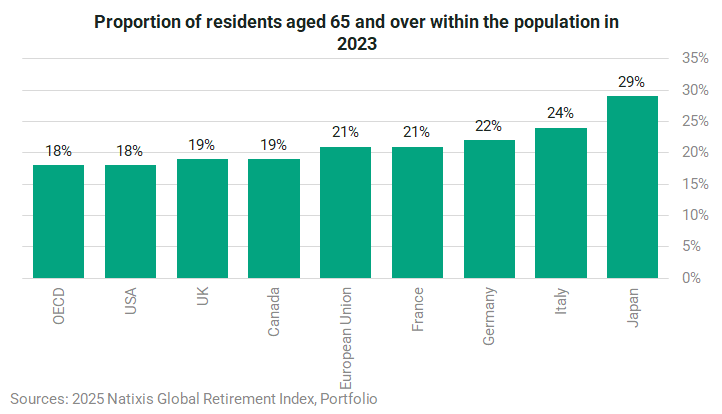
In Japan, the proportion of people aged 65 and over already exceeds 29%, while in the European Union, 21% of people fall into this category.
Overall, survey results show that investors anticipate living about 21 years in retirement, which one might think would provide a solid foundation for planning. But the goal may need to be longer to be realistic. The average lifespan is just that: an average. Some people won’t live as long; others will live longer. It’s hard to predict just who will be in which group. This is the so-called 'longevity risk'.
Individual longevity is turning into the problem of old-age dependency for policymakers across the developed world. Measuring the number of individuals age 65+ per 100 working-age people (age 18–64), this ratio shows that policymakers are faced with hard choices in the coming years.
Overall, the median old-age dependency ratio for OECD countries stood at 33.9% in 2024, and projections show it reaching 39.5% in 2030.
By 2050, however, it’s expected to almost double to 52.7%, meaning there will be 53 people of retirement age for every 100 of working age.
Japan has been at the leading edge of this wave of aging and today has the highest old-age dependency ratio (54.9%) of any country in the world. The trend shows little sign of slowing, and by 2050, Japan’s old-age dependency ratio is projected to reach 80.7%.
Policymakers in Japan are taking three critical steps now to accommodate an older society and sustain its National Pension and Employees’ Pension Insurance by:
- Gradually increasing pension eligibility age from today’s 65 and offering incentives to delay retirement.
- Reducing benefit payouts for future retirees to reflect the county’s demographics.
- Encouraging more personal savings through tax-advantaged retirement accounts.
Japan may be at the forefront of the longevity challenge today, but over the next 20 years, it will be joined by other Asian countries with Taiwan seeing its old-age dependency increase from today’s 29.3% to 71.4% in 2050 and South Korea, where the ratio will increase from today’s 29.3% to 77.3% over the same time frame. And China is anticipated to see its ratio increase almost threefold from 2020’s 18.2% to 52.3% by 2050.
How much would be enough?
Overall, investors anticipate they will need to save $625,000 to fund their retirement. But that one number does not tell the whole story. Those in Argentina/Uruguay, Singapore, and the US have the highest savings goal of $1.25 million, while those in Hong Kong, Korea, and Taiwan call for a more conservative median of $875,000.
Goals are lowest in Europe,
where individuals have been able to count on generous government benefits and employer pensions to fund the bulk of retirement. Given that 75% of Europeans surveyed believe the responsibility for funding retirement is increasingly theirs, those in Belgium/ Luxembourg, France, Germany, and the Netherlands may have set their savings goals too low at $350,000. Even those in Spain and Italy who’ve set their sights slightly higher at $450,000 may be off the mark, too.
Which are the world's best pension systems?
The Global Retirement index incorporates 18 performance indicators, grouped into four thematic sub-indices. These sub-indices have been calculated using reliable data from a range of international organizations and academic sources in order to assess and compare the level of retirement security in different countries around the world.
- The Health sub-index is based on performance across three indicators: insured health expenditure, life expectancy and non-insured health expenditure per capita. Life expectancy is a key driver of overall performance in the sub-index.
- The Material Wellbeing sub-index used to measure the material needs of a country's population. It is based on per capita income, income equality and average unemployment.
- The Finances in Retirement sub-index evaluates the stability of the financial system, the rate of return on savings and the maintenance of purchasing power. This assessment takes into account institutional strength, the investment environment, inflation, real interest rates and the tax burden, among other things.
- The Quality of Life sub-index encompasses societal happiness and 'fulfilment', as well as the impact of natural environmental factors (air quality, water and sanitation, biodiversity and habitat). It is calculated as an average of the happiness and natural environment indices.
- Finally, the geometric mean of the four sub-indices is used to calculate the Global Retirement Index, which is a quasi-aggregate pension index.
In the 2025 publication, the top five spots were taken by Norway, Ireland, Switzerland, Iceland and Denmark, while Hungary ranked 33rd, down from 32nd last year.
Hungary steps forward in health, back in material welfare
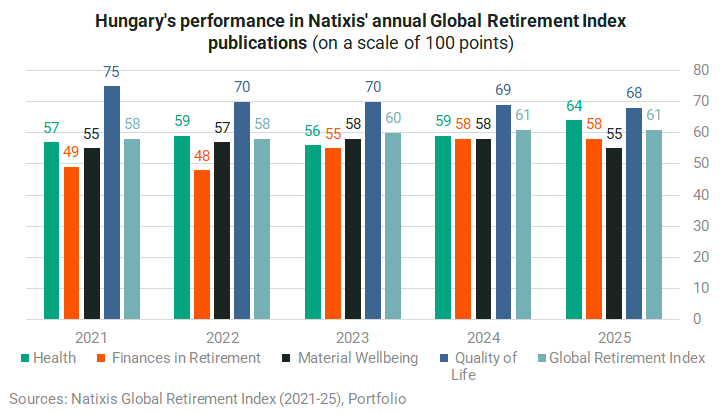
In 2025, Hungary scored 61 points on Natixis's 100-point pension report scale, the same as last year. However, there were significant changes in the individual sub-indices. The Health sub-index saw a substantial increase, rising from 59 points to 64, thereby improving Hungary's overall performance. Meanwhile, the Finances in Retirement sub-index remained stagnant at 58 points, and Hungary's scores in Material Wellbeing and Quality of Life fell from 58 to 55 and 69 to 68 respectively. Consequently, the aggregate retirement index remained unchanged.
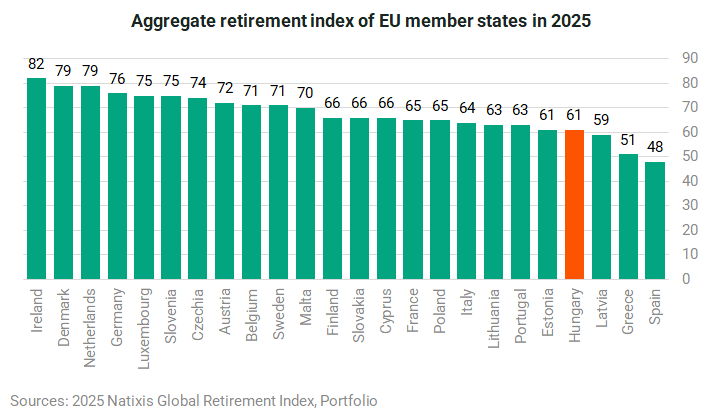
Hungary ranks relatively low in the EU comparison, coming in fourth from the bottom (tied with Estonia) in the ranking of 24 countries compiled by Natixis.
It is worrying that Hungary was still in fifth place in 2024, but in the year since then, Lithuania has overtaken it, meaning that Hungary has only managed to escape the 'negative podium' by one place.
It is true that the ranking is missing three Central and Eastern European countries: Romania, Bulgaria and Croatia. It is possible that including these countries in the analysis would result in Hungary being ranked slightly higher.
About six months ago, Allianz published its global pension report, in which Hungary ranked fourth from the bottom of the European Union.
Cover image (for illustration purposes only): Getty Images





