Hungary has never had so much foreign currency reserves - What happened?


Hungary's foreign exchange reserves have fluctuated near their peak for months, with a slight increase occurring in June following the issuance of dollar bonds. The only reason the reserves did not reach a new historic high was due to the high volatility of other factors, primarily derivative transactions related to reserve management. Then, in August,
a breakthrough was achieved, with foreign exchange reserves reaching a new high of €48.4 billion.

Compared to the previous month, there was an increase of EUR 1.3 billion, which was probably primarily due to the receipt of EU funds, since nothing else could explain such a large increase. Since the aforementioned dollar bond issue in June, there have been no international issuances that could have generated foreign currency.

At the end of August, gold accounted for 21.3% of total reserves, with a value of €10.3 billion. The increase in the value of reserves over the past year was largely due to the rise in the global market price of precious metals; the central bank's gold reserves were worth 'only' €6.9 billion in August last year.
Meanwhile, the amount of gold reserves remained unchanged but increased in value by almost 50% due to rising world market prices. Total reserves grew by only EUR 1.3 billion; without gold, the MNB would have experienced a significant decline.
The central bank's data also provides insight into the market positioning of the forint. According to this data, at the end of August, there was a short position of €11.9 billion against the forint on the market, accompanied by a long position of €12.2 billion betting on the forint. This difference of €287 million was significantly lower than the €1.5 billion recorded in July and €3.8 billion in June, largely due to the 'silly season' at the end of summer.
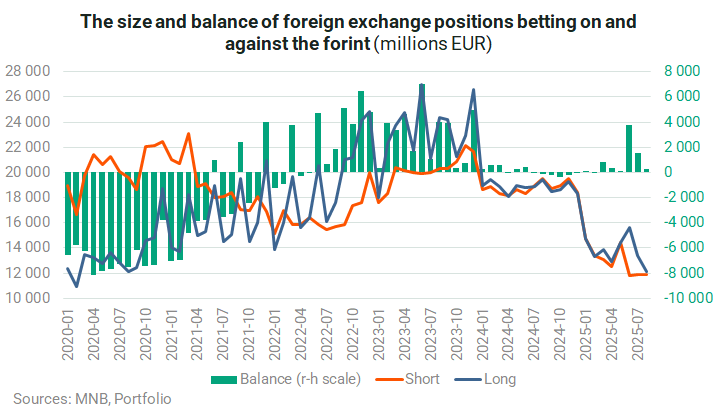
However, since the beginning of September, the Hungarian currency has strengthened again. Given these developments in the exchange rate, it would not be surprising if investors in long HUF positions had become active again in recent weeks.

Cover photo: Portfolio





