Credit boom in emerging economies, but Hungary is at the bottom of the ranking


In the first half of this year, one of the most important drivers of economic growth in emerging countries was domestic lending, which picked up strongly in many places, offsetting uncertainties in international trade. According to a recent analysis of corporate lending by BNP Paribas, looking at the world's 24 most important emerging economies, annual GDP growth reached 4.7% overall in the second quarter of this year, with quarterly growth at around 1%.
This is surprisingly stable, especially given that Donald Trump's second term in office was expected to slow down exports due to the trade war.
However, according to the bank's analysis, these customs measures have not yet caused a dramatic decline in practice; in fact, export confidence indicators in several regions, including Asia and Central Europe, do not indicate a panic-like collapse. One reason for this is that domestic demand and its financing have remained strong, and the expansion of bank lending to companies in many countries already exceeds economic growth in real terms.
Loan growth can be observed in almost all regions, albeit with varying intensity. Latin America and the Middle East saw annual growth of 7–11%, while in Central Europe, growth accelerated from 2% at the beginning of 2024 to nearly 7% today. This dynamic clearly contributes to stabilizing domestic demand, especially in an environment where export prospects are more uncertain.

However, rapid credit expansion also carries risks, according to the BNP:
if too much credit flows into the economy and to companies in a short period of time, it can cause overheating, increase the proportion of non-performing loans, and upset the foreign trade balance.
As was already apparent from the first quarter snapshot, credit growth is already extremely high in some countries, such as Türkiye, fueled in part by inflation and a weak currency, and in part by lax regulation.
In Central Europe, credit expansion is strengthening the internal stability of the region's economies. In Poland, the Czech Republic, Slovakia, and Hungary, it is clear that since the post-pandemic recovery, bank lending has once again played a decisive role in supporting consumption and investment. The relatively low interest rate environment, rising real wages, and buoyant corporate lending have together created a situation in which domestic demand is currently able to offset uncertainties surrounding exports. This is particularly important now that the future of certain export markets has become uncertain due to the Trump administration's tariff measures.
According to analysts at BNP Paribas, credit growth in the Central European region as a whole can still be considered sustainable, but if the current pace continues, care must be taken next year to ensure that financial stability risks do not arise.
What exactly is the situation in Hungary?
Although the bank's analysts did not specifically mention it, it is worth taking a detour to Hungary, where an interesting picture emerges: domestic lending picked up in the first and second quarters, but this is still far behind the regional trend.
As previously reported by Portfolio based on data from the National Bank of Hungary (MNB), the loan portfolio of credit institutions to non-financial companies increased by HUF 315 billion in the second quarter of 2025, resulting in an annual growth rate of 2% at the end of June, in line with the dynamics of the previous quarter. The loan portfolio of the SME sector grew by 2.4% on an annual basis. The expansion of the domestic corporate loan portfolio ranks in the middle of the European Union comparison:
it shows significantly slower credit dynamics than in other countries in the region, lagging significantly behind the 7% average of the Visegrad countries.
New non-current account corporate loan agreements worth HUF 1,456 billion were issued in the second quarter, exceeding the volume issued in the same period of the previous year by 36%. Several large individual transactions and the contracts concluded under the Sándor Demján Programme contributed significantly to this strong growth. The proportion of subsidized corporate loans in new contracts was 19%, and even higher among SMEs, reaching 32%, which represents a significant increase compared to 25% a year earlier.
It is important to note that weaker corporate lending in the region also explains why investment data continues to paint a bleak picture of the Hungarian economy.
According to recent data from the Central Statistical Office (KSH), the volume of domestic investment fell by 1.1% in the second quarter of 2025 compared to the previous quarter. This is the ninth consecutive quarter in which a decline has been measured, indicating a continuous downward trend that has lasted for three years. Although the rate of decline has slowed, the data is still disappointing, especially in light of the fact that investments fell by a historic 13.8% in 2024. The KSH has only released preliminary figures so far, but noted that the largest negative contributions came from real estate transactions, manufacturing, and education, while investment activity in transportation and warehousing showed growth, presumably driven by government road development projects.

There are several factors behind the decline. The slowdown in manufacturing investment is closely linked to the weakness of export markets, which is further exacerbated by cyclical and structural problems in the European automotive industry. This has a particularly sensitive impact on the Hungarian economy, which is heavily dependent on automotive production and supply chains. Although several large greenfield investments, such as developments by BMW, CATL, and BYD, are already in the pipeline, their implementation is being delayed, partly due to weak external demand.
The problem is that it is difficult to determine from the KSH's investment data how private sector activity has developed. This is because, in the case of public investment – for example, road construction – the activity appears in the data reported for the contractor, the private companies carrying out the construction work. However, it is certain that there is a significant lack of budget-financed projects: the partial blocking and slow drawdown of EU funds is currently having a dampening effect, but low levels of confidence among businesses and the general public are also having a negative impact.
In the first half of this year, the volume of investments fell 10% short of last year's already weak level, and even with a significant upturn in the second half of the year, it is unlikely that the annual decline will fall below 6%.
Although several major investments are expected to be activated in the second half of the year, which may have a one-off upward effect on statistics, experts say that the overall economic outlook is not very bright, with GDP growth of only 0.5-1% expected in 2025.
The Hungarian situation sticks out
Hungarian data deviates from Central European trends, with the domestic economy performing significantly worse in the private sector as well. For this reason, it is less important for Hungary that BNP Paribas' analysis warns that the sustained rapid pace of lending also carries risks.
These include increased inflationary pressure, the accumulation of bad loans, and a deterioration in the foreign trade balance.
According to the bank's analysis, in the coming period, banks and regulatory authorities will have the task of ensuring the quality of credit expansion and avoiding excessive exposure of the financial system. If this balance can be maintained, domestic lending can remain a stabilizing factor in the Hungarian and regional economies, especially in a geopolitical environment where the future of global trade and export markets has become more uncertain.
The bank also sees a risk that where lending has accelerated, the proportion of non-performing loans could increase with the uncontrolled expansion of corporate loans, especially if inflation proves to be sticky or accelerates again in the coming period, meaning that interest rates could remain higher. However, there are no signs yet that banks are preparing for a default on corporate loans.
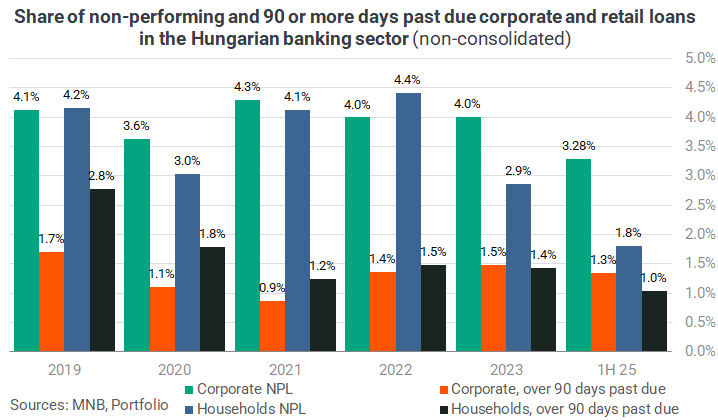
In Hungary, the moderate expansion may also explain why the ratio of non-performing loans fell to 3.28% of total corporate loans in the first half of this year, down from 3.8% last year.
According to BNP Paribas' summary, emerging economies will continue to rely on strong internal fundamentals in 2025, while risks related to export markets will increase. The key role of domestic lending is clear: it supports economic growth and investment in the short term, but requires careful supervision in the longer term to avoid excesses that could threaten financial stability.
According to the bank, Hungary, other countries in the region, and emerging economies are now in a position where they can mitigate the impact of external shocks through lending, but future success will depend on how well they can control this growth. Based on current data, the process is manageable for the time being, but next year it will be critical for the financial system to be able to support the economy in a sustainable manner while preparing for new challenges from the external environment.
Cover photo (for illustration purposes only): Getty Images





