A host of data may deced the fate of the forint and the markets this week


The S&P 500 and Nasdaq have posted their third consecutive weekly gains, supported by the Federal Reserve's interest rate cut on Wednesday and the prospect of further monetary easing.
Friday's trading volume reached 27.78 billion shares, compared to an average of 17.41 billion over the past 20 trading days.
The Dow Jones rose 172.85 points (0.37%), reaching 46,315.27, the S&P 500 went up by 32.40 points (0.49%), standing at 6,664.36, and the Nasdaq Composite rose by 160.75 points (0.72%), reaching 22,631.48.

In terms of weekly performance, the S&P 500 rose 1.2%, the Nasdaq rose 2.2%, and the Dow rose 1.05%.
Meanwhile, Donald Trump and his Chinese counterpart, Xi Jinping, had a telephone conversation. Following this, Trump stated that progress had been made on the TikTok issue and that they had agreed to a face-to-face meeting, which could take place as early as next month in South Korea.
Wall Street's three main indices have shown positive results in September, despite the fact that this is not usually a favourable period for US stocks. According to LSEG data, the S&P 500 has experienced an average loss of 1.4% this month since 2000, indicating a positive sentiment in the market.
The BUX index of the Budapest Stock Exchange (BSE) edged up by 0.57%, or 563.8 points, on Friday, closing at 100,198.56 points with a turnover of HUF 33.7 billion. The Hungarian stock exchange concluded the week in the red.

The BUMIX index, which tracks smaller stocks, ended the day up 0.54% at 9309.63 points.
What happened to the forint?
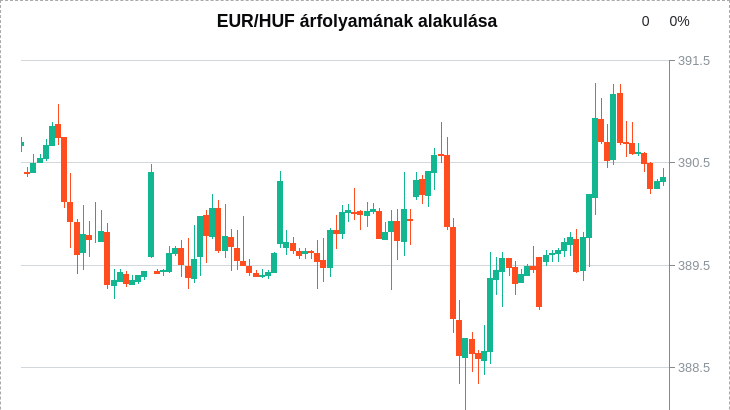
The forint exhibited a varied performance against major currencies this week. The exchange rate began the day near 389 against the euro, then experienced minor fluctuations before closing at 390.3 forints on Friday evening, representing a slight 0.3% weakening.
During the week, the exchange rate fluctuated between 389 and 391.3 forints.
The Hungarian currency demonstrated notable strength following the Federal Reserve's interest rate reduction, outperforming the regional markets this week and reaching an 18-month high. However, it subsequently returned to levels close to its initial position on Monday.
A more pronounced shift was observed in the case of the dollar: at the beginning of the week, it was still above 334 forints, but by Wednesday, the forint had strengthened to 327, followed by another weakening in the second half of the week, closing at 332.24 forints on Friday evening. Consequently, the forint demonstrated heightened volatility against the dollar relative to the euro.

What to keep an eye on this week?
On Monday morning, detailed public finance data for July will be released in Hungary, providing a more accurate picture of the budget situation and the development of the deficit. On the international front, the Chicago Fed index will be published in the US this afternoon, indicating regional economic activity, while consumer confidence data for September will be released in the eurozone, which is an important indicator of household expectations.
On Tuesday, the Hungarian central bank will hold its monthly rate-setting meeting, announcing the outcome in the early afternoon. This decision is expected to have a significant impact on the direction of the forint exchange rate and market yields. Investors will therefore be paying close attention, although the markets do not expect any changes. The signals given by MNB Governor Mihály Varga about the future could be important.
PMI data for September will be released for Germany and the eurozone as a whole in the morning, providing a forecast of manufacturing and service sector performance. In the afternoon, key economic indicators will be released in the United States, including the current account balance, the September purchasing managers' index, and the Richmond Fed index. These releases are expected to provide valuable insights into the health of the US economy.
On Wednesday morning, the National Bank of Hungary will publish its August statistical balance sheet and results for credit institutions, which will provide an indication of the state of the banking system. Japan will release its September PMI data and August machinery orders, while Germany will publish its Ifo sentiment index in the morning. This is an important indicator of the German economy's outlook and may also be significant for Hungary's economic relations. In the afternoon, the US will release August real estate sales and mortgage data, which indicate the state of the housing market.

On Thursday, the Hungarian Central Statistical Office (KSH) will publish August employment and unemployment data, which will provide an overview of the labour market situation. Concurrently, the MNB will release several significant data, including retail lending figures for the second quarter, the quarterly balance of payments, and FDI statistics for 2024.
At the international level, the EU's new car sales statistics for August will be released in the morning. In the afternoon, the United States will publish its final second-quarter GDP data, which could have a strong impact on the market. In addition, weekly US unemployment claims will be released, and this may also have a short-term impact on markets.
On Friday, Hungary's stats office will release its August statistics on population changes and tourism, which provide an indication of trends in domestic consumption and demographic processes. In the morning, the eurozone will release its latest data on inflation expectations for the next 12-36 months. These figures are important for the European Central Bank's decision-making process.
There are several key data releases scheduled for Friday afternoon in the United States. These include personal income for August and PCE inflation, which is the Fed's preferred inflation indicator. This could therefore have a significant impact on the markets. This will be followed by the release of the Michigan index, which measures consumer confidence.
On Saturday, China will release its August industrial corporate profit statistics, which provide a picture of the industrial performance and profitability of the world's second-largest economy.
Cover image (for illustration purposes only): Getty Images





