Happy birthday to the 6.5% base rate! How long will Hungary's c.bank maintain its stance?


One-year birthday: base rate to remain at 6.5%
The last time the MNB Monetary Council adjusted the base rate was in September of last year, meaning that a year has now passed since the previous change. Since then, the rate has remained unchanged at 6.5%, and it is highly unlikely that it will be altered now. The next step would be to lower it, but with inflation at 4.3% (with the margin cap being a key anchor),
the central bank cannot even consider easing at this point.
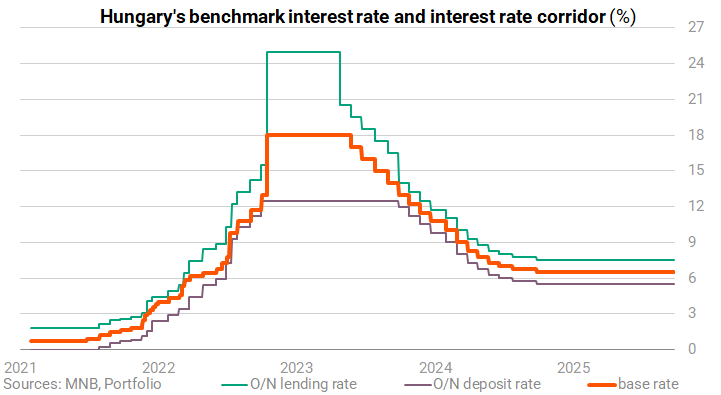
Not only is the rate of price increases higher than the central bank's target range, but the MNB's communications in recent months also point in this direction. Since assuming the role in March, Governor Mihály Varga has maintained the strict communication approach established by György Matolcsy, emphasising at press conferences following interest rate decisions that the Monetary Council will continue to adopt a patient and cautious stance. This could indicate that until inflation falls below 4% on a sustained basis, there will be no room for interest rate cuts. Please note that there is a slight twist to this, which we will address later.
It is the unanimous opinion of the experts surveyed by Portfolio that the interest rate will remain at 6.5% on Tuesday. At this juncture, the consensus among analysts is that the rate will remain at its current level until the end of the year, despite the fact that just two months ago, the majority anticipated that the benchmark interest rate would no longer be 6.5% by December. In fact, as recently as a month ago, forecasts indicated the possibility of up to two interest rate cuts in the final months of the year.

Inflation in August was in line with expectations, and it is worth noting as a particularly positive development that prices remained unchanged on average compared to July, and core inflation was within the central bank's target range, as pointed out by Péter Koncz. The Századvég Economic Research analyst also noted that the forint exchange rate has strengthened in recent weeks, primarily due to interest rate expectations, with the market increasingly pricing in the likelihood that the current interest rate will remain in place until the end of 2025.
"In my opinion, we can expect another rather uneventful policy meeting. Looking at the economic data for the past month, but basically for the past three months, the big picture has not changed," said Péter Virovácz, analyst at ING Bank in Budapest. Given that there have been no signs or communications indicating a change in September and the markets are not pricing in any change,
it would be the surprise of the year (or century) if the central bank were to modify interest rates in September,
Virovácz pointed out. However, he believes that it would be a major surprise if the forward guidance changed in any way.
Virovácz emphasised another noteworthy point: in the aftermath of the forint's strengthening, we are currently observing a novel and highly unusual occurrence. Previously, markets operated in such a way that any significant strengthening of the forint would automatically trigger a significant interest rate cut by the MNB, which would then reverse the exchange rate's strengthening. However, this is no longer the case. A huge one-way (long) position has been built up on the forint market, and for the time being, there seems to be no stopping this train. This time, the central bank's communication has convinced the markets that there can be no question of an interest rate cut in the short term, and the markets continue to stand by the forint.
The problem, however, is that all it takes is some kind of external or internal shock for this huge amount of capital to suddenly start looking for a way out. This makes the forint seriously vulnerable and carries with it the risk of uncontrolled exchange rate depreciation,
added the ING expert.

According to Zsolt Becsey at UniCredit Bank, the slowdown in the US economy and the strengthening of the forint could pave the way for interest rate cuts. However, the central bank still considers inflationary momentum to be too high, which is why he does not expect any changes.
Based on our assumptions regarding inflation, the forint exchange rate, and the external environment, we see room for a 25 basis point easing in December in a favorable scenario, Mariann Trippon pointed out. The CIB Bank analyst also noted that domestic market developments, particularly the forint exchange rate, have changed in a favourable direction since the previous meeting.
The strengthening forint is a significant asset in the central bank's efforts to combat inflation. However, the high interest rate spread is a key factor behind the strength of our currency, and its erosion would weaken one of the important pillars supporting the forint. Despite the stronger exchange rate, the MNB will not rush monetary easing for the time being, she emphasised.

Updated central bank estimates around the corner
The most significant event following Tuesday's interest rate decision will be the release of the MNB's latest forecasts, which may also influence decisions in the coming months. The central bank's most recent forecasts, published in June, estimate GDP growth at 0.8% for this year, with economic growth predicted to reach 2.8% by 2026. The MNB currently projects an annual average inflation rate of 4.7% for this year and 4% for next year. The primary concern is how these forecasts will be revised and the extent to which they may influence the decisions of the Monetary Council.
Recent analyses suggest that this year's GDP growth may be slightly lower than expected. Experts are forecasting a figure of around 0.5% for the year. In addition, the rebound may be slightly smaller next year. While this year's average inflation rate may be marginally lower than previously expected, next year's rate is projected to be revised upwardlly if they factor in the phasing out of margin caps.
We see downside risks in the GDP forecast for 2025, where a slight downward revision is conceivable, but the trajectory for 2026-2027 still appears realistic, said Mariann Trippon.
The question is how the central bank views developments related to the trade war (for example, whether the EU has managed to reach an agreement with Trump) and whether German economic indicators have shown clear signs of improvement in recent months, Zoltán Árokszállási pointed out. According to the MBH Bank analyst, the central bank's growth forecasts, which have been in effect since June, are realistic.
The key figures (GDP, CPI) of the new central bank forecast are scheduled to be released after the September policy meeting. Gábor Regős has highlighted one factor that has developed significantly differently than expected: the performance of agriculture. Although the sector does not carry much weight, crop losses due to drought could reduce this year's growth by a few tenths of a percentage point, according to the Gránit Fund Management expert.

MNB's could face a difficult moment in early 2026
Based on inflation forecasts, there is a realistic chance that the rate of price increases will fall steadily below 4% by the end of the year or early 2026, within the central bank's target range. Even a price index starting with the digit 2 cannot be ruled out at the beginning of next year. If this happens, it would be possible to reduce interest rates.
The only potential issue is margin caps, which are currently holding back inflation by around 1.5 percentage points. If the government removes these, the rate of inflation will increase, and
the central bank will need to factor this into its forecasts.
The question is how the MNB will address this issue, and what the current forecast indicates about the impact and future of margin caps. If they are planning to phase out the measure, there will be no room for easing, even if inflation remains below 4%.
The question will presumably be decided by whether interest rate cuts can be implemented without jeopardising exchange rate volatility,
said Zsolt Becsey regarding the dilemma facing the MNB.
"If the MNB plans based on the new information to be received in December, there will be time to prepare for the decision in the following period. However, it is also realistic that the MNB will begin preparing the markets for normalisation in December, when the latest forecasts are published. This would mean that the first interest rate cut would be postponed until early 2026," added Mariann Trippon.
Currently, high inflation expectations argue against easing, which means that prices do not always rise because costs necessarily justify it, but because it is "the season for it," and consumers are more willing to accept it, so now is the time to act, commented Gábor Regős. This is why he believes that any easing next year is questionable. Judging by inflation alone, I would say probably not. If the margin cap is abolished next year, we will see 'ugly' inflation figures in the second half of the year, which will make it difficult to ease.
At the same time, the strengthening of the forint and the international monetary policy environment may indicate that the central bank may still consider cutting interest rates in 2026, Regős added.
Cover photo: Shutterstock





